
Navy deployments are usually a pretty public goodbye. Sailors in dress uniforms line the rails, families wave from the pier, and there’s a decent chance a local news crew is filming the whole thing.
The USS Theodore Roosevelt didn’t bother with most of that. The carrier left San Diego on Sunday, September 27, and photos from ship spotters showed nobody lining the rails, according to USNI News. The Navy didn’t announce the departure either, which is a little funny, considering what’s sailing with this strike group.
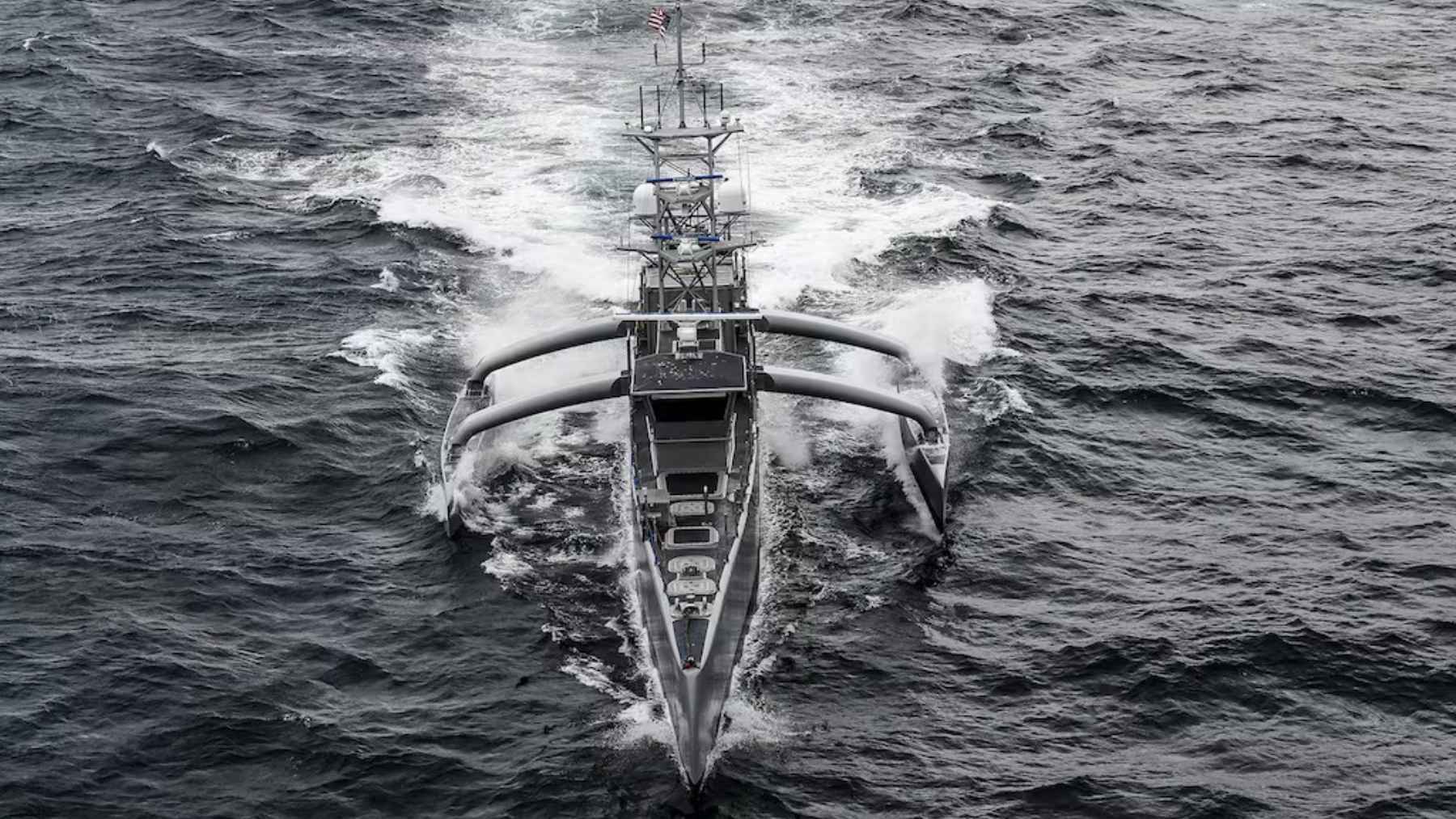
On October 14, Acting Navy Secretary Hung Cao confirmed that Seahawk, a 135-foot drone ship built by Leidos, is deployed with the Roosevelt’s group. He called it “the first carrier strike group to ever deploy with a large-size unmanned surface vessel,” Bloomberg reported.
Cao made the announcement at the Association of the United States Army’s annual conference, which is a slightly odd place to unveil a Navy first. To be fair, the panel was about the Pentagon’s push for robots and autonomous weapons, and the Navy’s got a pretty big robot at sea right now.
Seahawk is the little one in the group
If you don’t follow the Navy closely, a carrier strike group is basically an aircraft carrier plus the warships that travel with it. They’re mostly there to keep missiles, drones and submarines away from the carrier, which is the biggest and most valuable target in the group.
Right now, the Roosevelt’s escorts are the cruiser USS Chosin and the destroyers USS Paul Hamilton and USS Decatur, according to USNI News’ October 13 fleet tracker. Then there’s Seahawk. It’s tiny by comparison.
The Navy’s fact file puts Seahawk at about 135 feet long. It’s a trimaran (one long main hull with a slim float on each side to keep it steady), and its builder lists it at 145 long tons fully loaded, including 14,000 gallons of fuel for its two diesel engines.
Ships get weighed by the water they push out of the way, and the Navy still counts that in long tons of 2,240 pounds. So you’re looking at roughly 325,000 pounds of boat, which sounds like plenty until you see what it’s keeping company with. The Roosevelt is 1,092 feet long, about eight times Seahawk’s 135.
Lengths: U.S. Navy fact files. Escorts as listed by USNI News on October 13.
So can a drone ship keep up with a carrier?
The Navy spent a good chunk of the year finding out. Seahawk trained with the Roosevelt’s group during COMPTUEX in April, according to TWZ. COMPTUEX is basically a strike group’s final exam before it deploys, a month-long workup at sea where the whole group has to show it can fight together.
TWZ and Inside Defense both say Seahawk worked with the group during RIMPAC, the giant exercise off Hawaii, this summer too. Its builder’s own September announcement called its older sister ship, Sea Hunter, the only medium drone ship at that one, so take your pick. We first wrote about Seahawk and the Roosevelt back in July. All of that was practice, though.
The Navy also made sure Seahawk could take on fuel without heading home. In April, the fleet oiler USNS Guadalupe refueled it at sea off Southern California, passing a hose back to the drone from the oiler’s stern, according to Naval News.
Capt. Garrett Miller, who commands Surface Development Group One, explained the point of the demonstration at the time. Seahawk’s got to keep pace with a carrier strike group, he said, because “it can’t be an anchor.”
I’d argue keeping up is the least glamorous test Seahawk faces on this trip, and probably the most important one. Its builder says the boat’s mechanical and electrical systems were set up to go months without a mechanic touching them. The Roosevelt’s sailors have been told to plan on about eight months away from home, though, according to USNI News.
Nobody’s said yet whether Seahawk’s meant to stick around for the whole cruise. That’s a pretty big question for a boat with no one aboard to change the oil.
Technically, Seahawk didn’t even leave San Diego with the carrier. TWZ reported it was still tied up at the pier on September 30, three days after the Roosevelt sailed, and USNI News had it listed with the strike group by early October. That might’ve been the plan all along. When exactly it joined up isn’t public.
Seahawk mostly works as a set of extra eyes
I couldn’t find a public job description from the Navy for this deployment. Its fact file describes Sea Hunter and Seahawk as distributed sensor platforms for crewed ships, which basically means they hang out ahead of or around a group and push its view of the ocean farther out.
Seahawk’s also supposed to help hunt submarines and keep tabs on whatever else is moving on the water. Miller said in April it would give the strike group that kind of wider picture.
So who’s driving?
Mostly the boat itself, from the looks of things. Leidos says Seahawk works inside the strike group’s command network and steers around other ships on its own. If its main link drops, it can switch to backup channels or remote control. It can also hold its route without GPS, which is handy if somebody jams the signal. As far as I can tell, no one’s said how many people are watching over it day to day.
And if you’re wondering whether it’s armed, I haven’t seen anyone claim it is. That list of capabilities is all about getting around safely and staying connected.
Cao pitched Seahawk as a force multiplier, which is military-speak for anything that lets the people and ships you already have do more. He also told the panel that autonomous systems spare you from worrying about life support “like heads, latrines, feeding or caring for the troops,” according to AUSA.
Heads and latrines are both military slang for bathrooms, which is a pretty unglamorous way to sell a robot ship. He’s got a point, though. Every sailor you don’t have to put aboard is one less person to feed, house and bring home safe.
The Roosevelt is headed for the Middle East
USNI News reports the carrier’s expected to relieve the USS George Washington, which has been in the region since mid-August supporting U.S. operations against Iran. A U.S. official told Bloomberg the Roosevelt group gives commanders more options if President Donald Trump decides to restart strikes on Iran.
Other drones have already been busy out there. Cao pointed to a far smaller drone boat called Corsair that helped rescue both crew members of a downed Apache helicopter in June, according to Inside Defense. Underwater drones have been clearing mines from the Strait of Hormuz, too, he said. Seahawk’s a much bigger animal.
There’s a slightly awkward business twist here, too. Two days after the Roosevelt sailed, the Navy announced it’s buying 30 medium drone ships, 10 each from HII, Saronic and Galliano Marine Services.
Leidos made it through the same round of at-sea testing and got a $15 million completion award and a spot on the Pentagon’s drone marketplace, but no production order (we broke down the Navy’s 30-ship order when it landed). So the company behind the only medium drone ship deployed with a carrier won’t be building any of these 30.
The last public check-in came on October 13, when USNI News’ fleet tracker had the Roosevelt crossing the Pacific in 7th Fleet waters and heading west, with Seahawk listed as part of the deployment.