
Every so often a state highway department closes a stretch of road in the middle of the night so a truck with an “OVERSIZE LOAD” banner can crawl through at walking pace. If you’ve ever been stuck behind one of those convoys, you know it’s a pretty miserable way to spend an evening. But some things are heavy enough that even the banner-and-escort routine starts to look silly, and the Tennessee Valley Authority has a different answer for those.
It sends a boat.
On October 14, TVA said its towboat, the M/V Freedom, had pulled into the Port of Mobile in Alabama to pick up three parts bound for Sequoyah Nuclear Plant near Soddy-Daisy, Tennessee. There’s a 171-ton rotor, a 57-ton upper casing and an 87-ton lower casing, which adds up to 315 tons of steel. Since then the Freedom’s been working its way north with all of it, while one of the two reactors at the other end of the trip has been switched off for refueling since October 2.
If you’re picturing a tugboat dragging something on a rope, that’s not quite how it works. Despite the name, a towboat doesn’t really tow anything. It pushes barges lashed to its flat, square bow, and that’s how pretty much everything heavy moves on American rivers.
What’s actually on the barge?
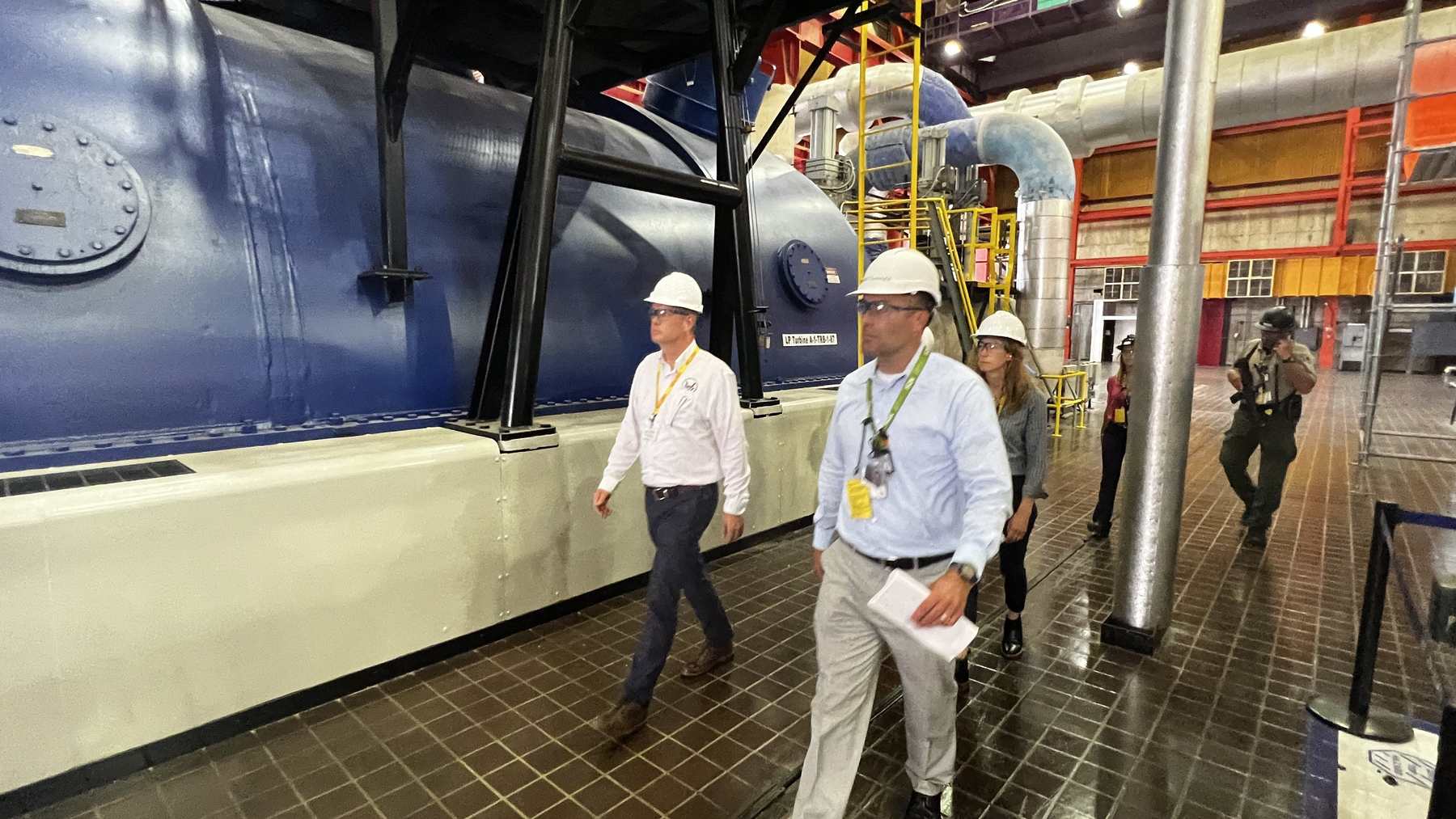
TVA calls the cargo critical components and hasn’t said a whole lot more. Here’s the short version of what they are. In a power plant, a turbine rotor is the long steel shaft lined with rows of blades that steam spins at high speed, and it’s what turns the generator. The casing is the heavy shell wrapped around it, built as a top half and a bottom half so workers can lift the lid off to get at the rotor.
Put those three pieces together and you’ve basically got the guts of one section of a steam turbine.
Which section, and for which reactor? I can’t tell you, because TVA hasn’t said. The agency’s only described the parts as an upgrade that’ll help keep the plant reliable for years. My guess is a low-pressure turbine, the big final stage the steam passes through before it’s cooled back into water. When TVA lined up new low-pressure rotors for Browns Ferry Unit 2, its plant in Alabama, the American Nuclear Society reported they weigh up to 327,888 pounds, or about 164 tons. A 171-ton rotor sits in that same weight class. But that’s me reading tea leaves, not TVA confirming anything.
So why not just put it on a truck?
You can move a 171-ton rotor by road. People do it. But federal rules cap an ordinary truck on the interstate at 80,000 pounds, trailer and all, and this rotor weighs about 342,000 pounds by itself. That’s more than four times the limit before you’ve even bolted it to anything. Loads like that usually need special superload permits, engineers checking every bridge on the route and a rolling escort, and you’d be signing up for that three times here, once per part.
A barge doesn’t care. It takes all three pieces in one go.
To be fair, TVA hasn’t explained why it picked the water. But the agency’s been keeping the Tennessee River navigable since 1933, and it says more than 28,000 barges haul something like 45 to 50 million tons of goods a year on the 650-plus miles between Paducah, Kentucky, and Knoxville. Shipping power plant parts on that river with its own boat is frankly about the most TVA thing TVA could do. It’s not shy about heavy hardware, either. Last year it rebuilt a pair of nearly 200-ton valves inside Raccoon Mountain, on the other side of Chattanooga.
How long a trip is this? TVA hasn’t published a route or a mileage, so here’s my rough math. The shortest water route from Mobile runs up the Tombigbee River and the Tennessee-Tombigbee Waterway, and that’s around 470 miles before you even reach the Tennessee River. From there it’s well over 200 more miles upstream, because Sequoyah sits at Tennessee River mile 484.5, according to TVA’s own environmental reports. Call it comfortably more than 700 miles.
If the Freedom went that way, it’s also 17 locks by my count: two on the lower Tombigbee, 10 on the Tenn-Tom and five at TVA dams on the Tennessee. The last of those is Chickamauga Lock in Chattanooga, which opened in 1940 and measures just 60 by 360 feet. The Army Corps of Engineers has spent years building a 110-by-600-foot replacement right next to it.
Moving reactor-plant hardware by river isn’t new, by the way. Portland General Electric once barged the old Trojan reactor vessel 270 miles up the Columbia River, though that cargo was headed for burial, not a second career.
Sequoyah Unit 2 is in the middle of a pit stop
A refueling outage is basically a nuclear plant’s scheduled pit stop. Operators shut the reactor down, swap the most worn-out fuel for fresh assemblies, and everybody else on site uses the downtime to fix things you can’t touch while the plant’s running.
Unit 2 went offline on the evening of Friday, October 2, after a 470-day run that TVA says produced more than 12.3 billion kilowatt-hours. I ran that through a calculator, and it works out to roughly 1,090 megawatts around the clock for the whole stretch, from a unit TVA rates at more than 1,160 megawatts. That’s a pretty respectable showing for a reactor that’s been in commercial service for 44 years.
The crowd on site is big, as you’d expect. TVA spokesperson Scott Fiedler told the Chattanooga Times Free Press that around 1,100 contractors would join Sequoyah’s 750 full-time employees for more than 11,400 maintenance activities, and the team’s loading 64 new fuel assemblies along the way.
Sequoyah has two pressurized-water reactors, each good for more than 1,160 megawatts, and TVA says the plant can cover the needs of about 1.3 million homes. Unit 1 is the older of the pair by about a year, and the Nuclear Regulatory Commission has Unit 2 licensed through September 15, 2041.
So is the rotor headed into Unit 2 during this outage? I wouldn’t bet on it. TVA said in mid-October that the parts would reach Sequoyah later this year, and a turbine swap is the kind of job that gets planned into an outage years in advance, not squeezed in when a barge shows up. They could just as easily be earmarked for a future outage on either unit. TVA also has what it calls a Nuclear Life Extension plan, with more than 400 projects underway that it says will add up to 244 megawatts of generation over the next 10 to 15 years. Whether these parts belong to that effort is another thing TVA hasn’t said.
The Freedom has done this run before
The boat itself is a 100-foot by 34-foot towboat that TVA put into service in 2023. It runs a pair of diesels making 1,341 horsepower apiece, and TVA officials told WorkBoat it was the first towboat built to the EPA’s Tier 4 standard, the strictest emissions tier for engines that size, ever commissioned by a government agency. That’s a slightly funny detail for a boat that spends its days hauling parts for power plants, but I’ll give TVA credit for it.
It’s also not the Freedom’s first trip out of Mobile. Its very first job, a few weeks after delivery, was picking up cargo straight off a heavy-lift ship in that same port.
On October 23, TVA said the Freedom’s crew would complete the delivery to Soddy-Daisy the following week. By October 28, the agency had more than 9,000 of Sequoyah Unit 2’s 11,400-plus outage jobs checked off.