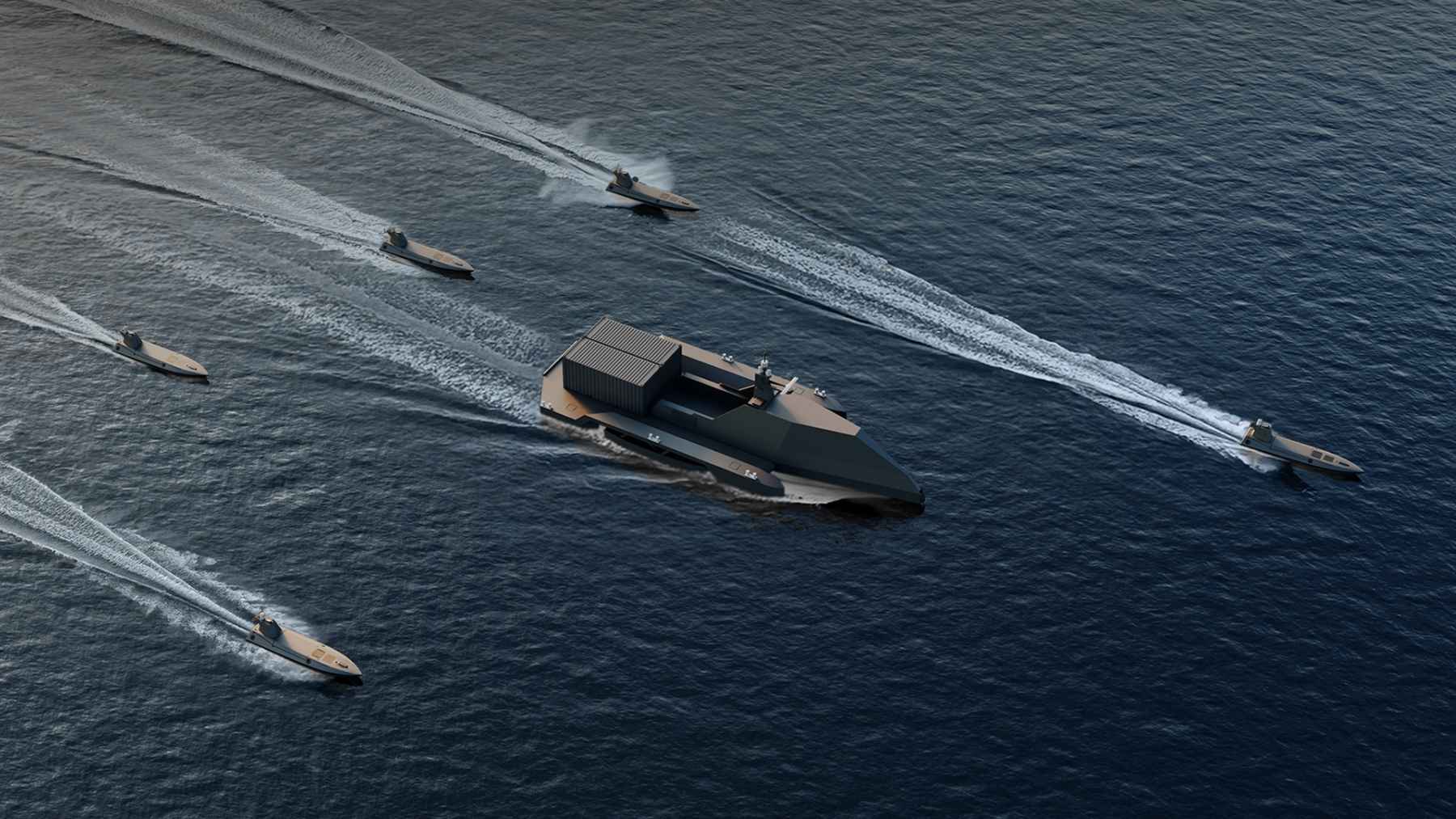

The US Navy has seven drone warship designs in the water right now, all of them American, all of them due to finish at-sea testing by October. The program is called the MUSV marketplace, and it’s the clearest sign so far that the service intends to buy crewless ships by the dozen instead of one at a time.
Two of the more interesting boats in this class aren’t in that competition at all. Both are being built in the same shipyard in Ulsan, South Korea, by a company most Americans know for container ships and excavators. One is a 14-ton reconnaissance craft running Palantir software, named after the Latin word for darkness. The other has Anduril’s name on it and a delivery month.
Both belong to HD Hyundai Heavy Industries. They’re in very different shape.
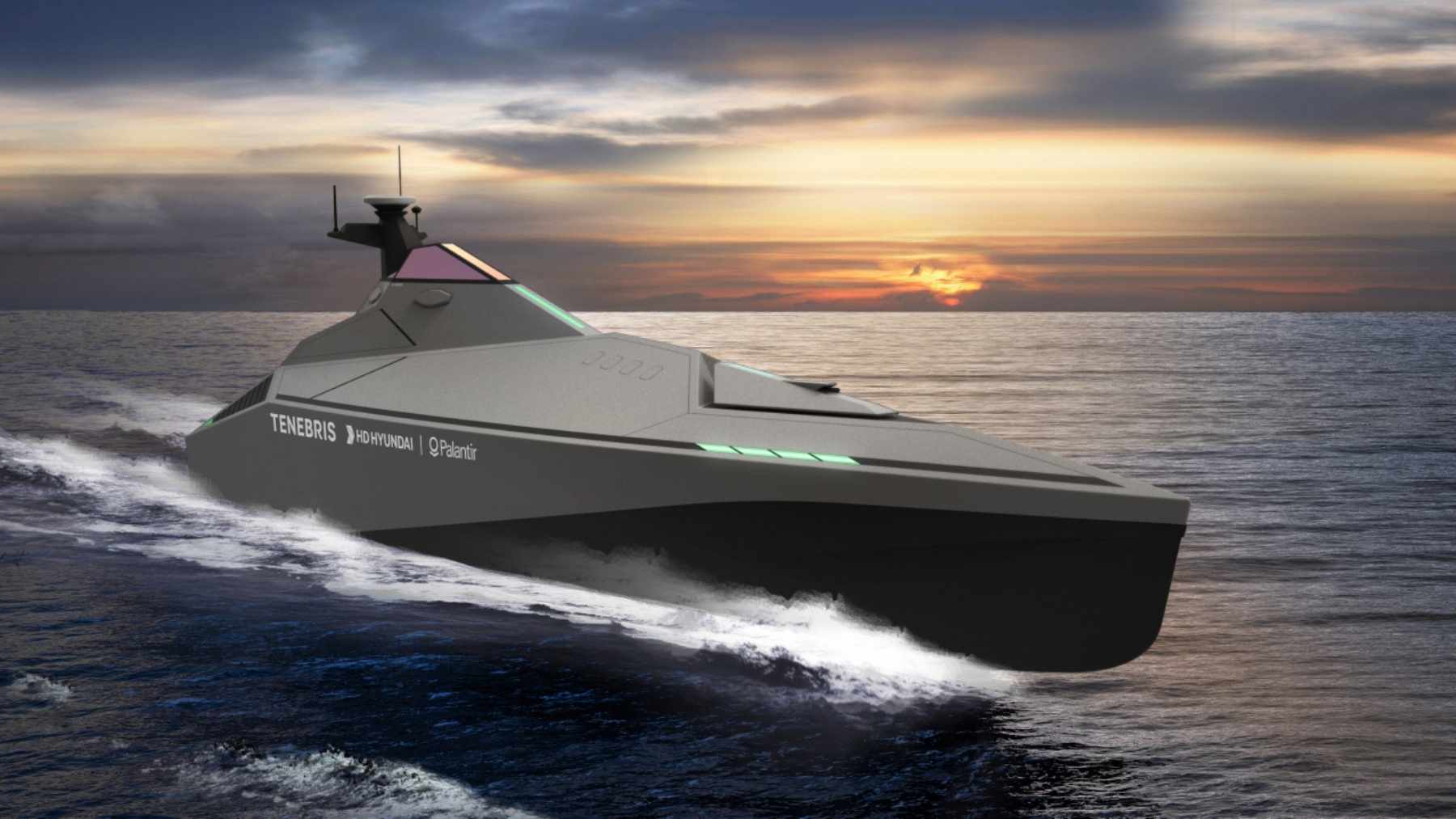
The boat is called Tenebris and the spec sheet is the whole pitch
HD Hyundai and Palantir showed the Tenebris design publicly for the first time in May 2024, as a model sitting on Palantir’s booth at the AI Expo for National Competitiveness in Washington. The two companies had signed a memorandum of understanding the month before to develop an unmanned surface vessel together by 2026.
The hull is 17 meters, about 56 feet, with a light displacement of 14 tons. That makes it small for a warship and large for a drone. The stated job is reconnaissance close to hostile coastlines, which is the mission navies least like sending people to do.
The design targets are where it gets interesting. Naval News, which interviewed the company at the reveal, reported the concept as aiming for 50 knots (roughly 58 mph) in up to sea state six, with an operational range of at least 1,000 nautical miles. “We aim to complete the development by 2026,” Brandon Yoon, an HD HHI representative, told the outlet, noting the project was then at concept design stage.
The distinctive piece of hardware is a dome the company calls the AI Bridge, which houses the sensors and the software that run the boat. Navigation comes from Avikus, HD Hyundai’s autonomy subsidiary. Mission autonomy, meaning the decisions about what the boat actually does once it’s out there, comes from Palantir. The first version is a scout, with combat variants described as coming later.
Fifty knots in 20-foot seas is the hard part, not the software
Sea state six is a specific thing, not a vibe. The World Meteorological Organization defines it as waves of 4 to 6 meters, or 13 to 20 feet, and files it under “very rough.” That’s not a storm. It’s an ordinary bad day in open water.
Holding 50 knots in a 17-meter hull is easy on flat water and punishing in waves that size. Speed at that length wants a light hull that skims across the surface; seakeeping wants mass and length that push through it. HD Hyundai has said since the reveal that it’s still working to improve the boat’s seakeeping and range, which tells you where the engineering difficulty sits.
The autonomy half has receipts, at least. Avikus put its HiNAS 2.0 system aboard the Prism Courage, an ultra-large LNG carrier, back in 2022, and the ship ran from the Gulf of Mexico through the Panama Canal to South Korea in 33 days. Roughly half of the 20,000-kilometer voyage was sailed under the autonomous system, which took avoiding action about 100 times along the way. The American Bureau of Shipping and the Korea Register of Shipping monitored it in real time.
Steering a 300-meter gas carrier down a shipping lane isn’t the same problem as throwing a small boat around at close quarters. But it’s a real ship crossing a real ocean, which is more than most maritime autonomy outfits can point to.
The Anduril hull is the one with a date on it
These two programs get conflated constantly, and they shouldn’t be. Tenebris is the Palantir boat. HD Hyundai’s other robot warship is with Anduril, and it’s a different vessel with a different partner aimed at a different job.
That relationship started in April 2024 on software, widened to a USV agreement in April 2025, firmed up into a memorandum of agreement in August and a signed contract in November. At the Sea-Air-Space show in April 2026, Anduril said the critical design review was complete and construction of the first autonomous surface vessel had begun at Ulsan.
The vessel goes in the water in October, Defense News reported, with Anduril taking ownership for testing off the US coast by the end of 2026. Serial production, if it gets that far, moves to Edison Chouest Offshore’s yards in the United States, and Anduril has said it will reactivate the old Foss Shipyard in Seattle as an assembly and test hub.
While the hull comes together, Anduril has been running its autonomy stack daily on a separate surrogate boat, working through navigation, mission software and containerized payloads. In April the two companies also added a memorandum on unmanned underwater vehicles, plus a three-way agreement with the American Bureau of Shipping on certification rules for autonomous vessels.
The Navy named seven designs in May and neither of these was on the list
On May 29 the Navy named the seven companies advancing to at-sea testing in the MUSV marketplace: Sea Machines, Leidos, Saronic Technologies, Galliano Marine Services, PacMar Technologies, Birdon and Huntington Ingalls Industries. Around two dozen designs were submitted. Each one that passes testing collects $15 million and becomes eligible for follow-on production.
The bar is written down. USNI News reported the requirement as 2,500 nautical miles at 25 knots in sea state four, carrying up to 25 metric tons in at least two 40-foot shipping containers, with a vessel fieldable in fiscal 2027. Testing runs June through October. Saronic’s 180-foot Marauder, the boat now slated to carry a hypersonic missile, is one of the seven.
Anduril had said in April that it intended to compete. It isn’t on the list, and the Korean partner confirmed as much on its own books. HD Korea Shipbuilding & Offshore Engineering told analysts on its second-quarter earnings call on July 29 that the local candidates for the first demonstration phase had been notified, that Anduril wasn’t among them, and that it expects US orders to come after next year, according to Asia Business Daily’s account of the call.
That’s a first round, not a final answer. The Navy built the marketplace to run in iterations and has said there’s no cap on how many designs it might eventually take. What it does mean is that the Korea-built boat is now testing on its own clock rather than the Navy’s, and the earliest order date the shipyard is willing to say out loud sits well past this year.
Korea’s real play is the yards, not the boats
None of this is happening because South Korea needs another export line. It’s happening because Korean yards are losing the volume fight and know it. Clarksons data puts Korea at about 19% of global new ship orders by compensated gross tonnage in the first half of 2026, against 72% for China.
What Korea has that China can’t sell into the United States is access. The two governments signed a framework in May earmarking $150 billion for shipbuilding cooperation under a program called MASGA, short for Make American Shipbuilding Great Again. On July 23 they opened a Korea-US Shipbuilding Partnership Center in Washington and signed 15 agreements in a single afternoon.
One of those has HD Korea Shipbuilding & Offshore Engineering working with ABSG Consulting to develop and verify an operating platform for next-generation autonomous vessels. Same company, same week, building the robot boats and helping write the rulebook they’ll eventually be certified against.
HD Hyundai Heavy Industries isn’t a small operation either. Its Ulsan yard runs ten large dry docks and nine Goliath cranes, turns out around 50 large vessels a year, and has delivered more than 2,300 ships to owners in 51 countries by the company’s own count. Hanwha, Korea’s other shipbuilding giant, is running a parallel unmanned track with a different American partner, on top of the hydrogen-powered submarine drone it built for the ROK Navy.
The number to be careful with is 50 knots
It came from a company interview at a trade show in 2024, describing a concept design. There’s no public trial anywhere showing a Tenebris hull reaching it, and no public update on the program’s status this year. The 17 meters and 14 tons are design figures too. Nothing about this boat has been independently measured, because nothing has publicly been in the water.
Which is the actual gap between HD Hyundai’s two robot warships. One has steel in a dock, a delivery month, and a customer waiting to take it off their hands. The other has a target speed and a deadline that runs out in about five months.
Either way, the economics behind all of it hold. A $240,000 drone boat got close enough to film a billion-dollar Chinese destroyer in June, and nobody had to be aboard to do it. December will show whether the yard that builds 50 large ships a year can turn that math into something that runs at 50 knots.