
- 3 MONTHS AGO · ENERGYA Belgian ship crosses the North Sea at 11.5 knots, drives four 426-foot steel legs into the seabed, then climbs its own legs until the hull is clear of the water and stops being a ship, because no crane on a rolling deck can thread a 351-foot blade onto a hub 500 feet up
- 2 MONTHS AGO · ENERGYA 19.7-foot rotor floating on a Dutch lake tilts back toward horizontal when the wind gets up instead of parking the way every offshore turbine does, and it makes 12 kilowatts against the 15,000 of the 774-foot rotor it is meant to replace one day
- 2 WEEKS AGO · ENERGYHundreds of offshore wind turbines with 318-foot blades slowed to under two turns a minute off the Dutch coast for six hours one night so migrating birds could cross the North Sea, on a forecast that had to be locked in two days before the birds took off
- 4 DAYS AGO · ENERGYBoulders weighing up to 4,400 pounds just went over the side of an activist ship onto the seabed off England’s east coast, and they’re spread across about 45 square miles of a protected porpoise habitat to keep out the heavy nets bottom trawlers drag across the sea floor
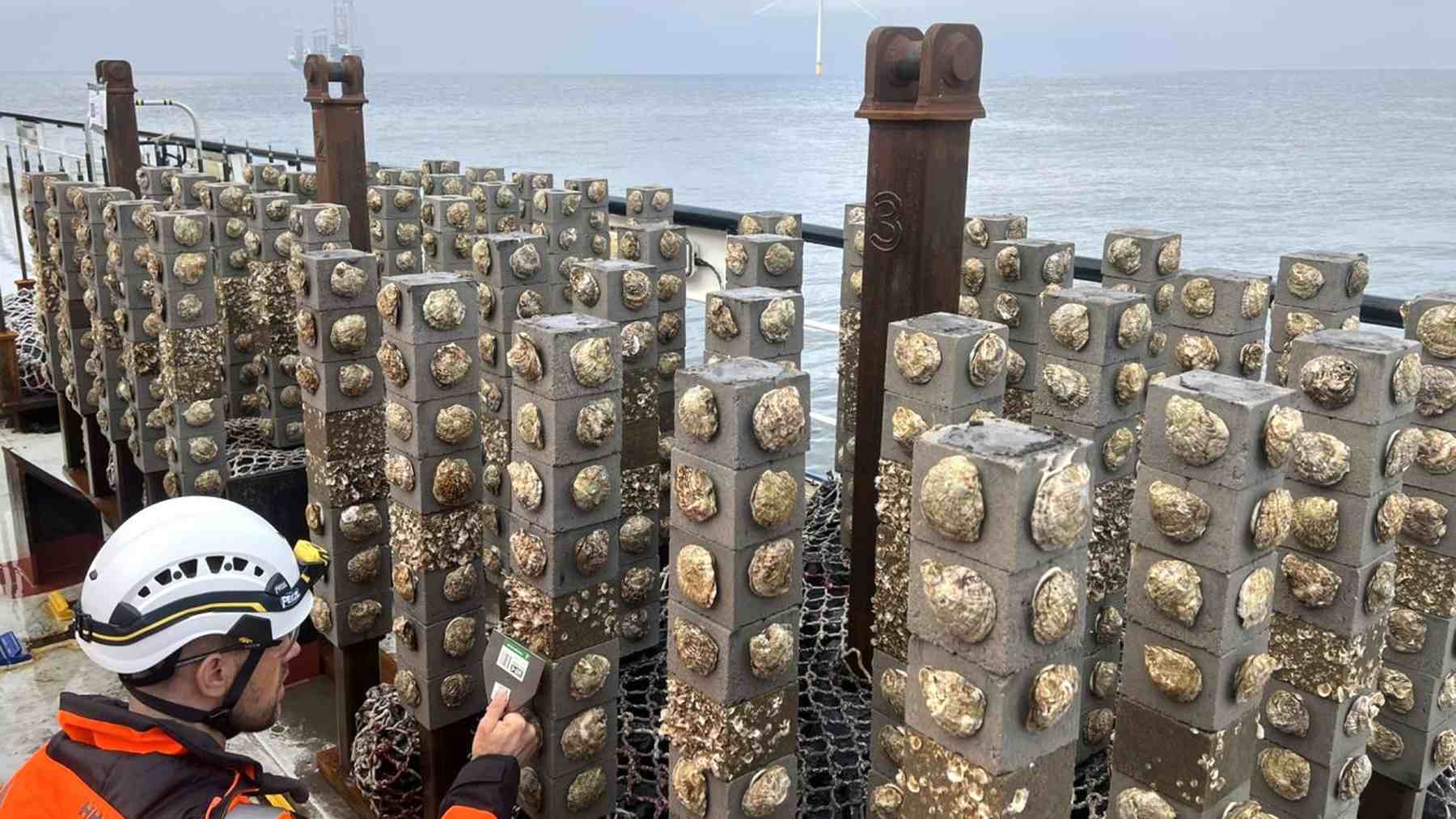
- TODAY · THIS ARTICLEA Dutch crew took a 402-foot cable-laying ship 33 miles out to sea and lowered six hubs of live oysters onto the seabed inside a 52-turbine wind farm, about 3,600 European flat oysters and thousands of young ones meant to breed in water where fishing boats can’t drag the bottom
Shellfish are usually bad news for anything people leave sitting in salt water. Barnacles and mussels slow ship hulls down, clog intake pipes and cost somebody real money to scrape off. Seattle just pumped a 55-foot-deep boat lock dry so crews could clean barnacles out of its 800-foot filling tunnels. That’s a lot of trouble over some barnacles.
So it’s a little backwards that one of the newest wind farms in the Dutch North Sea just had thousands of oysters delivered on purpose.
Ecowende, the joint venture of Shell, Eneco and Chubu Electric Power that’s building the 760-megawatt farm about 33 miles off IJmuiden, says six offshore oyster hubs are now in place. Between them, the hubs hold about 3,600 adult European flat oysters and thousands of juveniles. Van Oord’s cable-laying ship Nexus did the installation. Ecowende announced it on November 11, according to OE Digital, and Offshore Wind ran the details the next day.
So why send a cable ship?
The Nexus spends most of its working life laying power cable on the seabed. According to Van Oord’s spec sheet for the Nexus, the ship is 402 feet long and 90 feet wide. The big turntable on deck that holds the cable, which Van Oord calls a carousel, takes about 5,500 tons of it. Ecowende had already lined up the Nexus to lay the farm’s inter-array cables, which are the lines that link the turbines to each other. So it’s safe to assume the crew didn’t need directions.
Neither Ecowende nor Van Oord has said why the Nexus got the oyster job, and I’d be guessing if I told you for sure. But the spec sheet makes a decent case. The ship’s main crane is rated for about 110 tons. It also has what’s called DP2 dynamic positioning. That basically means computer-controlled thrusters hold the ship over one spot without dropping anchor, and the “2” means there’s enough backup that a single failure won’t leave it drifting. When you’re trying to set something down on a particular patch of seabed with turbines and live power cables all around, that’s a pretty handy thing to have.
What I can’t tell you is how much of that crane the job actually needed. Ecowende hasn’t published how big or how heavy each hub is.
The North Sea used to be full of these oysters
The European flat oyster (Ostrea edulis, if you want the Latin) used to be common across the North Sea. It has largely disappeared since then, and the reasons given in this week’s reports are overfishing, seabed disturbance and disease. One of the things holding back a comeback is a shortage of oyster larvae offshore. That part takes a minute to explain if you don’t spend much time thinking about how oysters reproduce.
An oyster starts out as a tiny larva drifting around in the current. To turn into an actual oyster, it has to land on something hard and cement itself in place, and biologists call that settling. If there aren’t any adults nearby putting out larvae, there’s nothing to settle in the first place, and good patches of seabed stay empty because nothing can reach them.
That’s the hubs’ job. Ecowende says the adults could start supplying larvae out in open water, and the original plan pitched the wind farm as a kind of relay station, pushing larvae toward isolated oyster grounds that otherwise wouldn’t get any. The juveniles, which oyster people call spat, are the next generation of breeders. Assuming they make it, of course.
What’s special about the rock?
The hubs also carry what Ecowende calls “specially selected calcareous rock,” according to Offshore Wind. Calcareous just means rich in calcium carbonate, the same mineral oyster shells are made of. Ecowende says research shows the rock can raise oyster settlement success by about 33%.
So what does 33% mean out there? Honestly, I’m not sure, and the announcement doesn’t help much. Ecowende hasn’t named the study or said what the rock was compared against, so I’d treat that number as promising rather than proven. It does make intuitive sense, though. If you’re a larva looking for somewhere to live, a rock made of roughly the same stuff as your parents seems like a pretty reasonable pick.
Six hubs, not three
When Ecowende and Van Oord signed their contract last year, the original Ecowende announcement talked about putting oyster hubs on three cable crossings sometime in 2026 or 2027. The count ended up at six. This week’s reports don’t say exactly where on the site the hubs went, or whether they’re all on cable crossings.
This isn’t Van Oord’s first go at it, either. The company has put oyster hubs in before, at the Borssele 1 and 2 and Luchterduinen wind farms. Waardenburg Ecology, which helped develop the hub concept, is Ecowende’s partner for measuring how it all works out.
I’d argue a wind farm is a pretty smart place to try this. Ecowende has pointed out that fishing isn’t allowed between the turbines in Dutch offshore wind farms. Since seabed disturbance is one of the reasons the oysters largely disappeared, a stretch of North Sea where nobody’s dragging fishing gear across the bottom looks like a decent bet. The seabed at this site has already gotten plenty of hard material, too. Van Oord dumped 300,000 tons of rock around the farm’s 52 foundations to keep the current from digging pits at their bases.
Other wind farms are trying their own versions of this. A floating farm off France’s Mediterranean coast bolted 32 cages packed with oyster shells to one of its platforms so young fish have somewhere to hide. The Dutch approach puts live breeding oysters near the bottom instead of empty shells on a float.
Ecowende plans to spend the next few years tracking how many larvae the hubs produce and how far they travel. It wants to find out whether a handful of hubs can link up oyster populations that are currently cut off from each other. The joint venture also says oyster reefs give other marine species shelter. We’ll need that monitoring data before anyone can say how much.
The rest of the farm is nearly done. Van Oord put up the last of Ecowende’s 52 turbines on October 30, first power reached the Dutch grid this summer, and Ecowende expects the farm to be fully running by the end of 2026.
 A 79-foot steam generator weighing about 694 tons, nearly 20 feet across, was hoisted into a Guangdong reactor building on Wednesday, the first of two for a 1,250-megawatt unit whose steel vessel went in this summer, a lift its builder said was kept stable and precisely controlledEnergy · 3 hours ago
 A 100-watt nuclear reactor sitting in a 35-foot concrete pit under Texas ranch land has been cleared by the Energy Department for unrestricted operations three months after its first chain reaction, and its maker will use it to train operators and check its math for an isotope reactorEnergy · 6 hours ago
 An 882-ton boiler, one of eight at a closed nuclear plant on the English coast, is slated to be jacked and slid out of its bay under a contract announced late last month, a job meant to take away about a third of the buildings still standing on the siteEnergy · 21 hours ago