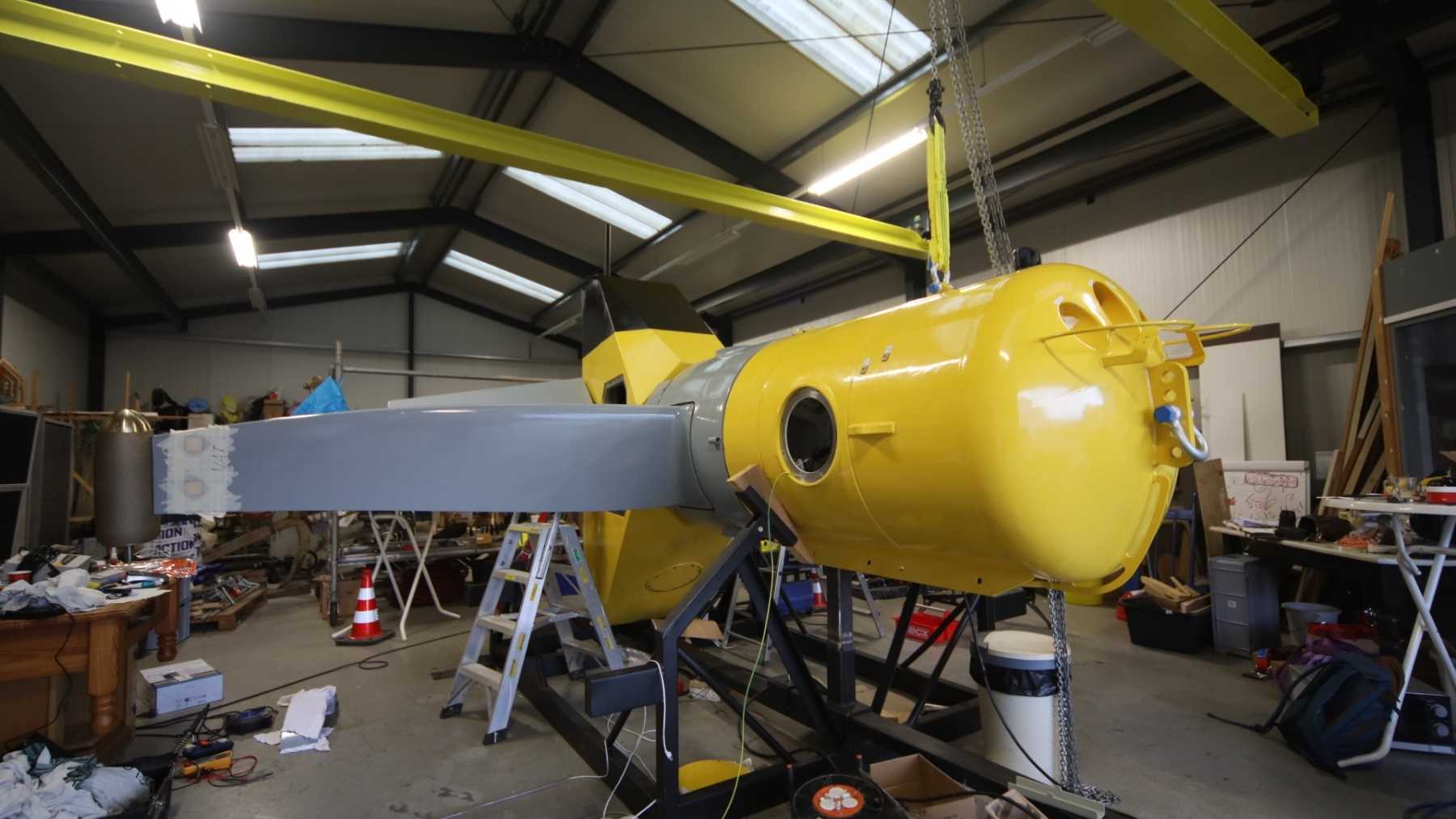

Every turbine you’ve ever looked at keeps its generator in the same place. Blades turn a shaft, the shaft runs back into a housing, and the generator sits inside that housing making electricity. The arrangement only works because something heavy is holding the housing still while the blades try to twist it out of position.
A small Dutch company decided the housing is the expensive part, built a turbine with nothing in the hub but a bearing, and has now started talking to American regulators about anchoring one in the Gulf Stream off Florida. Equinox Ocean Turbines told the offshore trade group Oceantic in early September that the Florida Current is its primary target, that it’s begun regulatory engagement and permitting exploration in the US, and that it’s opened its next funding round to pay for the half-scale machine it wants in the water in 2028.
So what exactly has this company proven so far? A 16-foot model that dives, surfaces, spins and makes electricity on command, which is more than most ocean-current startups can say.
What went in the water off Texel
In July Equinox lowered Mobula 5, a 1:10 model of the full-size machine, into the Marsdiep, the tide race between the island of Texel and the mainland at Den Helder, and on August 25 it said how the week went. The model dived on command. It surfaced on command. It started and stopped its rotor and it made power. Chief executive and CTO Pieter de Haas said in the announcement that the tests “confirmed key aspects of the system’s design and performance,” which puts the design at Technology Readiness Level 6, the rung where a prototype has to work in a real environment instead of a tank.
When we first covered this test, Equinox hadn’t published a size or a rating for the model. It has now: Mobula 5 carries a 16-foot rotor and is rated at 30 kilowatts, per the company’s September briefing to Oceantic. Scale that up ten times and you get the machine the whole plan rests on.
So why bolt the generators onto the blade tips?
Picture the full-size Mobula 50. Two blades, one rotor, 164 feet tip to tip, turning slowly the way a ship’s propeller turns when it’s barely under way.
Slow blades produce enormous torque and very few revolutions per minute. A generator that has to eat torque instead of speed gets big, gets expensive, and usually needs a gearbox in front of it to make the numbers work at all. Every marine turbine developer runs into this. Most of them accept the gearbox and the giant nacelle and move on.
Equinox went the other way. It hung a small three-bladed turbine off the tip of each big blade, and those two little turbines are the only things on the machine that generate anything.
The tip of a 164-foot rotor moves quickly even when the rotor itself is loafing. Fast water arriving at a small rotor means high speed and low torque, which is what a cheap generator wants. Equinox’s described the big blades as concrete, picked to handle the loads and vibration a long, slim underwater blade lives with. Concrete is an odd word to find next to the word turbine, and I get why it stops people, but the loads down there are nothing like a wind blade’s.
The big rotor doesn’t generate a single watt
I had to read the American paperwork twice on this one, because it’s stranger than the press release makes it sound.
The Department of Energy has a program called TEAMER, short for Testing Expertise and Access for Marine Energy Research, which hands federal lab time to marine energy companies. Equinox got a slot. The work went to the National Laboratory of the Rockies in Golden, Colorado, the lab that used to be called NREL, and the report is public.
Here’s the line that matters. Inside the hub of that big rotor, the lab found a bearing and nothing else. Zero watts leave the middle of the machine. Both tip turbines together account for every electron.
Which means the big concrete rotor is a delivery mechanism. It’s there to drag two small generators through the water faster than the water is actually moving.
The lab spends more time on the second consequence. Almost no reaction torque builds up at the center of the machine, so the whole thing can hang from a single-point mooring instead of a fixed seabed foundation. Put a conventional turbine on that same mooring and the rotor just spins its own housing around instead of turning against the water, which the report says rules out generating anything at all. One anchor point instead of a piled foundation is a lot of money in deep water, and it’s arguably the real product here. Equinox now describes Mobula 25 as a semi-floating system, which is the same idea with a name on it.
A Colorado lab ran it through a supercomputer and hit a wall
The modeling itself didn’t go smoothly, which is unusual to see written down this plainly.
Hannah Ross, Will Wiley and de Haas ran high-fidelity computational fluid dynamics on the lab’s high-performance computer using Siemens STAR-CCM+. The mesh for the main rotor on its own came to 4.68 million cells, the tip turbine on its own to 3.16 million, and the combined machine to 20.59 million. The point of all that was to build a cheaper mid-fidelity model that Equinox could run on its own afterward, using the open-source OpenFAST code.
They swept 2,700 parameter combinations, narrowed to 115, then to 31, then to one. The combined-stage version still “was not successful in this stage of the project,” in the report’s words, and the full set of planned design load cases never got run.
They found the reason. The tip vortex shedding off the end of the big blade twists the water arriving at the little turbine, and the wake trailing behind the big blade punches a sharp velocity hole through it on top of that. Those two things decide how fast the small blades fatigue, how hard the drivetrain gets hit and whether the controller can hold a steady speed. A vortex model has no way to see the hole at all.
The Gulf Stream is the slow one
Tidal races are violent. The Alderney Race off Normandy, where France’s six-turbine FloWatt farm is stalled on paperwork, runs at around 11 mph. The Bay of Fundy, where Canada cleared a 680-ton floating turbine, is worse.
The Gulf Stream isn’t like that. It runs closest to the American coast off southeast Florida, and in the stretch where turbine demonstrations have been staged, off Broward County and Palm Beach County, the water moves at roughly 3.5 to 5.5 mph and never stops. You get a fraction of the punch and none of the four-times-a-day slack. A design built to pay for itself at low flow speeds is interesting here for that reason specifically, and that’s the water Equinox says it’s going after first, ahead of Japan’s Kuroshio and South Africa’s Agulhas. The company puts its opening addressable market at roughly 30 gigawatts, inside a worldwide resource it estimates at over 700.
American estimates for the home stretch are more modest. A federally funded Georgia Tech assessment set the theoretical ceiling across the whole Florida Current at about 5.1 gigawatts, or 45 terawatt-hours a year. Widen the extraction zone to everything within 200 miles of the shoreline and that ceiling rises to roughly 18.6 gigawatts. Nobody gets the ceiling. Florida Atlantic University’s marine energy center, renamed the Southeast Marine Energy Center on July 1, holds a federal lease for floating test berths 13 miles off Broward County rated for prototypes up to 100 kilowatts. That’s a five-percent-scale sandbox for a 2-megawatt machine, and a comfortable fit for a 30-kilowatt one.
Equinox hasn’t said which American agency it’s talking to or whether the Florida berths are on its list. Its pitch to Oceantic was that a US machine would be built the way ships are built, with final assembly in a shipyard and the manufacturing, testing, installation and maintenance done stateside.
Six people and a 164-foot rotor
Six people are listed on the Equinox team page, which isn’t many of humans to be aiming at a 164-foot concrete rotor and an American permit at the same time. The Colorado report closes with what still has to be modeled before anyone builds one: platform motion in six degrees of freedom, rotor speeds free to vary, moorings and non-uniform inflow. All of that, it says, is the subject of future proposals.
Equinox’s planning the semi-floating Mobula 25 for 2028 and the 2-megawatt Mobula 50 for 2030. If you want to check the American half of the story yourself, the report by Ross, Wiley and de Haas is dated March 26, 2026, and sits on the Department of Energy’s marine energy repository under a Creative Commons license.













A picture here, would be worth a thousand words.