
Offshore wind turbines have a habit nobody designed on purpose. Sink a few thousand tons of steel into open water, leave it there long enough, and marine life tends to colonize the base, treating the foundation like a reef. Divers have tracked seals working the turbine rows in the North Sea in near-straight lines, reading the layout like a map.
A pilot farm 16 kilometers off the French Mediterranean just turned that side effect into the actual plan. It reached full power on July 10, and it is the first floating wind farm anywhere fitted, from the design stage, with artificial habitats meant to grow sea life instead of just tolerating it.
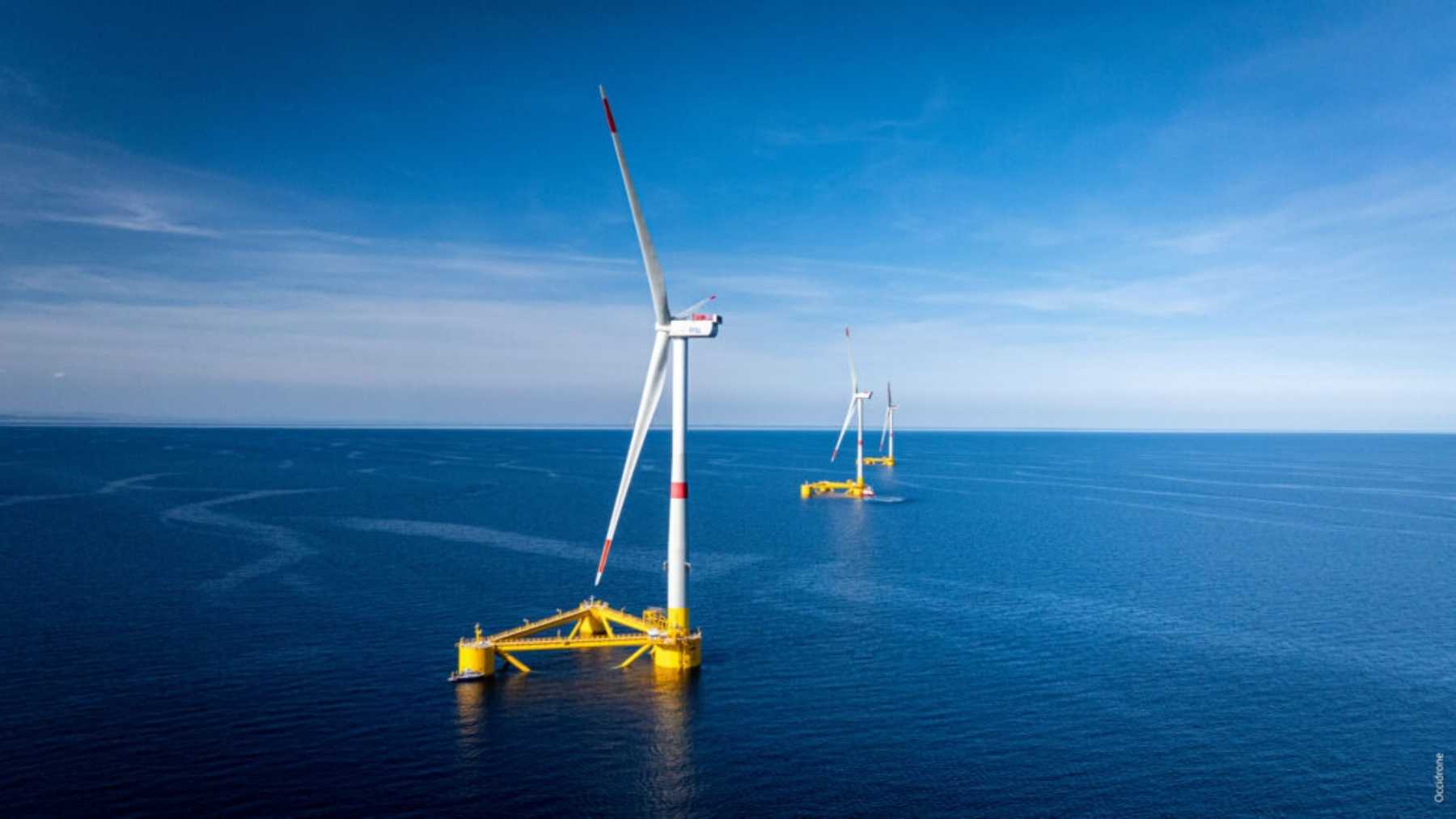
The project is called Éoliennes Flottantes du Golfe du Lion, or EFGL. Three 10-megawatt turbines, 30 megawatts total, floating in deep water off the Occitanie coast. Its owner, Ocean Winds, says the farm will push out around 110,000 megawatt-hours a year, enough to power the equivalent of roughly 50,000 people for the next two decades. What sets it apart from every other floating farm is bolted to one of its three platforms, and it has nothing to do with generating electricity.
The farm floats because the Mediterranean drops off fast
Most offshore wind you have seen is planted on the seabed. That works in the North Sea, where the water is shallow enough to drive a foundation into the bottom. The Mediterranean does not cooperate. The seabed off southern France falls away quickly, too deep for a fixed foundation to make economic sense.
So EFGL floats. Each turbine sits on a semi-submersible steel platform, the WindFloat design from Principle Power, held in place by mooring lines rather than driven into the seafloor. The platforms were assembled onshore, towed out from the port of Port-La Nouvelle, and connected 16 kilometers out.
Ocean Winds is a joint venture between EDP Renewables and ENGIE, working here alongside the French public investor Banque des Territoires. The company says 99 percent of its suppliers were European and 85 percent French, and it now runs a maintenance base in Port-La Nouvelle staffed by more than 20 local workers. For a port town, that base is the part of a wind farm that actually sticks around.
The site does two useful things at once. It is one of the windiest stretches of the French coast, with average wind speeds near 10 meters per second and enough turbulence to keep engineers honest, which makes it a real test bed. It also sits inside the Gulf of Lion Marine Natural Park, a protected area, which is why the biodiversity question was built into the project from the beginning instead of tacked on at the end.
Thirty-two steel cages full of oyster shells
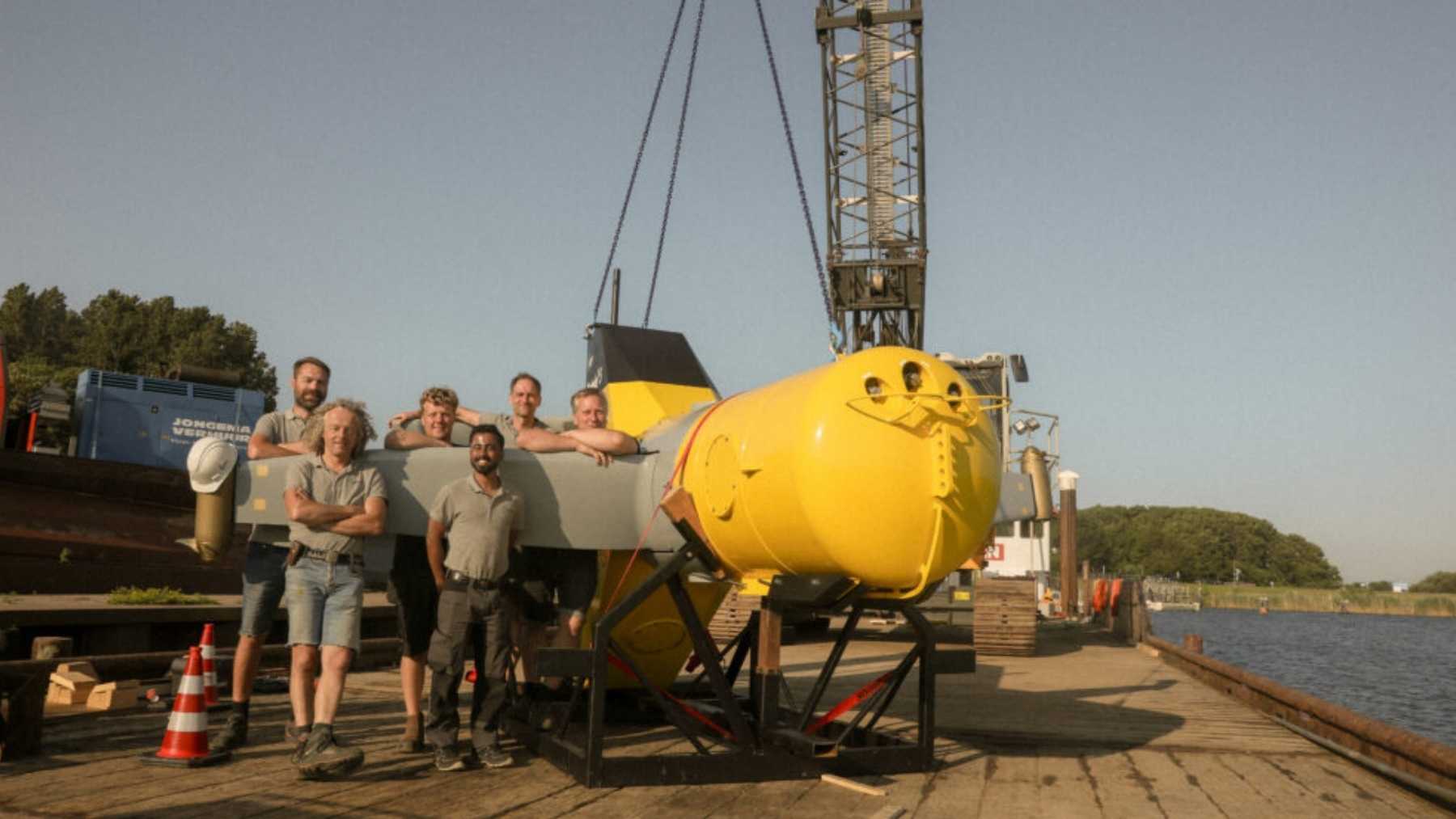
Here is the part that makes EFGL a first. On one of the three floating platforms, the team fixed 32 units called Biohuts, built by a Montpellier engineering firm named Ecocean. Each one is a steel cage doing a specific job: the inner section is packed with oyster shells that seed the bottom of the food chain, and the outer cage gives juvenile fish somewhere to hide from whatever wants to eat them.
The concept started in ports and marinas, where Ecocean has been installing these nurseries for years. Moving them onto a floating wind foundation in open water had never been done. Ocean Winds calls the result the world’s first “nature-inclusive” floating wind farm, and on the narrow claim of putting designed marine habitat on a floating turbine, the record backs it up.
This was not a late add-on. The groundwork ran for years before the turbines went up, including a buoy rigged with Biohut units left at the site from 2019 to 2023 to test whether anything would show up that far offshore. Something did. Divers from the University of Perpignan, who monitor the habitats, have already logged seabream, salema and sea bass around the structures.
The monitoring plan runs five years and it is not casual. It pairs underwater fish counts with passive acoustic recording, eDNA sampling and camera traps, all validated by the University of Perpignan, to work out whether the habitat does anything measurable in open sea rather than just reading well in a press release.
Whether turbines help the ocean is a real fight
Any of this matters because people have argued for years over what offshore wind does to marine life, and both camps tend to skip the evidence. Some foundations turn into dense habitat. Others sit in the water doing little for anything alive.
The seals that scientists tracked hunting the turbine rows in the North Sea were the accidental version of that reef effect. A decades-long review of the evidence found the payoff depends mostly on how old a turbine is and where it stands, not on which side’s slogan you happen to prefer.
EFGL is a bet that you can stop leaving it to chance. Instead of hoping a foundation grows into habitat over ten or twenty years, you build the nursery in on day one and measure what happens. If the numbers come back flat, that is useful too, because most of this debate still runs on anecdote.
Floating wind is having a year
EFGL is not the only floating milestone of 2026. Back in January, Japan switched on its first commercial floating farm off Goto City, 16.8 megawatts across eight Hitachi turbines, sitting on a hybrid float with a steel top and a concrete base, according to The Maritime Executive. Japan’s coastline drops off almost immediately, so floating is close to the only way it gets offshore wind at all.
China has been chasing size in the same kind of water. State-owned engineers floated a single 16-megawatt turbine off Guangdong earlier this year, taller than most skyscrapers and built to ride out a Category 5 storm. Those are record-hunting prototypes. EFGL is a small farm that actually sells power, which is a different kind of proof.
For Ocean Winds, the 30-megawatt pilot is a warm-up. The company and Banque des Territoires already hold the rights to a 250-megawatt commercial floating project off the same Occitanie coast, awarded in late 2024. EFGL exists to sort out the engineering, the supply chain and, now, the biology before the bigger farm gets built.
The generation part is now boring, on purpose
Marc Hirt, Ocean Winds’ country manager for France, said floating offshore wind is “no longer a future concept, but an operational reality in France.” The power side of that is now routine in the best way: three turbines, full power, 110,000 megawatt-hours a year headed to the grid.
The open question is the one hanging off the side of a single platform. Nobody has run designed marine habitat on a floating turbine in open water long enough to know whether the fish stay. Five years of dive counts and eDNA sampling will settle it one way or the other. If oyster shells and steel cages can turn a wind foundation into a working nursery, the next farm will not have to guess whether it is helping the water or just standing in it.