
Every photo of an offshore wind farm looks about the same. White towers in a row, blue water, a service boat parked in the frame for scale. What none of them show you is the seabed, which spends every tide trying to dig those towers back out.
That is not a figure of speech. Push a 30-foot steel tube into sand and the water accelerating around it scoops a pit at the base. Engineers call it scour, and nobody has found a way to talk it out of happening.
So Van Oord, the Dutch marine contractor, spent the last ten months burying the problem. The fix was 300,000 metric tons of rock, roughly 330,000 US tons, dropped down a pipe onto 52 turbine foundations off the Dutch coast.
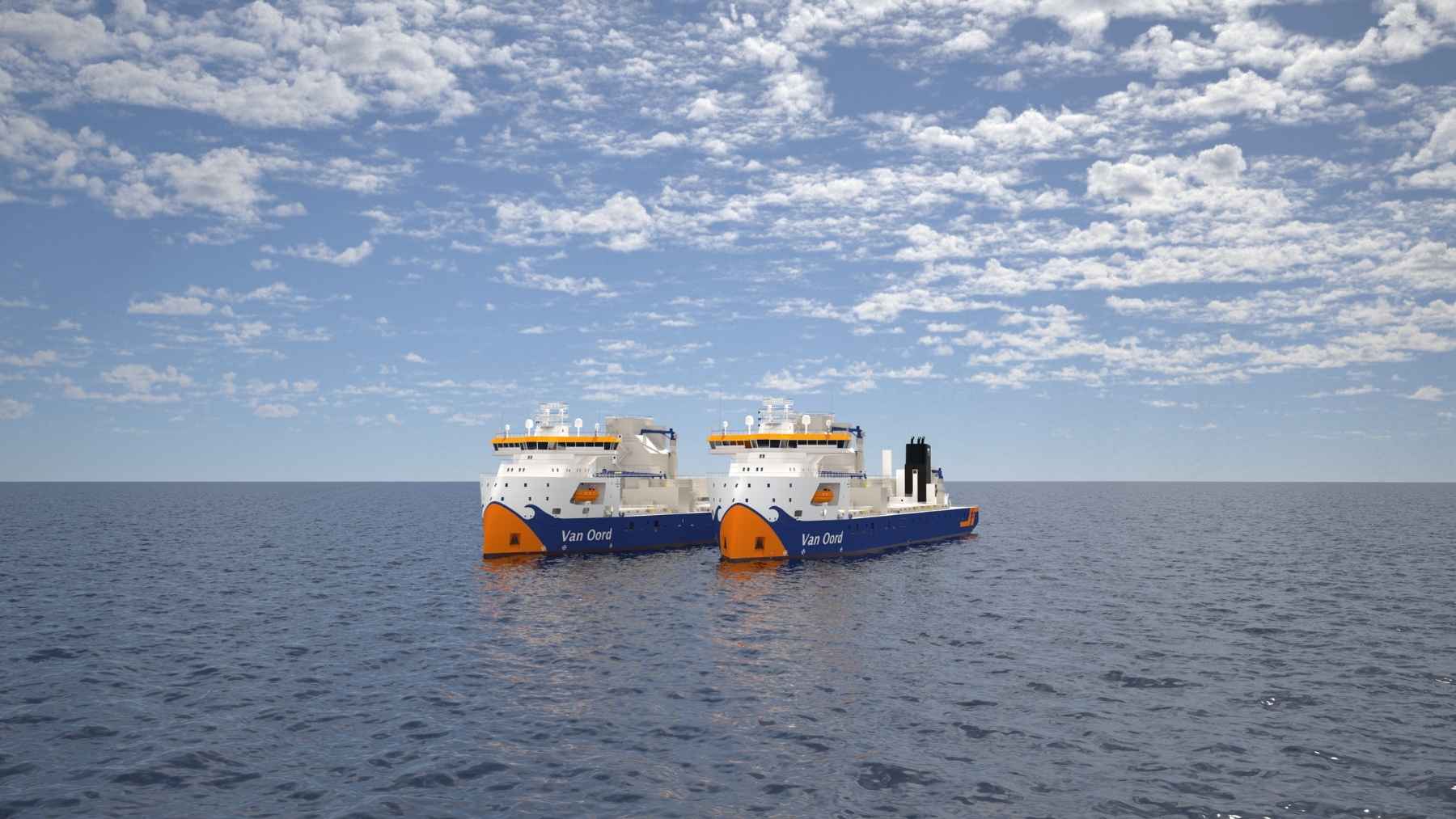
Van Oord announced the finish on July 22 via LinkedIn, and the trade outlet offshoreWIND.biz reported it the following day. Two ships did the whole job, the Bravenes and the Nordnes, working since September 2025.
The site is Hollandse Kust West VI, a 760-megawatt wind farm about 33 miles off IJmuiden, developed by Ecowende, a joint venture of Shell, Eneco and Chubu Electric Power.
The heaviest stones in that pile weighed 450 kilograms each, about 990 pounds, or just under half a US ton. Van Oord says they are the largest rocks any subsea rock installation vessel has ever placed.
The pit the current digs is deeper than the pile is wide
Scour is the least photogenic problem in offshore wind and one of the more expensive ones to get wrong. Water hits a fixed cylinder, speeds up around the sides, sheds vortices behind it, and hauls sand away faster than the tide brings it back.
The British hydraulics lab HR Wallingford, which wrote much of the design guidance the industry still uses, went out and measured real holes. In sandy seabed with no hard layer underneath to stop the digging, its surveys recorded scour depths between 0.95 and 1.38 times the outer diameter of the pile.
The monopiles at Hollandse Kust West VI come in two sizes, 8.8 and 9.3 meters, so 29 and 30.5 feet across. Run the upper end of that ratio against the bigger pile and you get a crater around 42 feet deep.
Those surveys were done on older and narrower piles, so the scaling is a rule of thumb rather than a promise. The direction of travel is not in doubt, though.
Nothing falls over the week the sand leaves. The pile loses the soil that was holding it steady, the structure gets softer, and the fatigue math the designers signed off on quietly stops applying. Which is why the rock goes in early and the turbine goes in after.
The rock goes down a pipe, not over the side
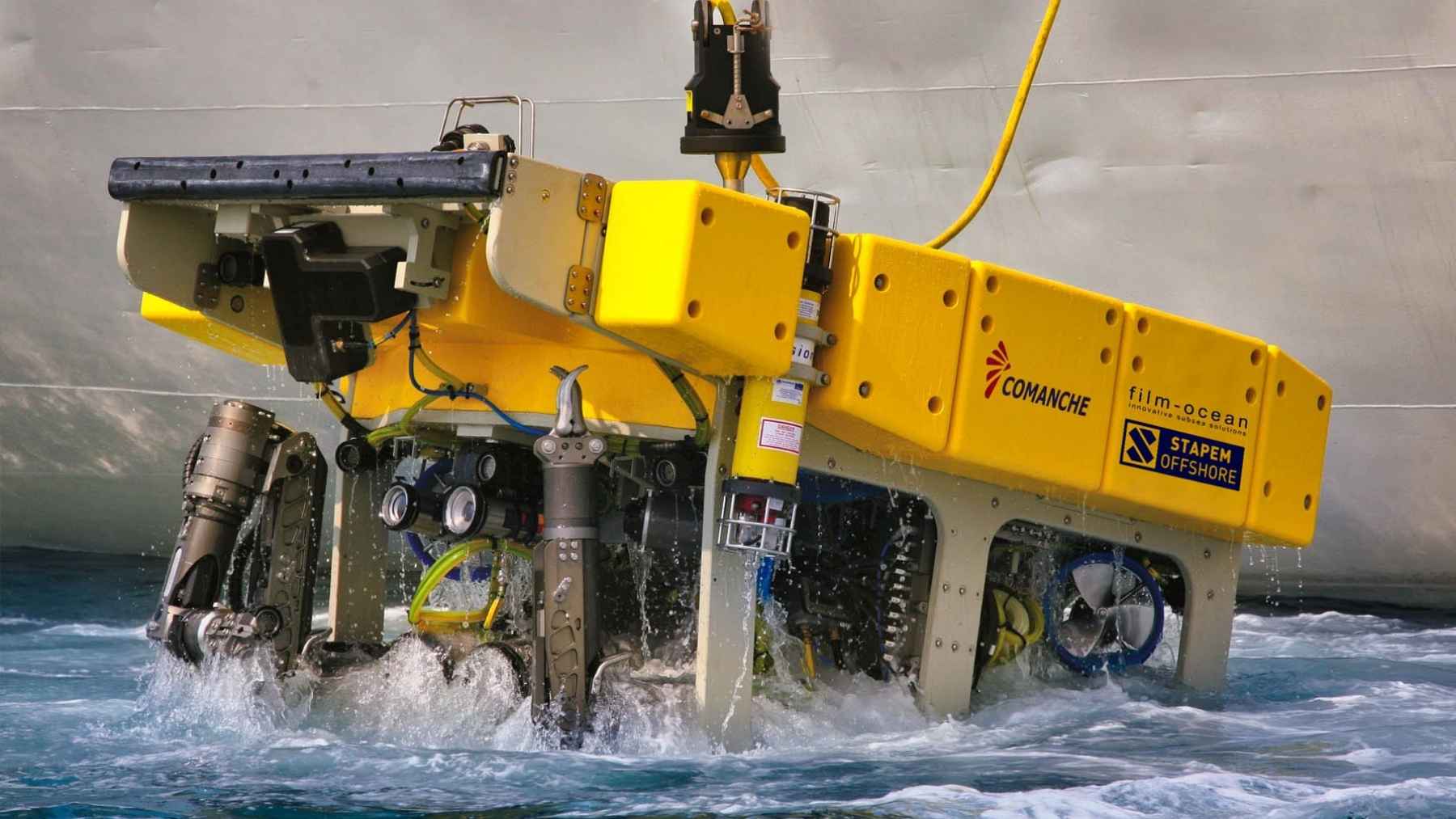
A subsea rock installation vessel is basically a bulk carrier with a hole in it. Rock leaves the hold on conveyor belts, drops through a chute, and falls down a flexible pipe hanging under the ship, with a remotely operated vehicle on the bottom end aiming where the stream lands.
Boskalis, which runs a competing fleet, describes the same arrangement on its own equipment pages and claims placement accuracy down to 1,500 meters of water, about 4,900 feet. That is a fleet-wide claim rather than a spec for any single hull.
When the pipe cannot reach the spot, which happens right up against a foundation, the ships switch to a side-dumping unit instead. Ulstein, which designed the Bravenes, lists it as working in up to 1,000 meters of water, and Van Oord’s own leaflet puts its load at 15,500 tonnes.
Do the arithmetic on the campaign and 300,000 tonnes comes out somewhere near twenty full ship-loads, split between two hulls across ten months of North Sea weather. For scale on the rest of the fleet, Boskalis lists its three fallpipe ships at 23,500, 17,500 and 15,000 tonnes.
These are not small vessels doing a small job. The same class of contractor is floating 22,000-tonne concrete boxes into a ring off Belgium to build an artificial island in the same stretch of sea.
The rock weighs more than the steel it is protecting
Here is the number that reframes the whole job. Sif, the Dutch fabricator, built all 52 monopiles for this farm at a combined weight of roughly 70,000 tonnes of steel, the largest of them running close to 1,500 tonnes apiece.
So the rock outweighs the foundations by more than four to one. The expensive precision-welded part of an offshore wind farm is a minority of the tonnage sitting on that patch of seabed.
Divide the rock evenly and you get about 5,770 tonnes per foundation. That average flatters the turbines slightly, because the same 300,000 tonnes also stabilized the cable protection running between them, and Van Oord did not publish the split.
These are unusually clean piles to start with. They went in without transition pieces, and three of the 52 were installed using vibration and water jetting rather than an impact hammer, which Van Oord and Ecowende called the first commercial-scale use of that silent method.
British contractors have been hammering 2,300-ton monopiles into the North Sea at Inch Cape the conventional way, which is louder and harder on whatever is swimming past.
Ecowende wants the pile to work as a reef
The interesting part of this campaign is not the tonnage, it is the shape. Van Oord and Ecowende designed four progressively more complex rock layouts using a 60 to 300 kilogram grading, with the 450-kilogram outliers thrown in to open gaps between stones.
The layouts also include deliberate bays along the edge to stretch out the length of available habitat. Van Oord called the result a new benchmark “for combining critical infrastructure protection with marine biodiversity enhancement.”
Ecowende is trialing holes cut in the monopiles themselves as fish shelter, and seven of the turbines will fly a single red blade to test whether the color contrast keeps birds out of the rotor.
It would be easy to file all of that under corporate scenery, so it is worth knowing there is peer-reviewed work behind it. A 2024 study in the Journal of Sea Research found that giving scour protection more surface area raised the number of species living on it, and that mixing substrate types widened the range of behaviors among them.
Two caveats come attached. The authors recommend larger in-situ testing before anyone treats the design as settled, and the author list includes a researcher from Van Oord alongside teams from Wageningen and TU Delft.
What is not in question is that hard structure on a sandy seabed pulls in life. Scientists have already tracked seals hunting turbine rows in the North Sea, swimming the grid in near-perfect lines and stopping at one foundation after another.
The southern North Sea used to hold oyster beds and loose stone until bottom trawling scraped most of it flat. That is the honest reason a graded rock berm now reads as habitat rather than as landfill.
America just took delivery of its first ship that can do this
US offshore wind has been buying this service from foreign-flagged vessels, because nobody in the country owned a purpose-built one. That changed on June 25, when Great Lakes Dredge & Dock took delivery of the Acadia from Hanwha Philly Shipyard, the first US-flagged, Jones Act-compliant subsea rock installation vessel.
She is 461 feet long, 112 feet in the beam, sleeps 45, and carries up to 20,000 metric tons of rock. Her first assignment is Equinor’s Empire Wind 1 off New York, then Ørsted’s Sunrise Wind, before crossing to Europe on contracts that keep her busy for most of 2027.
Equinor spells out the sequence on its own Empire Wind project page. A filter layer of rock goes down at every turbine position first, foundations next, then an armor layer over the top, plus rock at key points along the cable route. Rock laying there runs through 2026.
The contrast with Europe is hard to miss. Britain topped out the first 95 turbines of what will be the world’s largest wind farm in June, at a point when several American projects were stalled. Empire Wind is one of the few US sites where the ships are actually sailing.
Hollandse Kust West VI sent its first power to the Dutch grid in early July and should be fully running by the end of the year, covering roughly 3 percent of Dutch electricity demand. The rock was in place long before any of that.
It will also be the last thing out there if the steel ever comes out. Whether you lift a decade-old artificial reef off the seabed or leave it where the fish are living is a decommissioning question the industry has not answered, and every campaign like this one makes it a bigger question.













Hi