
Most big industrial projects kick off with the same little ceremony. A row of executives and politicians in spotless hard hats pushes gold-painted shovels into a neat pile of dirt, somebody snaps a photo, and everybody heads back to the parking lot.
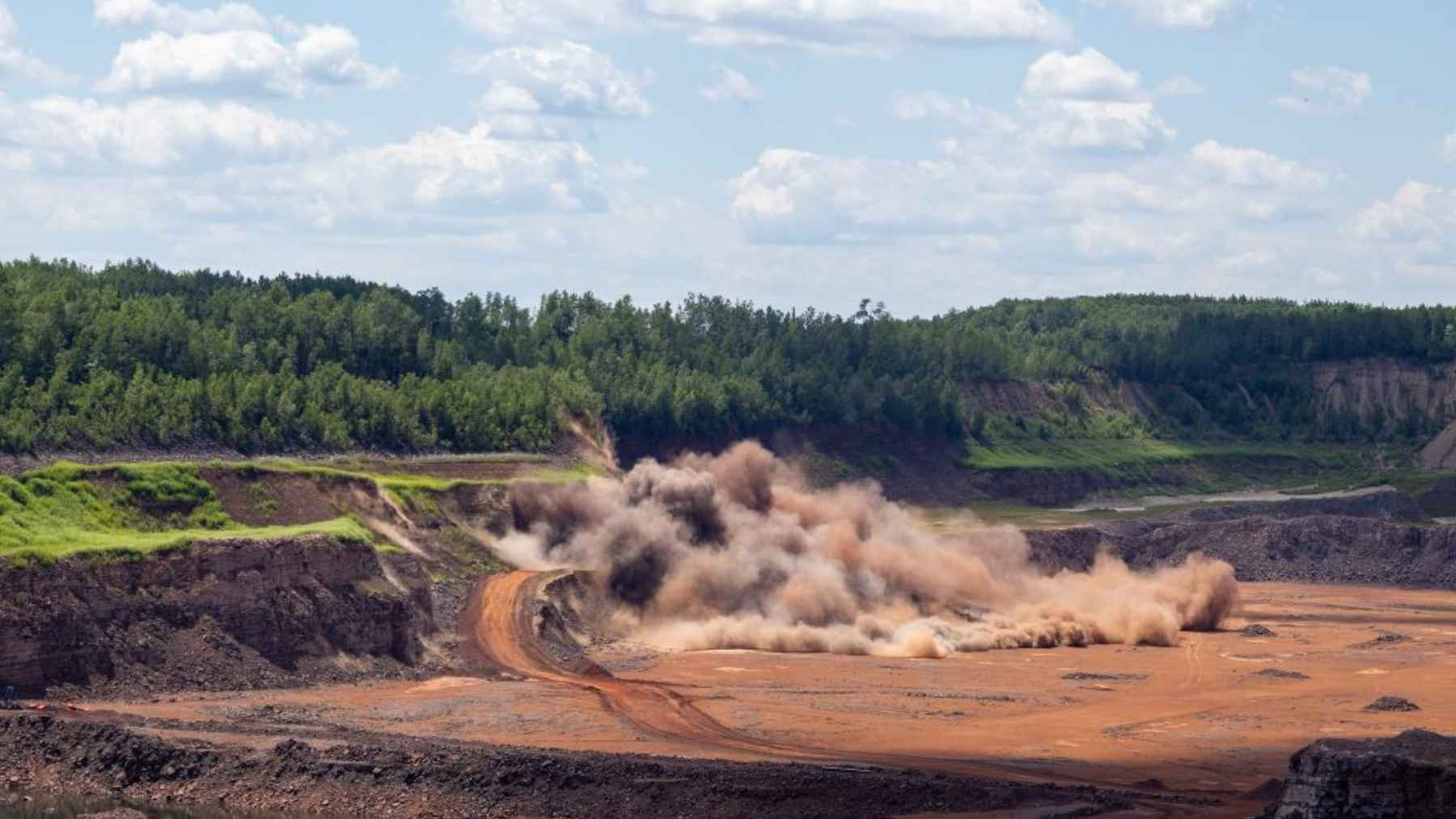
The new iron ore mine outside Nashwauk, Minnesota, skipped the shovels. On September 17, with Trump administration officials watching, workers set off more than a million pounds of explosives packed deep into the pit, MPR News reported. The dust cloud came up red, white and blue, which was apparently on purpose.
That’s frankly the most Iron Range way to throw a party I’ve ever heard of.
The mine belongs to Mesabi Metallics, and MPR says it’s the first new taconite mine to open in Minnesota in roughly 50 years. The ground shook hard enough to feel like an earthquake, and the blast knocked loose an estimated 1.3 million tons of iron ore. It wasn’t the mine’s first blast, though. That one went off on July 13.
So how big was this one?
Mesabi says its first production blast used a 66-hole pattern and opened the first ramp down to the bottom of the pit. That July shot broke up roughly 211,000 tons of ore, and the September blast shook loose an estimated 1.3 million tons, about six times as much.
The company compared the July blast to nearly half the rock that came off the mountain to carve Mount Rushmore. Carving the monument meant removing about 450,000 tons of granite, so I did the math, and the September blast works out to nearly three Mount Rushmores. Blame me, not Mesabi, if a park ranger writes in.
A mine blast is really a lot of small charges going off in sequence. Drill rigs punch a grid of holes into the rock, workers load those holes with explosives, and the timing breaks the rock into chunks a shovel can actually scoop. Mesabi ordered fully electric Epiroc Pit Viper 351 E rigs earlier this year, with the first one due on site over the summer, and those drills came up when we looked at the self-driving drill rigs in Australia.
Then you have the trucks. If you’re picturing a regular dump truck, you’re way off. MPR describes them as the size of two-story houses. Each one’s a Komatsu 980E-5, rated to carry 400 tons in a single load. Komatsu lists the truck at 584,500 pounds empty, and a full load takes it to 1,384,500 pounds. Its 3,500-horsepower diesel doesn’t turn the wheels directly. It runs a generator that feeds electric motors in the wheels, which is pretty much how a railroad locomotive works. The tires alone stand 13 feet tall, according to Charles Sutton, Mesabi’s chief development officer.
Mesabi plans to run seven of them, and they’re the first trucks in that class on the Iron Range. Some of the other mines up there use 240-ton trucks, so these haul nearly twice as much per trip. They’re also built to drive themselves with Komatsu’s FrontRunner system, which we’ve covered at a Nevada gold mine. Mesabi says it’ll switch the autonomy on as soon as it’s feasible while keeping the same number of jobs on site. It hasn’t put a date on that.
This mine sat half built for a decade
As fun as the explosion is, the comeback’s arguably the better story.
Mesabi’s plant sits on the old Butler Taconite site, which shut down in the 1980s bust and took a big chunk of Nashwauk’s population with it. The project, owned by the Indian conglomerate Essar, went bankrupt about ten years ago with the plant half built. It still owed the state and several contractors tens of millions of dollars, according to MPR. Minnesota took back the state mineral leases and handed them to Cleveland-Cliffs, a rival miner. Gov. Tim Walz even tried to ban Essar from Minnesota.
So how does a project come back from that?
Mostly by paying up. Essar restarted construction a few years ago, and MPR reports it’s since paid the state back nearly $50 million, on top of $47 million in taxes, lease payments and rent. The Export-Import Bank, a federal agency, lent Mesabi $770 million, and EXIM chairman John Jovanovic toured the site on blast day as the operation started up. That’s a pretty remarkable turnaround for a company the governor once wanted gone.
The Iron Range could use the jobs. Two of the region’s six taconite operations, Minorca and Hibbing Taconite, shut down last year. John Arbogast, a United Steelworkers district representative, told MPR that 600 laid-off workers are going on 17 months without permanent jobs, and he called the new mine “perfect timing for us.” Mesabi’s hired more than 200 of the 350 full-time workers it plans to employ, and about 1,500 construction workers are still on site.
Mesabi and Cliffs are still fighting over the ore. Without the leases Cliffs holds, Mesabi says its mine has about 23 years of life in it. Cliffs has argued it needs those leases to keep Hibbing Taconite going, though MPR notes it hasn’t moved ahead with mining them. Mesabi has also sued Cliffs, accusing it of anticompetitive behavior to block the mine, and it’s asking for more than $5 billion in damages. A jury’s scheduled to hear the case next May.
What’s a DR-grade pellet, anyway?
You’ve probably never wondered where the iron in your car’s frame started out, and that’s fine. On the Iron Range, it comes out of the ground as taconite, a hard, low-grade rock miners turned to after the richest ore ran out. Plants crush it into powder, pull the iron out with magnets, roll it into balls about the size of marbles and bake them in kilns.
Traditional taconite pellets go into blast furnaces, the old-school giants that melt ore down with coke. DR pellets are purer and made for direct reduction, which strips the oxygen out of the iron with gas while it’s still solid. What comes out, direct reduced iron, feeds electric arc furnaces, and those now make 70 percent of the steel produced in the U.S., according to MPR.
Two other Minnesota operations have upgraded to make DR pellets, but Mesabi built its plant to make them from day one. The company plans up to 7 million tons a year, and it’s branded them the Patriot Pellet, because of course it has.
So are pellets coming out yet? Not quite, as far as I can tell. It’s getting close, though. SteelOrbis reported in late September that the plant had made its first iron ore concentrate, the powder that becomes pellets, with every concentrator due to run in October and pelletizing to follow shortly after. I couldn’t find anything confirming the first pellet has left the kiln as of October 8.
The pellets are headed to Iowa
On September 28, President Trump announced at the White House that Mesabi plans a $15 billion steel mill in eastern Iowa that’ll run on the Minnesota pellets. The White House says it’ll eventually turn out 10 million tons of steel a year, which would make it the biggest steel plant in the country. Mesabi says it’ll take more than 6,000 construction workers to build and employ at least 1,750 people full time once it’s running. The White House puts its own figure at more than 2,000 jobs.
Mesabi and the White House haven’t said exactly where in Iowa the mill goes. I’d guess people in Minnesota noticed it isn’t going in Minnesota, though. State Rep. Spencer Igo, a Republican who represents the stretch of the Range where the mine sits, called that a “gut punch.” Mesabi says it still wants to expand the Nashwauk mine and build a plant there to turn its own pellets into iron briquettes. Joe Broking, Mesabi’s CEO, told Itasca County officials the company needs faster state permitting, better incentives and those Cliffs leases back first. You can see why a lawmaker from up there might be a little grumpy about that.
Broking told MPR the pellet plant would be up and running by October, so we’ll find out pretty soon whether all that dyed dust paid off. The Iowa mill is a lot further out, with the White House pegging its first steel for 2030.