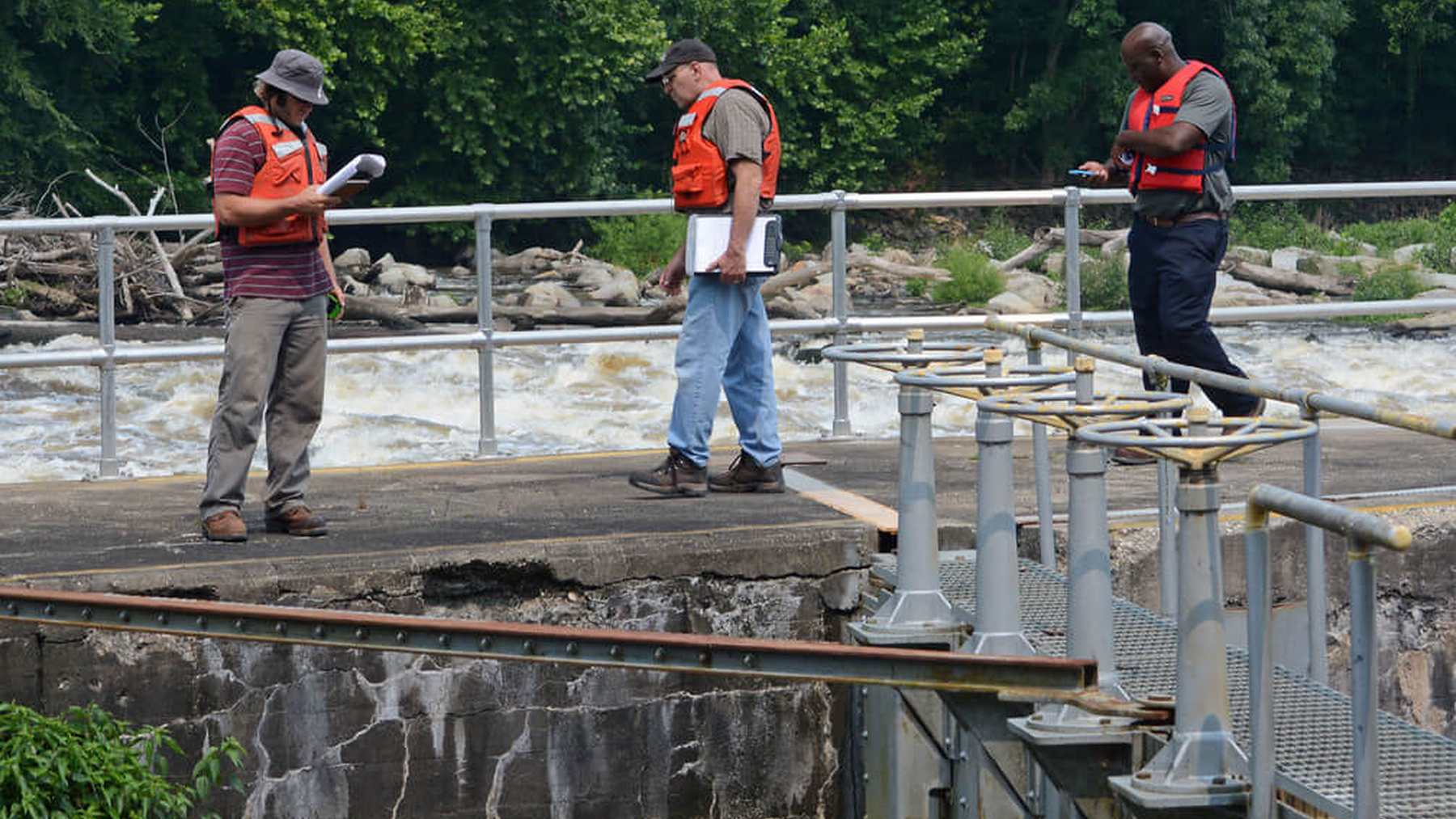

When a dam makes the news, it’s usually a big one. Hoover, Oroville, Glen Canyon, the kind of concrete wall you can spot from a plane window. Lock and Dam No. 1 on the Cape Fear River isn’t in that club. It’s a low, 111-year-old structure tucked into the woods of Bladen County, North Carolina, and unless you fish there or launch a boat there, you’ve probably never given it a second thought.
But if you drink tap water anywhere around Wilmington, there’s a decent chance some of it came out of the pool this thing holds back. And on October 30, the Army Corps of Engineers said the river has been digging a channel underneath it.
The Corps’ Wilmington District, which owns and runs the structure, said its inspectors had confirmed the current cut that channel into the riverbed below the lock. If nobody deals with it, the Corps warned, the erosion could keep eating away at the bed the structure rests on, and the structure could start to settle. Then there’s the scarier half of the sentence. WWAY’s version of the Corps statement says “structural damage,” while WECT’s says “structural failure.”
I’d love to tell you which phrase the Corps actually used, but the statement hadn’t shown up on the Wilmington District’s own news page when I looked, so the two TV stations are the only versions out there. Either way, it isn’t a sentence any engineer types casually.
So it’s an emergency job.
The Corps is working with one of its own in-house units, a team that specializes in maintenance and repair, on a plan to shore up that stretch of riverbed and keep the erosion from spreading. Once the hands-on work gets going, the Corps expects the job to take about 30 days. After that, the district will look at how the fix held up and decide whether Lock and Dam No. 1 needs something more permanent.
What the Corps hasn’t said is when that work starts. WECT’s headline says repairs are already underway, but the text of both reports only talks about a 30-day clock that starts when the actual repair work does. The Corps also hasn’t published how long or how deep the channel is, which is pretty much the first thing I’d want to know.
For now, the Corps is asking anyone headed to the site to be careful, stay out of the areas it has closed off, follow the signs, and give the crews and their equipment plenty of room. WWAY also passed along a note for nearby dock owners, who should keep taking the same precautions they’d take for the river’s normal ups and downs.
So what does a channel under a dam actually do?
Engineers call this kind of thing scour, and you’ve probably felt a tiny version of it at the beach. Stand in the surf for a few minutes and the water pulls the sand out from around your feet until you sink a little. A river does the same thing to anything solid sitting in it, just slower and with a lot more water behind it. Fast, churning current picks up sand and sediment from the bed and carries it off downstream. The spots right next to a concrete structure tend to get it worst, because that’s where the flow gets forced around, over and through things.
And a structure like this is only as solid as what’s under it. Wash out enough of the bed beneath part of it, and that part can sink, which is what “settling” means here. Concrete doesn’t like being propped up unevenly. That’s how a scour problem turns into a structural one.
What is Lock and Dam No. 1, anyway?
It’s older than most people’s grandparents. The Corps has a photo from one of its annual inspections with an old image of the steamer Mercur laid over it, passing through the lock in July 1915, right after it first opened for business. The Corps titled that feature “100 Years Old and Still Functioning,” which has aged pretty well, considering we’re 11 years past it.
Back then, the whole point was boats. The Corps built three locks and dams on the Cape Fear between 1915 and 1935 to keep cargo boats moving on the river, and No. 1 is the farthest downstream, at Kings Bluff near Riegelwood, about 39 miles upriver from Wilmington.
If you’ve never been through one, a lock is basically a water elevator for boats. A boat pulls into a concrete chamber, the gates close behind it, and operators let water in or out until the boat sits level with the river on the other side. This one’s chamber measures 40 by 200 feet, according to the Corps, and its lift was raised by 3 feet in 1934 to the 11 feet it has today. The National Inventory of Dams lists the dam itself at 23 feet tall and 375 feet long.
These days, it barely does the job it was built for. The Corps says the Cape Fear locks rarely pass large vessels anymore. What they mostly do is back the river up so the towns and plants that pull water out of it have a steady pool to draw from, and they’ve become pretty popular spots for fishing and picnics. That’s a fairly unglamorous second career for a structure built for steamboats, but it’s arguably the more important of the two.
It’s also taken a beating or two. During Hurricane Florence, the Corps put out photos of Lock and Dam 1 completely submerged under the Cape Fear, with plans to inspect it once the water went down.
So why does Wilmington care?
Right behind the dam at Kings Bluff, the Lower Cape Fear Water & Sewer Authority runs a pump station that pulls raw water straight out of the river. According to the authority, that water gets in through Johnson screens sitting on the river bottom behind Lock and Dam No. 1. Those are basically big slotted metal cylinders that let water through and keep fish and debris out.
The station started out with three of those screens feeding a 48-inch pipe. The authority later added three more screens and a 60-inch intake pipe, and it rates the combined raw water supply at 100 million gallons a day. That water goes to Brunswick County, the Cape Fear Public Utility Authority (the utility that serves Wilmington), and a couple of industrial users.
CFPUA’s own source water protection plan says the utility draws from two intakes at Kings Bluff, near the lock. And in its study of the three dams, the Corps noted that CFPUA’s Sweeney Water Treatment Plant runs on water taken from behind Lock and Dam No. 1, and that the utility considers that intake critical to its operations.
Why would an intake care so much about a dam? CFPUA has said that without it, the river at Kings Bluff wouldn’t be deep enough for the intake to work properly. The utility has also said the dam helps keep saltier water from the coast away from its supply. So the dam is basically what keeps the water there, in the right amount and on the right side of salty.
So should you be filling the bathtub in Wilmington?
From everything that’s been published so far, no. The Corps’ statement doesn’t say a word about the water supply, and I couldn’t find anything from CFPUA or the Lower Cape Fear authority suggesting service is affected. The National Inventory of Dams also rates Lock and Dam No. 1 as low hazard potential. That rating isn’t a grade on the dam’s condition. It’s a measure of what a failure would do downstream, and “low” means the government doesn’t expect one to cost lives. The Corps put the emergency label on this because of where the erosion could lead, and it’s moving before it gets there. Frankly, I’d much rather read about the Corps’ inspectors catching something like this than read about it after a flood.
This isn’t the first hole the river has dug here
The Cape Fear has been working on this spot for a long time. With federal stimulus money from the American Recovery and Reinvestment Act, the Corps filled in a scour hole 40 feet deep at Lock and Dam No. 1, according to Wildlife in North Carolina, the state wildlife commission’s magazine. The magazine blamed almost a century of water and debris coming over the dam.
That was a different spot from the one the Corps is worried about now, at least going by the reports. The old hole was a classic low-head dam problem. Water spills across the full width of a dam like this and slams into the riverbed below, and over the decades that churn digs a pit. The new channel is under the lock, and beyond pointing at the current, the Corps hasn’t said what started it.
Once that old hole was filled, the Corps built rock arch rapids down the front of the dam, a long, stepped ramp of boulders that lets shad, striped bass and sturgeon swim up and over it to spawn. The Corps says nobody had built rapids like it anywhere else on the East Coast, and it’s a pretty clever bit of work if you’ve ever watched fish stack up below a dam with nowhere to go.
Lock and Dam No. 1 isn’t the only old piece of water infrastructure we’ve been keeping an eye on, either. Last week we covered an Idaho dam where the Corps can only run its 70-year-old spillway gates fully open or fully shut, and last month we looked at the 301-foot Elephant Butte Dam on the Rio Grande, which is a year younger than this one and had a very different kind of fall.
The Corps’ Wilmington District said on October 30 that the emergency work at Lock and Dam No. 1 should take about 30 days from the time repairs actually start, and that it’ll decide after that whether the 111-year-old structure needs more work to stabilize it for good.