
Ask pretty much anyone who makes wine and they’ll tell you grapes want sun. Hot, dry, and a lot of it. Zinfandel built its whole reputation in California on that idea, and Zinfandel’s the same grape Italians call Primitivo. So a group of researchers in southern Italy sticking solar panels over a block of Primitivo and cutting the light underneath to about 5 percent sounds like a reasonably efficient way to wreck a vineyard.
It turns out the vines in the dark did considerably better. The bunches under the heaviest shade weighed about two and a half times what the bunches in open sun did, a few rows over on the same farm.
The study comes from the University of Bari, and it ran on a commercial agrivoltaic vineyard called the Vigna Agrivoltaica di Comunità near Laterza, in Puglia, down in the heel of Italy. The team published the results in Scientia Horticulturae over the summer, and pv magazine ran an interview with the lead professor, Giuseppe Ferrara, on October 2. We’ve written about this same farm before, when Ferrara measured the dirt under the panels running 36 degrees cooler than open ground a short walk away. This is the grape half of that story.
So what did the vines actually do?
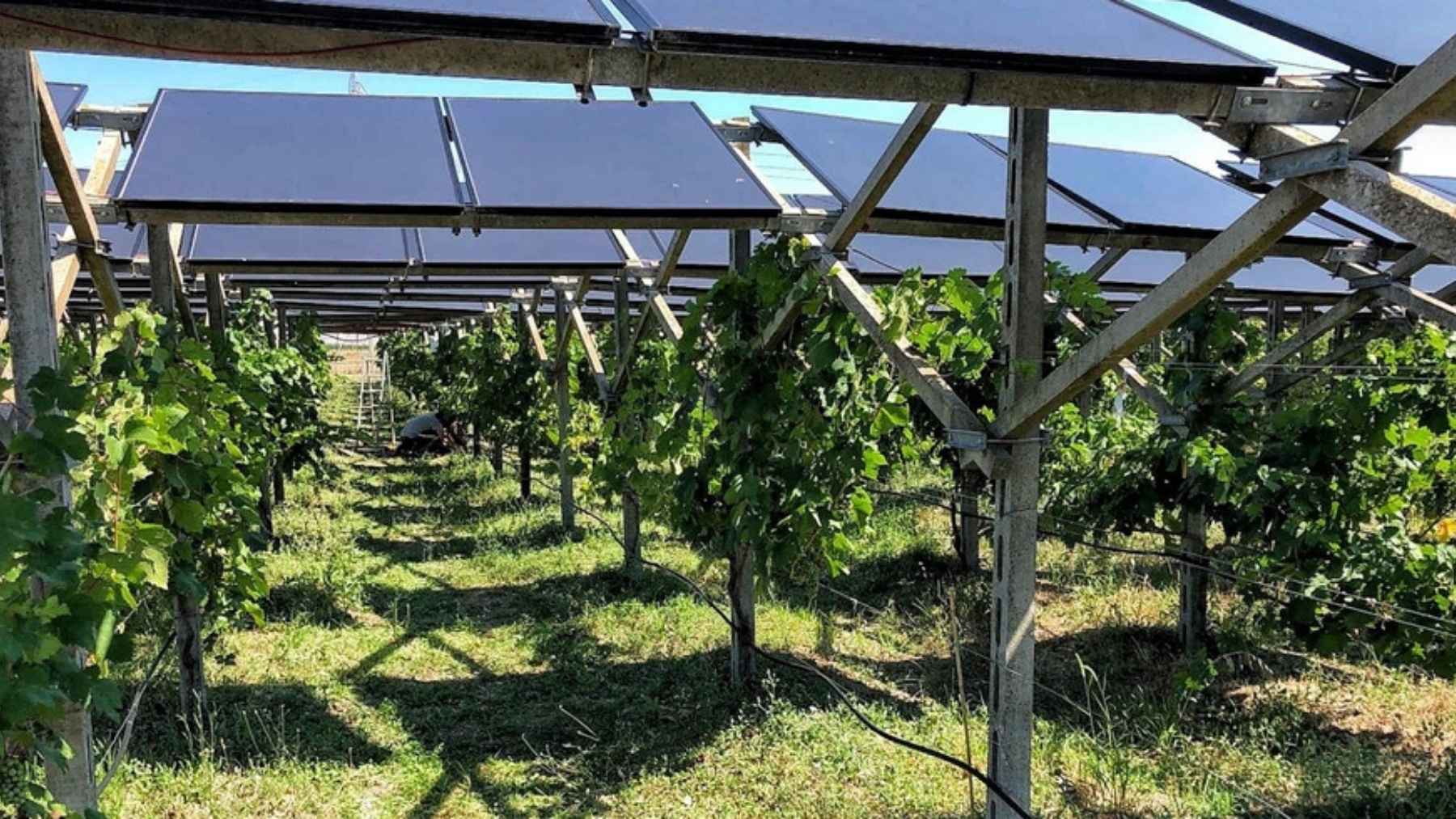
The test block covers 8,812 square meters, which works out to about 2.2 acres, with 350 kilowatts of panels sitting on concrete pergola-style frames over the rows. A plot of Primitivo nearby in full sun served as the control. The researchers split the covered area into two zones: directly under the panels, where only about 5 percent of the sunlight gets through, and the gaps between panel rows, where about 95 percent does.
Shoot length is where it got odd. Shoots on the full-sun vines averaged just shy of four feet by the end of the season (115.8 centimeters, if you want the paper’s number). Shoots under the panels, in both the light and the heavy shade, came in between 106 and 108 inches. That’s nearly nine feet of growth. The shaded vines also pushed out bigger leaves, thicker stems and more total biomass.
Then there’s the fruit. Average bunch weight under heavy shade was 164.9 grams, about 5.8 ounces. In full sun it was 65.4 grams, or 2.3 ounces. Both shaded zones also produced more bunches per cane than the open-sun vines, so the gain wasn’t just a few fat clusters pulling up the average.
You’d expect the price for all that growth to show up in the sugar, and it did. Berries in full sun hit 25.8 degrees Brix. Under heavy shade they stopped at 22.9. Acidity, according to the paper, barely budged.
Why would a vine grow better in the shade?
If you don’t spend your weekends thinking about grapevine physiology, Brix is basically the percentage of sugar in the juice by weight, and winemakers use it to guess how much alcohol they’ll end up with. The rough rule is a bit over half a point of alcohol per degree Brix, so 25.8 is heading toward a 14 or 15 percent wine and 22.9 lands closer to 13. For a southern Italian red that routinely gets accused of being a sugar bomb, I’d argue a few degrees less isn’t a tragedy.
As for the growth, Ferrara’s explanation is pretty simple. A vine in a Puglia summer spends a lot of the afternoon in survival mode. When leaf temperatures climb high enough, the tiny pores on the leaf (the stomata) shut to stop water loss, and the moment they shut, photosynthesis stops with them. The plant then burns water just trying to cool itself down. This particular vineyard’s dry-farmed apart from a bit of emergency irrigation, so there isn’t much water to burn.
Under the panels, air temperature dropped by only 1 to 2 degrees Fahrenheit, and relative humidity went up somewhere between 2 and 14 percent. That doesn’t sound like much. But Ferrara told pv magazine Italia the vines under cover were simply less stressed, which let photosynthesis keep running through the hours when the sun-exposed vines had shut down. So the shaded vines get more hours of actual work in each day, and that shows up as growth. The extra water in the shaded berries also dilutes the sugar, which accounts for part of the Brix gap.
One more thing turned up that the researchers hadn’t gone looking for. They surveyed the weeds growing between the vines, and the number of plant species under the panels came out at roughly double what it was in the open. Clover, sowthistle, plantain, tassel hyacinth, a few kinds of alfalfa. Ferrara’s take is that more ground cover means more pollinators and pest predators, less erosion and more organic matter in the soil. They haven’t tested the soil bacteria or insects yet, and he says that’s planned.
This doesn’t work everywhere, and the professor says so
Before anyone in Napa gets excited, Ferrara was unusually direct about the limits of his own result. He pointed to an earlier trial in Valpolicella, up in northern Italy, where the vines outside the panels out-produced the ones underneath. Cooler, wetter places don’t have the heat-stress problem, so the shade just takes light away from a plant that wanted it. His line was that agrivoltaics has to be assessed site by site, matching the panel setup to the crop and the local climate.
There are a couple of other caveats you should know about. It’s one growing season on one farm, and the paper’s own conclusion calls for longer trials in more places. Ferrara also said the sugar and acid differences can swing a fair amount from year to year. And the paper doesn’t say how many individual panels sit over the 2.2-acre test block, so I can’t tell you that either. The farm’s full array, going by pv magazine’s earlier reporting, is about 970 kilowatts across several thousand thin-film modules.
What I find pretty convincing about this one is that it’s a working winery, not a university test plot. Svolta Srl, the company that runs the vineyard, sells the Primitivo it grows under the panels, and it’s been talking up the lower-sugar, higher-acid style of the wine for a couple of vintages now. The research puts numbers on that instead of tasting notes. It’s also a different bet from the one a French cognac grower made when he hung 6,000 panels about 16 feet over his vines, mainly to stop hail, and lost his appellation for the trouble.
Ferrara’s interview ran in pv magazine on October 2, 2026, and the paper, “Agrivoltaics in Mediterranean viticulture: Impacts on physiology, yield and biodiversity,” appeared in Scientia Horticulturae in August.