
Big rebuild contracts come with dates printed on them, and the dates move. The Army Corps of Engineers hired ANDRITZ to re-equip the turbines at Old Hickory Dam in Tennessee, and the contractor put one in writing: “Commissioning of the first unit is expected in August 2026.”
August 2026 has about a week left in it.
On August 24, the Corps’ Nashville District marked National Hydropower Day with a status update in which Chris Stoltz, the Section 212 program manager, placed Barkley and Old Hickory “in the thick of major replacements.” The Corps had already published a later target back in November 2025: first unit finished at Old Hickory in December.
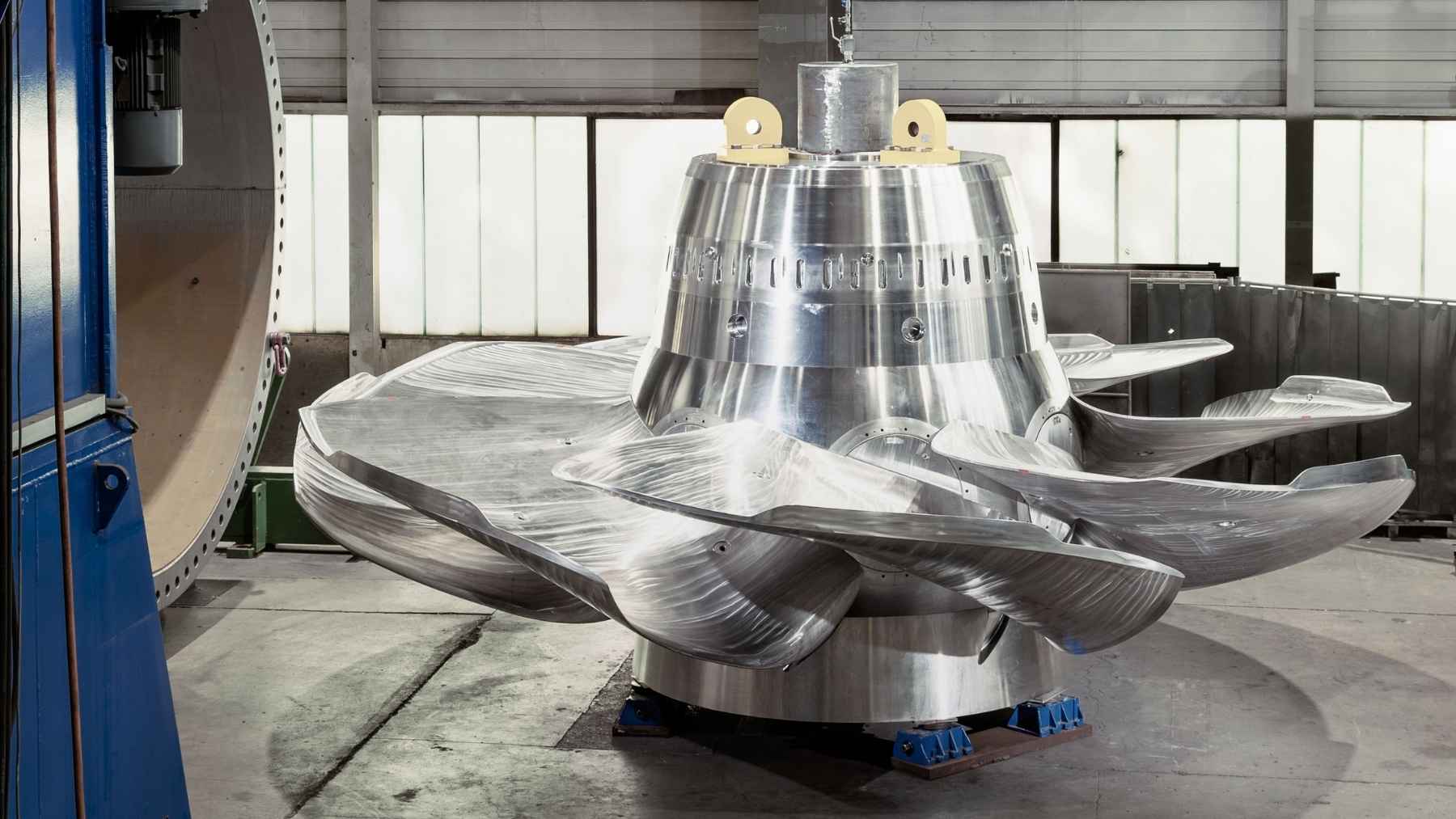
Nobody is hiding any of that. And the machine sitting on the powerhouse floor is more interesting than the calendar, because Corps crews on the Cumberland River have pulled a 22-foot Kaplan runner that had been under water since 1957 and are dropping in one with two extra blades.
The old runner has five blades and the new one has seven
The four units at Old Hickory went into service between 1955 and 1957. Published specifications put them at vertical-shaft, five-blade Kaplan machines with a runner diameter of 264 inches (6,705 mm), turning at 75 rpm, rated 25,000 kW and 31,250 kVA at 0.8 power factor on 13.8 kV.
Renewable Energy World, working from the original builder’s data, puts output at 44,000 horsepower under 44 feet of net head, through 24 wicket gates with a maximum vent opening of 28 inches. The rehab paperwork rates the site at 45 feet (13.72 m), so the two figures are one foot apart and describe different things.
The replacements come out at 40,500 kW and 45,000 kVA at 0.90 power factor, on the same 13.8 kV and the same 75 rpm. That is 15,500 kW more per unit than the 25,000 kW nameplate they displace, a 45% uprate, and ANDRITZ says the seven-blade layout is what delivers it while staying inside the cavitation limits written into the contract.
Spreading the same water across seven blades instead of five drops the pressure differential each one carries. Lower differential, fewer vapor bubbles collapsing against the metal, less pitting. The Corps photographed the new part last November and described it plainly: a stainless steel seven-blade runner hub, replacing an original five-blade steel one.
Blade geometry has been quietly doing heavy lifting elsewhere in hydro. A California lab ran 112 sturgeon through a spinning runner and got nearly all of them out alive by changing nothing but the shape of the leading edges.
A 504,000-pound rotor had to come off before anyone could reach the turbine
You cannot get at a Kaplan runner without taking the generator apart above it. On September 3, 2025, crews at Old Hickory put the powerhouse bridge crane on a generator rotor, lifted it clear and set it down. The Corps puts that rotor at 504,000 pounds, which is 252 tons swinging inside a building finished under Eisenhower.
Five weeks later they went after the turbine itself. A Corps caption dated October 9, 2025 shows an original 1957 turbine out of Unit 3, sitting on the floor outside the machine it came from.
By the November 19 update, both critical lifts on the first unit were done and the unit was still coming apart around them. Kyle Keer, a project manager for the Nashville District, listed what was behind the team by then: design, contract award, mobilization, disassembly, and fabrication of the major components waiting to go back in.
The Corps rebuilds one unit at a time on purpose. Three machines keep generating while the fourth is in pieces, which is why a four-unit job takes seven years rather than one long outage.
The powerhouse has moved since 1957 and the new machines have to be squared up to it
One problem in the rehab has nothing to do with turbines. The stationary and rotating components of Units 1 through 3 are out of concentricity by as much as a quarter of an inch (6.5 mm), which ANDRITZ attributes to historical powerhouse movement.
Concrete settles. Seventy years of concrete settles further.
A 1950s machine tolerates that much error because it was built with clearances loose enough to swallow it. A runner sized for 45% more output through the same 264-inch opening has less room to be generous, so the alignment work is part of the contract rather than a footnote to it.
The company that built these turbines was already on its way out
Two American names are on the original units. General Electric built the generators. Baldwin-Lima-Hamilton built the turbines, and that company was in trouble before the water ever hit them.
Baldwin had turned out more than 70,000 locomotives at Eddystone, Pennsylvania, and merged with Lima-Hamilton at the start of the 1950s to get out of a locomotive market it was losing. Heavy machinery was the escape route. Hydraulic turbines were part of the heavy machinery.
A 1970 Court of Claims decision shows how deep into it the firm went. BLH held a contract dated October 19, 1956 to design, manufacture and test two 90,000-horsepower hydraulic turbines for the fourth and fifth units at Garrison Dam in North Dakota, another Corps project. The dispute turned on the seal rings that stop water bypassing the runner. The Corps’ own Board of Contract Appeals ruled against the company, and the court reversed that and entered judgment for BLH in the sum of $112,053.86.
Baldwin was out of the locomotive business before the decade ended, and the firm was eventually wound up altogether. Its turbine kept turning in the Cumberland River for decades after the company that built it stopped existing. The replacement is being built under contract by ANDRITZ’s US subsidiary in Charlotte, North Carolina.
Nine plants, 28 machines, and the power bill pays for the work
Old Hickory sits inside the Section 212 Hydropower Rehabilitation Program, a $1.2 billion effort covering nine plants and 28 turbine generators across the Cumberland River Basin. Congress authorized it in the Water Resources Development Act of 2000, and the funding model is the unusual part: the Corps reinvests revenue from hydropower sales into the plants that generated it, then repays the Treasury through incremental customer rate adjustments.
Stoltz said in November that “the existing equipment averages nearly 65 years of service,” with some of it past 75.
The Nashville District runs 910 megawatts of nameplate capacity, about 2.8 billion kilowatt-hours a year, serving 4 million customers across eight states. During the winter storm in late January and early February, Hydropower Branch chief Loren McDonald put the value of that generation at $21.65 million over 14 days.
Old Hickory itself is a run-of-river station, 162 MW total, about 25 miles upstream of Nashville behind a 35-square-mile reservoir (91 km²). Projected output once all four units are done is 565 GWh a year. That is a plant nobody in Nashville thinks about, holding up a chunk of the grid in a state where an 865-megawatt coal hall is being handed to machines that generate nothing at all.
Center Hill was the first of the nine to get a full turbine generator rehab, finished in 2021. Barkley and Old Hickory are the two active ones, and both contracts run to 2030.
None of this looks like the pumped storage arms race playing out elsewhere, where four schemes are queuing up for the same Scottish loch and a regulator’s letter decides who builds first. Old Hickory is a 69-year-old run-of-river plant getting 45% more out of the same river, and it needs no new dam, no new reservoir and no new transmission to do it.
The Corps’ most recent published date for the first rebuilt unit at Old Hickory is December 2026, from its November 19, 2025 update. Barkley’s first unit is due this month.















But I do!