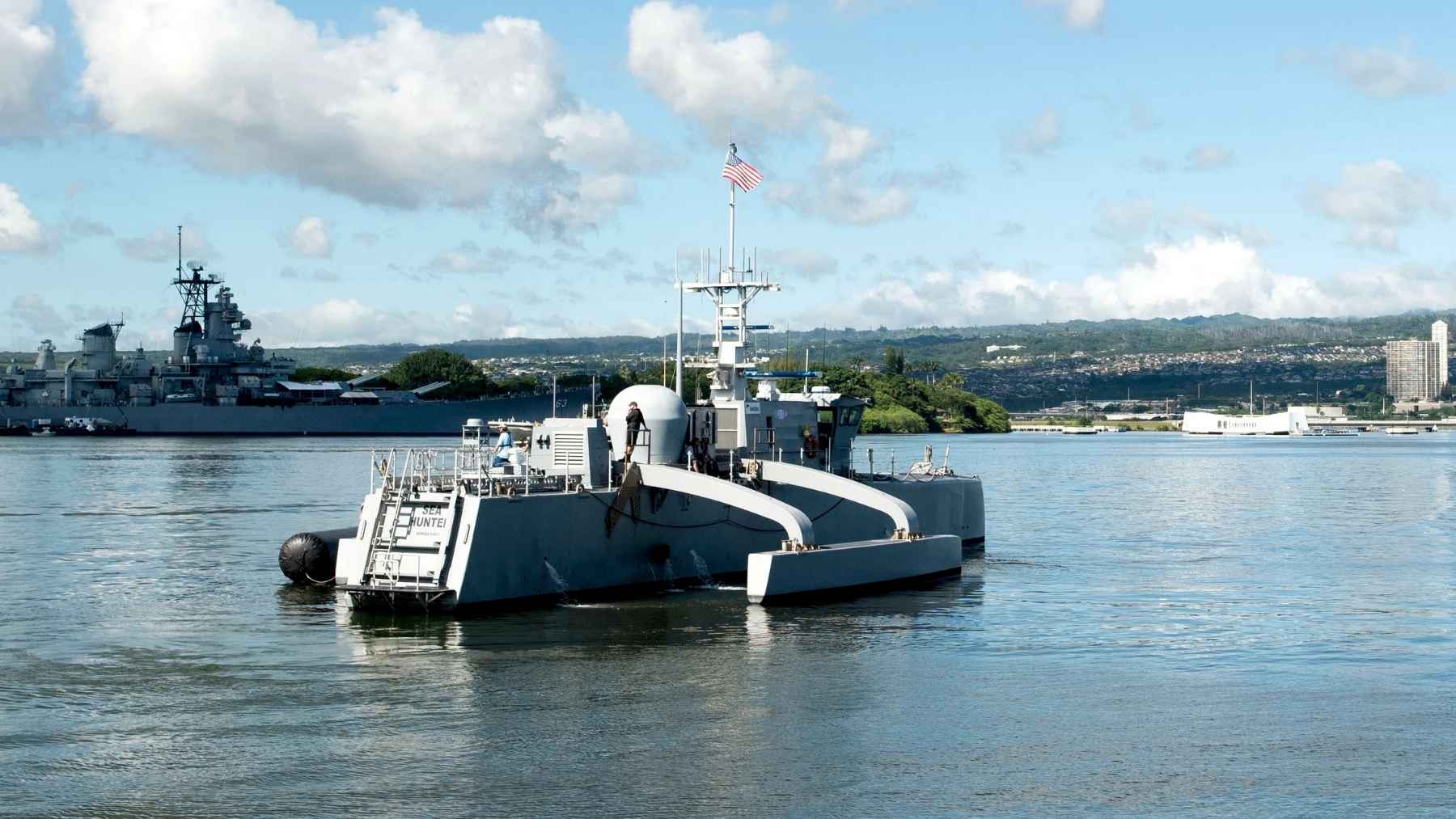

When you picture a Navy ship crossing the Pacific, you probably imagine a captain on the bridge, a few hundred sailors below deck and an awful lot of bad coffee. Sea Hunter’s trip from Pearl Harbor to San Diego this summer worked a little differently.
Sea Hunter’s a Navy drone ship, and it spent a good part of July at RIMPAC, a giant naval exercise off Hawaii. Then it had to get to California. According to an announcement from Leidos, the defense contractor that designed it, Sea Hunter “operated autonomously” for more than 2,000 nautical miles on the way from Pearl Harbor to San Diego.
If nautical miles aren’t your thing, each one’s about 1.15 regular miles, so that’s roughly 2,300 of the miles your car’s odometer counts. I plugged both ports into a distance calculator, and the shortest path across the globe between them comes out to about 2,270 nautical miles. So the company’s figure is, if anything, a little modest.
So why should you care about a drone ship’s commute?
Mostly because Sea Hunter’s been at this for about a decade, and this is the year the Navy said it’d stop treating the ship as an experiment. Plenty of ships cross the Pacific every week with crews on board. Ships that steer themselves across are a lot newer, and the Navy’s just started putting real money behind them.
So what is Sea Hunter?
Sea Hunter started out as a DARPA project with a very specific job. The agency’s ACTUV program wanted a drone ship that could keep track of quiet diesel-electric submarines. Those subs can switch to battery power and run almost silently, which makes them a real pain to follow. DARPA’s idea was a ship that could latch onto one and stay with it for weeks or months. That way, a crewed warship wouldn’t have to spend all that time babysitting a submarine.
The result was a 132-foot trimaran, christened in Portland, Oregon, about a decade ago. A trimaran’s basically one long, skinny main hull with a smaller hull sticking out on each side, kind of like a canoe with training wheels. Those side hulls keep the main hull from rolling around too much when the sea gets rough. Here’s how Sea Hunter looked on paper when it was new, plus this summer’s trip.
DARPA eventually handed Sea Hunter to the Office of Naval Research for more testing, and a sister ship, Seahawk, joined it a few years later. The Navy’s upgraded both since then. In January, Capt. Garrett Miller, who commands the Navy’s Surface Development Group One, told the Surface Navy Association’s annual symposium that the pair would move under fleet control. “Those will no longer be experimental vessels,” he said, according to DefenseScoop.
Sea Hunter has made this trip before
Back in early 2019, Leidos said Sea Hunter had become the first ship to sail itself from San Diego to Pearl Harbor and back. Fortune later reported that the return leg alone took about 10 days.
That trip came with a small asterisk, though. People from an escort vessel climbed aboard for quick checks on the engines and electrical gear, according to the company’s release at the time. So it wasn’t completely hands-off.
So was anyone aboard this time?
The company hasn’t said, and its announcement doesn’t mention escort ships or how long the run took. The War Zone did note that Sea Hunter had a crew aboard when it left Pearl Harbor for the exercise on July 7. That was on the way out to the exercise, though. The run to San Diego came later.
Given how the last crossing went, I wouldn’t be shocked if someone hopped aboard at some point along the way. That’s just my guess, though.
The timing’s fuzzy too. RIMPAC wrapped up on July 31, and the announcement went out on September 8. If Sea Hunter kept the pace it managed on that last return leg, the run would’ve taken about a week and a half.
RIMPAC is a pretty big deal
If the name doesn’t ring a bell, RIMPAC’s basically a huge naval get-together. U.S. Pacific Fleet runs it around Hawaii every two years and bills it as “the world’s largest international maritime exercise.” When this year’s edition kicked off on June 24, the Pacific Fleet counted 30 nations, more than 30 surface ships, five submarines and 30,000 personnel.
Leidos says Sea Hunter was the only medium drone ship in the exercise, and that it spent its time there running surveillance on its own and working inside a bigger group of crewed ships. The military calls that second part manned-unmanned teaming.
I’d take that first claim with a grain of salt, though. The War Zone reported on September 30 that the USS Theodore Roosevelt’s carrier strike group drilled alongside Seahawk, which is also a medium drone ship, during RIMPAC.
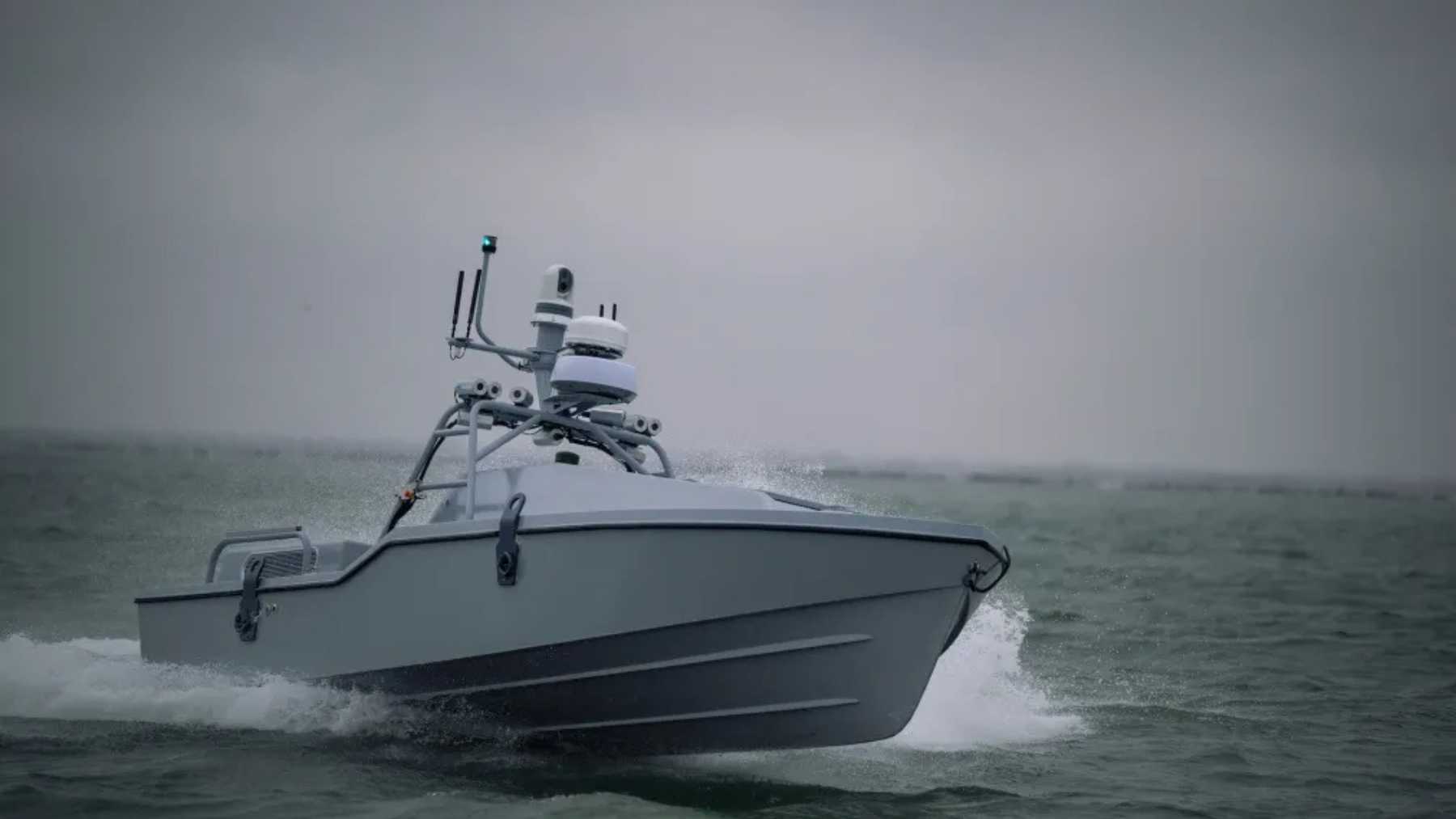
“Medium,” by the way, is the Navy’s size class for drone ships that are a lot bigger than the jet-ski-sized drone boats you’ve probably seen in war footage and a lot smaller than a destroyer. The Navy’s moved the exact cutoffs around over the years.
The Navy is buying medium drone ships now
On September 29, the Navy announced it’s buying 30 medium drone ships, 10 each from Huntington Ingalls (HII), Saronic and Galliano Marine Services, at an average of $40 million apiece. Leidos made it through the same round of at-sea testing but wasn’t one of the three companies picked to build them.
That’s a little awkward for the company behind the only medium drone ship at RIMPAC, at least by its own count. Still, the Navy says Leidos, PacMar Technologies and Sea Machines will get completion awards and a spot on the Pentagon’s online drone marketplace, where the military can order from them later.
So Sea Hunter’s going to get a lot more company, at least on paper. The Navy says the first of those 30 ships should be delivered before the end of fiscal 2027, and since the Pentagon’s fiscal year ends in September, that means by September 30, 2027.