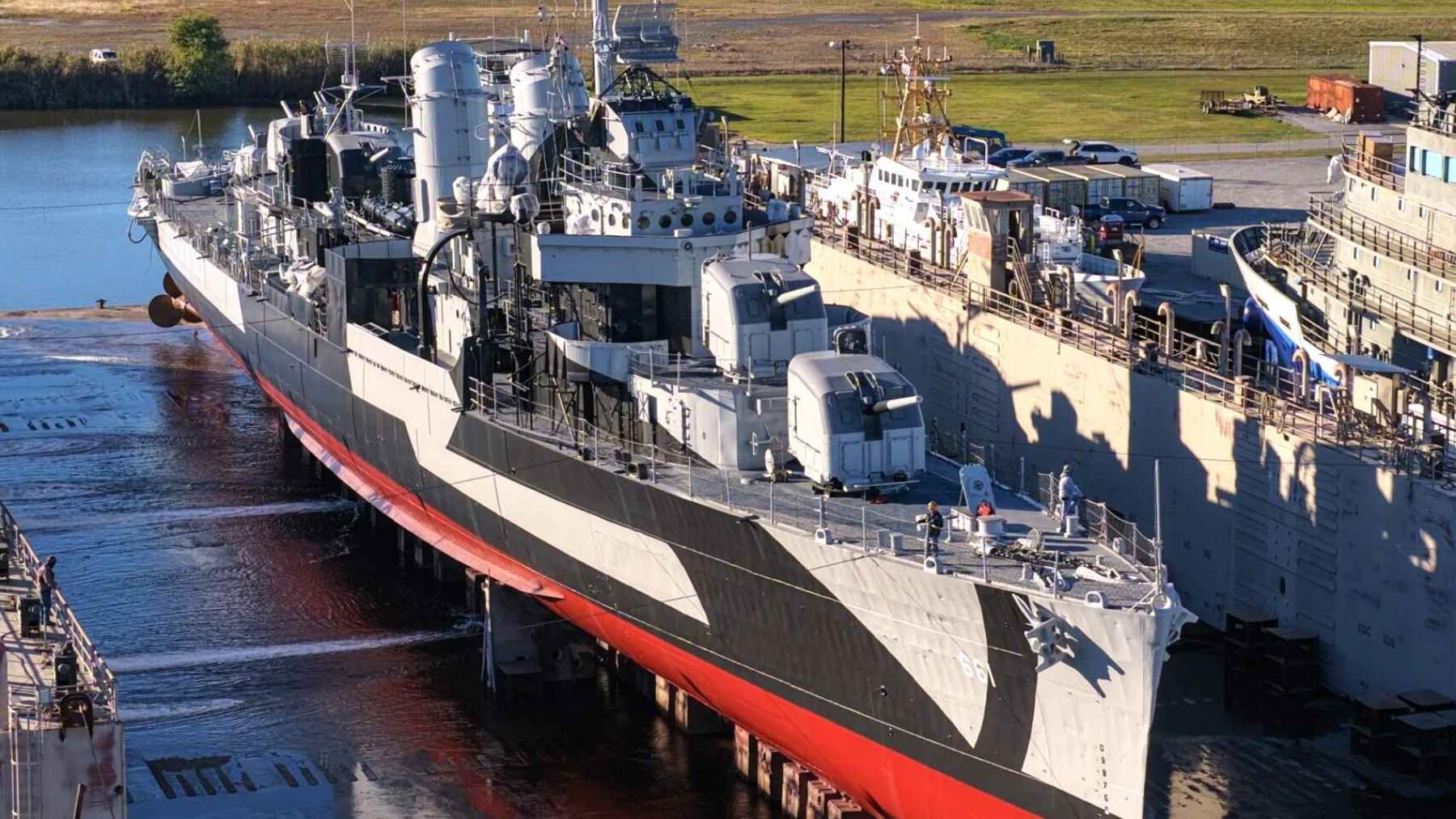

Baton Rouge had a welcome-home party penciled in for the USS Kidd on May 23, the Saturday of Memorial Day weekend. It got postponed, because the guest of honor had no way to get into her parking spot.
The Kidd is a World War II destroyer that spent more than 40 years as a museum on the downtown Baton Rouge riverfront. She left for an overhaul at a shipyard in Houma in the spring of 2024, came out of dry dock there on Veterans Day last year, and she’s been tied up at that yard ever since. The museum says she’s ready to go. The Mississippi just hasn’t cooperated.
“We are totally at the mercy of the Mississippi River right now,” Parks Stephenson, the museum’s executive director, told WBRZ in Baton Rouge back in July.
The magic number is 32 feet on the river gauge in Baton Rouge, and Stephenson told 225 magazine in August that next spring is the earliest the Kidd can come home. He isn’t putting a date on it, which is probably the only honest answer when your schedule depends on rain and snowmelt hundreds of miles upriver.
So how high is it now?
I checked the National Weather Service’s gauge for the Mississippi at Baton Rouge, and at 5 p.m. local time on Friday, October 9, it read 12.15 feet, nearly 20 feet short of the 32 the Kidd needs. That 12.15 is actually up from 5.96 feet on September 20.
If you’ve never looked at one of these gauges, the number’s basically a ruler reading. It’s how high the water sits against a fixed zero mark at that spot, and 32 is just a line farther up the same ruler.
That’s a pretty big ask. The weather service puts flood stage at Baton Rouge at 35 feet, so the Kidd’s 32 is just 3 feet under it.
She spends half the year out of the water
Most museum ships stay afloat at a dock all year, and even nudging one a few feet takes serious planning, as the battleship Wisconsin showed when tugboats pushed her four feet off her pier in Norfolk last month. You can’t really keep a destroyer at a regular pier in Baton Rouge, though, because the Mississippi there can rise and fall by as much as 40 feet over a year.
So the Kidd sits in a custom cradle at the river’s edge. When the water’s up, she floats in it, held in place by collars wrapped around clusters of big pilings that let her ride up and down without drifting off. When the water drops, she settles onto keel blocks and sits there high and dry with her whole hull showing. Stephenson has said no other museum ship anywhere splits its year like that. Basically, getting her back in means floating her over those blocks and between those collars, and 32 feet on the gauge is the minimum to do that safely, according to Les Nicholson, who chairs the state commission that owns the ship.
The last time the Kidd moved with the river falling, it didn’t go smoothly. Nicholson has said the river was dropping fast when she left in 2024, and her rudder got stuck on the way out. Underwater welders had to cut 4 feet off it to get her free, ship superintendent Tim NesSmith told The Advocate.
As it turns out, the cut helped. The Navy had enlarged the rudder in 1951 to tighten her turning circle, and losing 4 feet put it close to its 1945 size, so the museum decided to leave it that way. NesSmith also told the Waterways Journal, a river industry trade paper, that she should be easier to get back in than she was to get out, since the overhaul removed a sonar dome from her Cold War years that stuck out under her hull.
I’d bet no one involved is eager to test that theory with a foot or two less water than the plan calls for.
Why can’t she take a shortcut?
Houma and Baton Rouge aren’t that far apart by car. But the Kidd can’t use the Gulf Intracoastal Waterway, the sheltered canal that runs along the Louisiana coast, because she sits too deep in the water for it, Stephenson told WBRZ. That canal’s built for barges, with a channel 12 feet deep.
How deep is too deep? Draft is just how far a ship’s bottom sits below the waterline, and the Navy listed the Kidd’s at 17 feet 9 inches when she was a working warship. I can’t find a published number for how deep she sits today as a museum ship, but according to the museum, it’s still too much for that canal.
So she’s got to go the long way: down the Houma Navigation Canal, out into the Gulf, around to where the Mississippi empties into it, and then upriver to Baton Rouge. Stephenson puts the trip at roughly 360 miles and two days. He said the $16 million repair contract, which the state legislature largely paid for, covers the ride home too, and the museum has said a Baton Rouge salvage company will handle the actual parking.
For the record, she’s a Fletcher-class destroyer, 376 feet 6 inches long, 39 feet 8 inches wide and 2,050 tons, according to the Navy’s own history of the ship. She’s named for Rear Adm. Isaac Kidd, who died aboard the battleship Arizona at Pearl Harbor, and off Okinawa in April 1945, a Japanese plane crashed into her and killed 38 of her crew. She’s also one of four Fletchers left out of the 175 the Navy built.
The high water came while she was in dry dock
And this is where it gets pretty frustrating. The Mississippi did get high enough, just at the wrong time. The Baton Rouge gauge crested at 42.18 feet on April 30, 2025, according to the weather service, and the Kidd was sitting in a dry dock in Houma that day, with months of hull work still ahead of her.
This year, with the work done, the river topped out under 30 feet. You really can’t blame anyone for that, but it’s some pretty rotten timing. I haven’t seen anything from the museum about a plan B if next spring comes up short too.
The wait is costing money on both ends
The delay isn’t cheap for anyone. Each time the Kidd has to be shuffled around the shipyard’s harbor, it runs $20,000, Stephenson told 225 magazine, which reports the shipyard is covering the cost of the extended stay. The museum’s an independent nonprofit that lives mostly on what it makes from tickets and the gift shop, and it’s been without its main attraction for nearly two and a half years. Stephenson says admissions have dropped hard, and the state put up money to keep the doors open this year.
He also told the magazine about a family of about a dozen who’d gone out and bought closed-toe shoes, because the museum’s website tells visitors to wear them on the ship, and then walked in to find there wasn’t a ship. I’d hate to be the person at the ticket desk that day.
She’s not the only old ship with a housing problem this fall, either. In Baltimore, the nuclear-powered NS Savannah is running out of time to find a new home.
Baton Rouge has been getting ready for the Kidd anyway. Her cradle got restored while she was away, and the shipyard reinforced the spots on her hull that rest on its pads. WBRZ reported in July that local companies were pressure-washing the shoreside walkway and donating the paint to freshen it up, without charging the museum a dime.
She’ll look different when she gets there, too. The Kidd now wears a 1944 dazzle camouflage scheme, the kind of jagged pattern designed to confuse an enemy about which way a ship’s going and how big it is, and the museum plans to keep it for about five years.
So if you want to follow the Kidd’s homecoming yourself, bookmark the weather service’s Baton Rouge gauge, because the museum can’t give you a date until the river does. The Mississippi usually runs highest in March, April and May, the number to watch is 32, and at 5 p.m. on October 9, it read 12.15.