
Anyone who’s rolled epoxy onto a garage floor knows the stuff is weirdly fussy about the weather. Rust-Oleum’s instructions for its EpoxyShield kit, for one, tell you not to coat a floor that’s colder than 55 degrees, and to wait for a drier day if it’s humid.
So try doing that inside a steel pipe more than a mile long, on the side of a mountain range, through a Tasmanian winter. That’s more or less what Hydro Tasmania, the island state’s government-owned power company, has spent the last three months doing at Poatina, its second-largest power station. The company said in an October 6 release that the station was running again after one of the biggest planned outages it’s run in years, and that the first round of recoating work inside that pipe was done.
If the word penstock is new to you, it’s basically the big pipe that carries water from a lake or a tunnel down to a power plant’s turbines. The farther the water falls before it gets there, the harder it hits, and that’s why so many hydro plants run their penstocks straight down a hillside.
At Poatina, the water starts out in Yingina / Great Lake, up in Tasmania’s Central Highlands. A tunnel and then the steel penstock carry it down a steep mountain range called the Great Western Tiers. At the bottom, it reaches a power station built inside an artificial cavern 490 feet underground. Site manager Julian Quinn says the plant makes up around 10% of Tasmania’s total generating capacity.
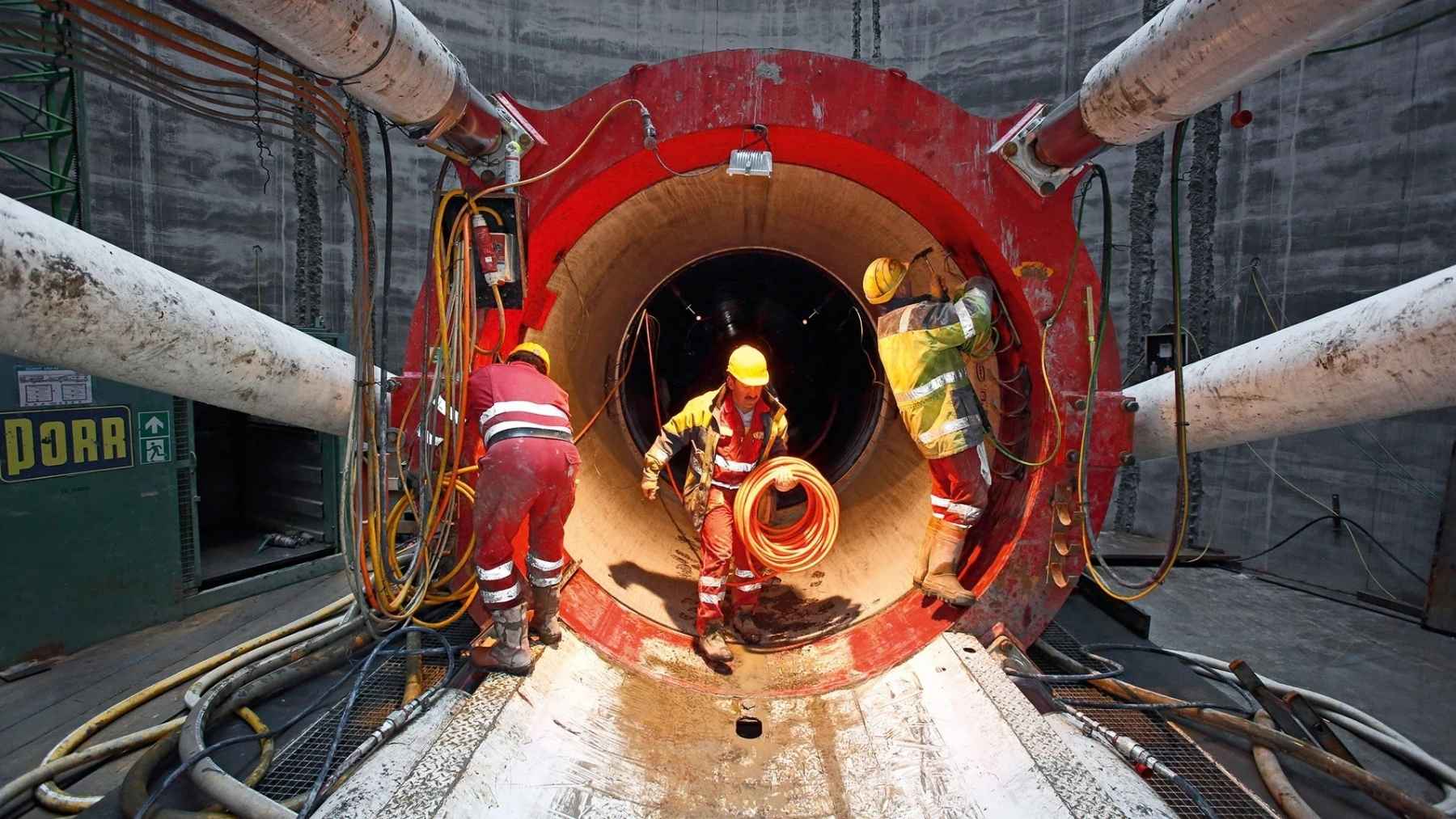
The penstock’s 5,900 feet long, according to Hydro Tasmania, but the company didn’t give its diameter in either of its updates. BlastOne, a blasting-equipment supplier that published a case study on work inside this same pipe, lists it at about 10 feet across, with a long stretch pitched at 32 to 38 degrees. That’s roughly the angle of a steep staircase, except this staircase is made of steel and it’s normally full of water.
A robot stripped the old coating
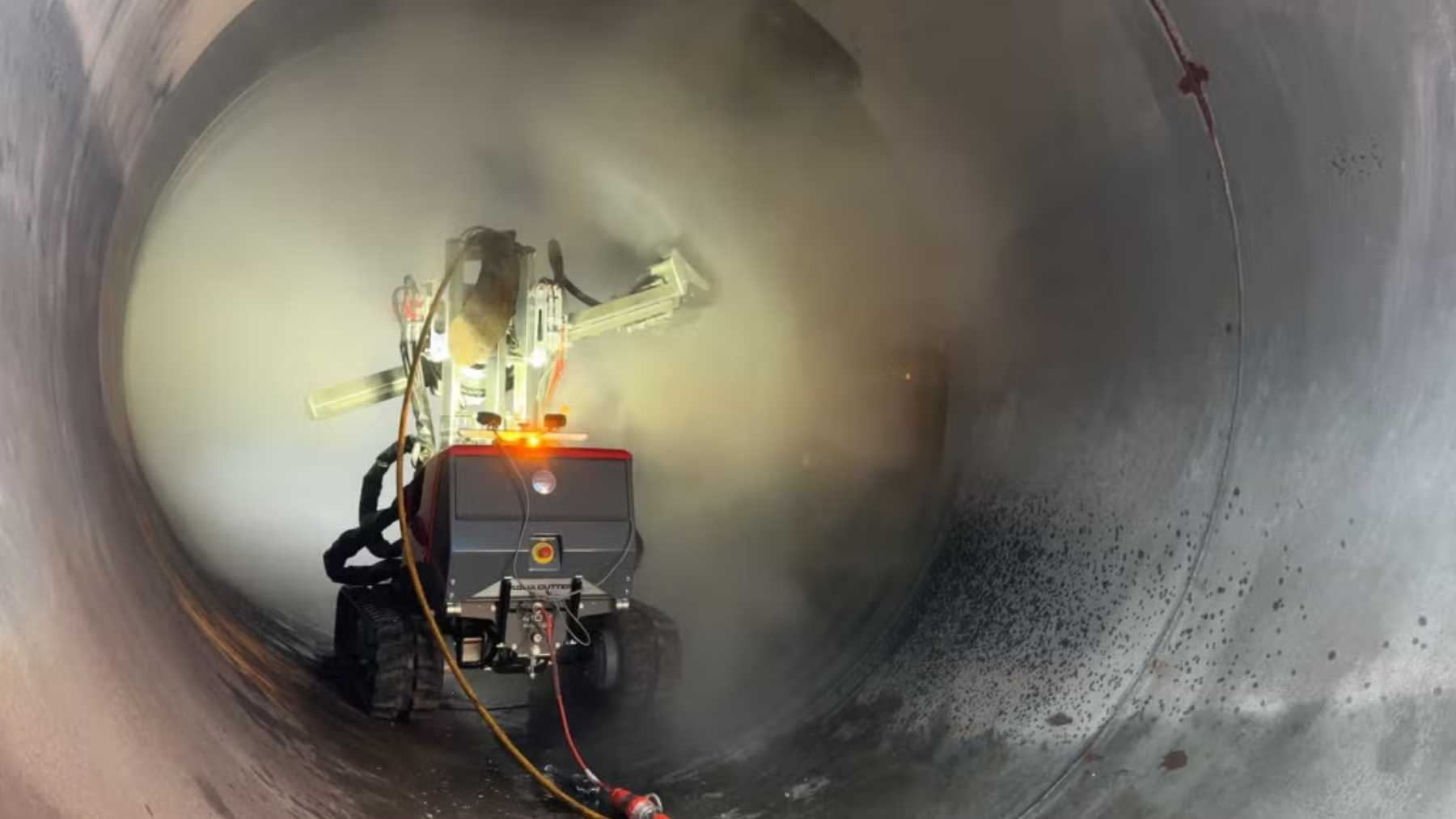
Before anyone could paint, the old coating had to come off the inside of the pipe. Parts of the job were hundreds of yards from the nearest way in or out, so Hydro Tasmania sent a robot in to do the stripping.
In Hydro Tasmania’s own write-up of the job, senior project manager Karlo Poslon describes it as an ultra-high-pressure water jetting robot. Think of a pressure washer turned up far past anything you’d ever point at your deck, to the point where the jet can peel a coating right off steel. Abrasive blasting then cleaned the steel up enough to take paint, according to Poslon.
Honestly, that’s a pretty sensible job to hand a robot. A steel tube on a steep slope, a long climb from the nearest exit, is about the last place you’d want a person holding a high-pressure lance all shift. Hydro Tasmania hasn’t named the robot’s maker or model, though, so I can’t tell you much more about the machine itself.
So why does a pipe need heaters?
Epoxy doesn’t dry the way house paint does. It hardens through a chemical reaction between two parts. Cold slows that reaction way down.
Poslon says the coating they’re using needs the steel kept above 50°F at a minimum, and the target’s somewhere between 68 and 77°F. That’s tough to manage in a steel pipe on a Tasmanian mountainside in winter, so heaters, dehumidifiers and ventilation ran inside the pipe around the clock. Even with all of that going, the new epoxy took several days to get properly hard.
Damp air’s the other problem. Freshly blasted steel can grow a thin film of rust surprisingly fast when the air’s humid, and keeping water off the metal is a big part of what the coating’s for. I’d argue the heaters are the more interesting half of this story, even if the robot gets the photo op.
The finished coating also got checked several times, and an outside coating inspector went over it too, with specialist tests aimed at defects small enough to let water get at the steel. Poslon says that by the time the job wraps up, the team’s “pretty confident that paint is going to hold up” between now and the pipe’s next overhaul. In utility-speak, pretty confident is about as close to a promise as you’re going to get. I’ll take it.
Figures: Hydro Tasmania.
Poatina was dry when Tungatinah burned
Poatina’s long shutdown landed at a pretty awkward moment. On the night of September 2, a fire gutted Tungatinah Power Station, a 142-megawatt hydro plant in the Central Highlands that had been supplying around 5% of Tasmania’s power. No one was hurt. The company said the power system stayed secure, and that it’d bring the gas-fired Tamar Valley Power Station back online to cover the lost output.
The pipe wasn’t the only thing on Poatina’s to-do list, either. The company’s partway through an A$200 million program to upgrade all six of the station’s turbines, and Quinn says this outage also covered major electrical upgrades, including swapping out electrical controls that had been in service for about six decades. One of the units got a new Pelton runner, which is the bucket-lined wheel the water jets slam into, plus new nozzles, and the utility expects to finish that unit in early 2027 while the rest of the station keeps running.
It’s been a busy stretch for Hydro Tasmania’s maintenance teams in general. Last month, we covered the 110-ton valve it shipped around Africa for Gordon Power Station, Tasmania’s biggest hydro plant.
There’s still 3,100 feet to go
This shutdown only covered part of the penstock. Stage one took in the valve area at the top of the hill, the upper end of the penstock and some of the pipe farther down, and the remaining 3,100 feet or so are lined up for the next shutdown. Hydro Tasmania hasn’t said exactly how many feet got their new coat this time around. Its October 6 announcement also skips the day the water went back in, saying only that the station’s running again.
So why not do the whole thing in one go?
Because people downstream need that water. With the penstock dry, the station’s shut down and nothing flows out of its tailrace into Brumbys Creek, so the company counted on winter runoff to keep the creek going at lower levels than usual. The utility says the whole recoating job adds up to about nine months of work, and it’s spreading that over two years to fit around irrigation seasons. Its notice to water users gave this year’s shutdown a window from July 13 to September 30, with a possible extension to October 9. Poatina was running again by October 6.
From the sound of it, the robot’s coming back for round two. Hydro Tasmania’s second shutdown, with the last 3,100 feet of penstock on the list, is due to kick off in April 2027.