
If you’ve ever had a nuclear stress test, or sat with a parent while a scanner followed a radioactive tracer through their bones, you’ve already met the output of a very strange machine. There’s a decent chance that tracer started life inside a block of beryllium roughly the size of a washing machine, drilled through with 79 channels, in a small Belgian town called Mol.
The block is the core of BR2, a research reactor the Belgian Nuclear Research Centre SCK CEN has kept in routine service since 1963. It stands 3 feet tall and 3.4 feet across, and according to a specification deck from SCK CEN’s own radioisotope project manager, it runs at up to 100 megawatts of thermal power. That’s 100 million watts of pure heat coming out of something you could hide behind a couch.
So what does a 100-megawatt machine that never sends a watt to the grid actually do?
Neutrons, mostly. When uranium atoms split, they throw off neutrons, and if you park the right material in that storm, its atoms soak up neutrons and turn radioactive. Those freshly radioactive atoms are the medical isotopes hospitals use to light up scans and treat certain cancers. BR2 is basically a very intense neutron oven, and almost everything about its design comes down to getting things in and out of that oven fast.
So why is the core so small?
Most reactors spread their fuel out. BR2 crams it together, and the trick behind that is frankly one of the more elegant pieces of early-1960s engineering I’ve run into. The 79 channels run through the beryllium block at a slant, twisted around one another so the whole bundle pinches together at the middle, the way a handful of straws does when you twist it. That pinch packs the fuel into a tight knot, and a tight knot of burning fuel throws off a ferociously concentrated neutron field.
The beryllium earns its keep too. It’s a good neutron reflector, which in plain terms means it bounces escaping neutrons back into the fuel instead of letting them leak away and go to waste.
How concentrated does it get? Per PRISMAP, the European medical radionuclide network BR2 anchors, the flux inside the vessel reaches 1015 neutrons per square centimeter per second. That’s a quadrillion neutrons crossing an area about the size of your thumbnail. Every second.
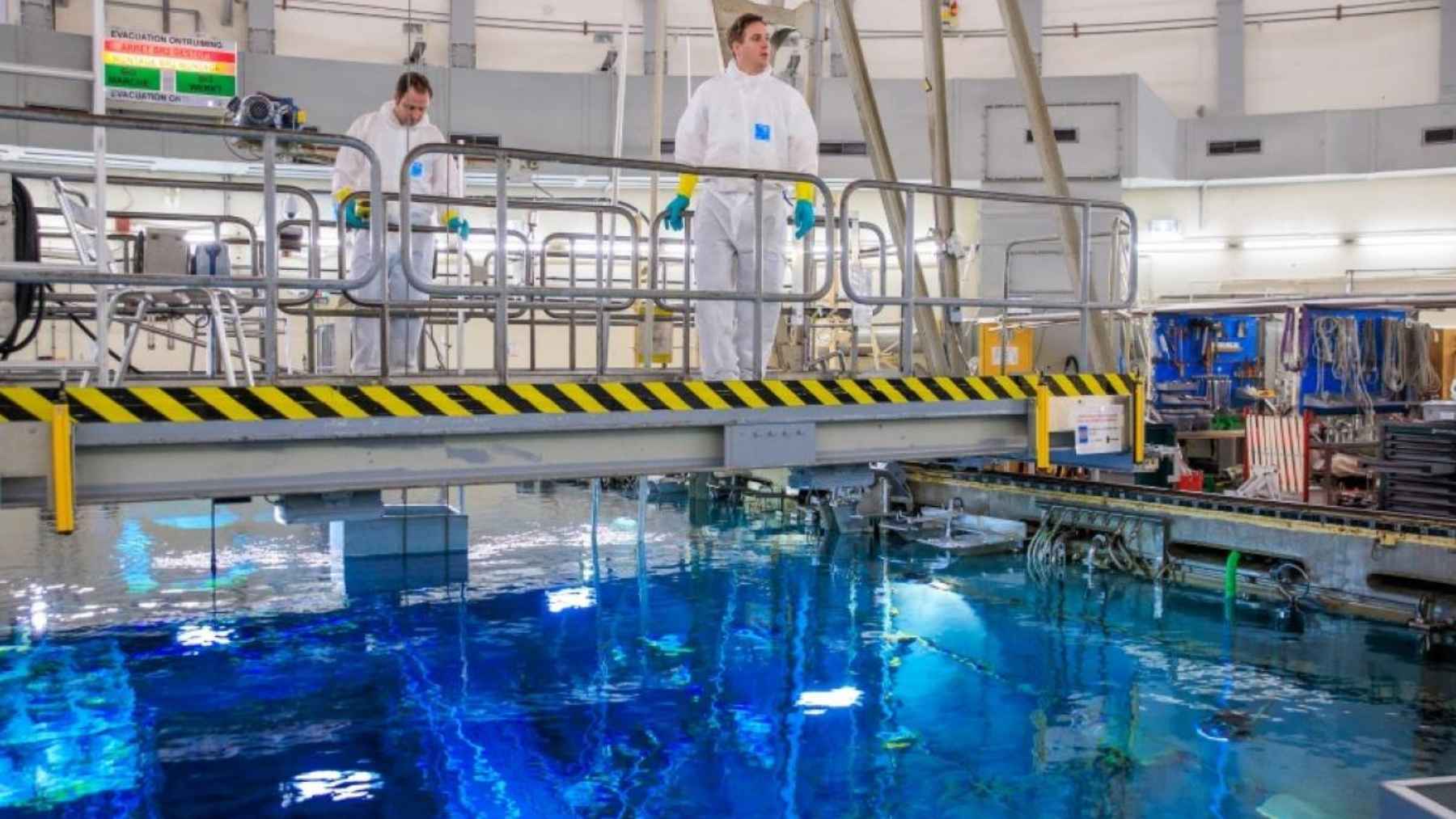
The vessel wrapped around the core is aluminum, 28 feet tall, and shaped like an hourglass, wider at both ends than at the waist. It sits at the bottom of a pool with more than 23 feet of water above the lid whenever the reactor’s running, and that water pulls double duty as radiation shield and coolant. BR2 pushes about 1.7 million gallons of it through the vessel every hour, top to bottom, at roughly 180 psi. Call it five times your tire pressure.
The targets go in and out while it’s running
BR2 also does something most power reactors flatly can’t: it takes deliveries during operation. Targets, which in this business just means capsules of the material you want to irradiate, ride in and out of channels holding a flux of up to 4×10¹⁴ neutrons per square centimeter per second while the reactor keeps running, per PRISMAP. Which means you don’t cook a target one minute longer, or shorter, than its recipe calls for. The deeper, hotter positions at 1015 stay locked in for a full cycle of three to four weeks.
Why does mid-run access matter so much?
Because the main product spoils. Molybdenum-99, the parent isotope of technetium-99m, the workhorse tracer of nuclear medicine, loses half its radioactivity every 66 hours. You can’t stockpile the stuff. It has to be made, pulled, processed and flown out on a schedule tighter than fresh fish, and a reactor that had to shut down every time a batch came due would wreck that schedule. So BR2 hands its batches up through the lid instead: SCK CEN’s own description of the reactor lists 79 plugged openings in the stainless steel top lid, one per channel, so a target can climb through more than 23 feet of shielding water without anyone going near the core. Which strikes me as a pretty slick way to run a delivery business out of an operating reactor.
Loading things into a compact core is delicate work even when the reactor’s off, by the way. An American crew got a reminder of that this month when a 12-foot fuel bundle tipped over inside the Palisades core in Michigan.
The uranium is the next thing to change
The fuel that goes down those channels is uranium enriched to 90 to 93% U-235, per SCK CEN, supplied by the United States. That’s the highly enriched kind, and nonproliferation officials have spent decades trying to get it out of civilian reactors, for the fairly obvious reason SCK CEN itself gives: the same material can end up in nuclear weapons.
The switch is moving, but it isn’t done. On April 27, 2026, SCK CEN submitted a safety dossier to Belgium’s nuclear regulator, the FANC, asking for clearance to run BR2 on a high-density uranium silicide fuel made with high-assay low-enriched uranium. If the agency signs off, the plan calls for the first low-enriched elements to enter the core in 2027, with a gradual conversion from there, and SCK CEN says BR2 would become the first high-performance research reactor in the world converted to that class of fuel. As far as I can find, the FANC hasn’t said when it’ll rule.
The rest of the machine gets renewed piece by piece. The beryllium block itself has been swapped out three times, in 1980, 1996 and 2016, so the 3-foot core hospitals lean on today is arguably the fourth of its name. For a sense of how compact this whole class of machine runs, the 20-foot steel canister American crews just lowered down a Florida borehole was built to hold an entire microreactor, and it’s still shorter than BR2’s vessel.
The little core keeps its schedule either way. SCK CEN says BR2’s isotope production reached 13 million patients in 2025, a record, per a February 20, 2026 announcement. For a machine that’s been running since 1963 around a 3-foot lump of drilled metal, that’s a pretty decent run rate.