
- 4 MONTHS AGO · ENERGYA 165-ton nuclear cask that fits in a two-car garage but weighs as much as two Abrams tanks just got a British ship rebuilt around it, holds re-machined to the millimeter, to haul Japanese reactor fuel across the planet to France
- 3 MONTHS AGO · ENERGYSingapore bolted 13,312 solar panels and more than 30,000 floats into the Straits of Johor after a 2020 wave-tank test that named barnacles out loud, and five years on the array still carries its original rating while nobody has published what the crustaceans cost across a 25-year life
- 2 MONTHS AGO · ENERGYA 42-foot nuclear pressure tank weighing 93 tons opens through a single 16-inch hatch, so when 30 heaters melted inside it and dripped copper onto the floor, the Swedish crew built a full-size copy to practice on, dropped tools down 39 feet on poles and sent a robot in to vacuum
- 2 MONTHS AGO · ENERGYA 427-foot ship built to haul carbon dioxide as a liquid at 31 below zero docks twice a week at Europe’s largest fertilizer plant, loads almost 2 million gallons from its seven tanks, and sails it to Norway to be pumped 8,530 feet under the North Sea
- TODAY · THIS ARTICLEA 19,000-ton Russian nuclear power plant with no engine now has both of its 58-megawatt reactors built, and tugboats will haul it to a copper mine across the Bering Strait from Alaska, where reactor heat piped into its ballast tanks will keep the sea ice off its hull
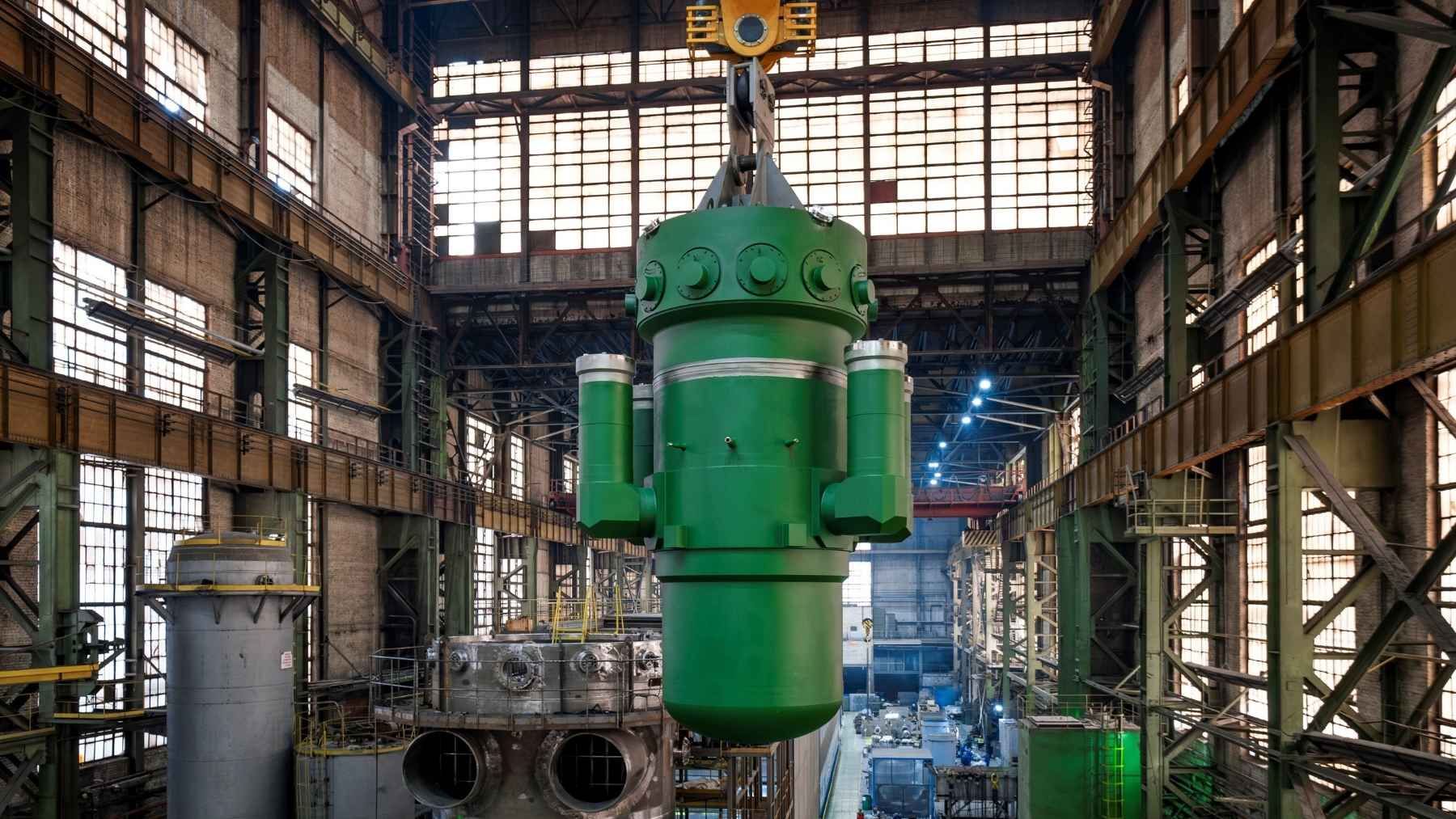
Small modular reactors are the concept cars of the energy business. Everybody’s got a design, everybody’s got a glossy rendering, and very few of them exist as metal you could walk up and put a hand on. So when Rosatom announced in late September that its reactor factory outside Moscow had finished the second RITM-200S for its new floating nuclear plant, I paid attention. Both reactors for the lead barge now physically exist.
The factory is ZiO-Podolsk, the Rosatom plant south of Moscow that builds these units, and it says the new reactor passed its hydraulic tests and a trial assembly before getting signed off. Basically, the vessel gets pumped full of pressurized water to prove the welds hold, then the whole reactor gets bolted together once on the factory floor to prove every component fits the drawings. Then it’s taken apart and shipped.
Its twin was finished back in May, and that one has already crossed the country by rail to the Baltic Shipyard in St. Petersburg, where it’s waiting to be lowered into a hull.
That hull is PEB-106, and it’s a strange machine by any standard: a 459-foot barge, 98 feet across, displacing about 19,000 tons with everything aboard, and no engine of its own. The two reactors each generate 58 megawatts of electricity, which gets you a 106-megawatt power plant that has to be towed to work.
So who’s buying a nuclear power plant that shows up behind a tugboat?
The customer is a copper mine
PEB-106 is the lead unit in a series of four identical barges Rosatom is building for the Baimskaya project in Chukotka, the Russian region that sits across the Bering Strait from Alaska. Baimskaya is one of the biggest untapped copper deposits on the planet, and it’s in territory with brutal winters and no grid to plug into. Developing it takes somewhere around 300 megawatts of steady power, so the plan calls for three barges working and a fourth tied up as a spare, covering whichever unit is shut down for its five-year refueling.
If floating nuclear sounds like science fiction to you, Russia’s been doing it commercially for years. The Akademik Lomonosov, which we covered back when the first of these new reactors left the factory, has fed a small Arctic grid since 2020 with two older 35-megawatt reactors, 70 megawatts in all. Each new barge pushes 106 megawatts. Same idea, half again the output, and this time there are four of them.
These reactors started out pushing ships through ice
The RITM-200 family wasn’t designed for mining camps at all. It was built to power Russia’s newest icebreakers, and eight units are doing exactly that right now aboard the Arktika, Ural, Sibir, and Yakutia. Sixteen have been built so far. The production line is apparently humming along too: “in less than a year, four RITM-family units have already been manufactured,” ZiO-Podolsk director Anton Lebedev said in the announcement picked up by World Nuclear News, with five more in production behind them.
The S version is the same reactor tuned for a completely different life. An icebreaker reactor gets worked hard and unevenly, surging to full power while the ship rams pack ice and backing way off when it doesn’t need the shove. A mine wants the opposite, flat output around the clock, so the RITM-200S runs steady and a little hotter, at 198 thermal megawatts against the icebreaker unit’s 175, per Nuclear Engineering International. Thermal megawatts measure the heat the core puts out; the electrical number is what’s left once the steam turbines take their cut.
How do you park one of these in the Arctic?
This is frankly the best engineering in the whole program. The barges will be moored at Cape Nagloynyn, where the sea freezes solid in winter and Arctic tides keep moving the water level under the hull. Drop a regular anchor there and the ice will either snap the chain or shove the whole plant off its spot.
Rosatom’s fix is weirder than that. NEI reports each barge gets locked to heavy steel columns by hinged mechanical arms, so the hull can ride up and down with the tide but can’t drift sideways. That matters because 50 high-voltage cables run from the barge to the shore grid, and a cable that keeps stretching eventually fails. A breakwater of rock and concrete goes up around the berth to turn drifting ice floes away, and for the ice that forms right against the plating, the plant fights back: pipes on the seabed release compressed air, the rising bubbles pull warmer bottom water up toward the surface, and reactor waste heat gets routed into the ballast tanks so ice can’t bond to the steel. It’s a nuclear plant with heated seats, more or less.
One detail jumped out at me. The hulls for the first barges weren’t welded in Russia; NEI notes they were built at a shipyard in China and towed to St. Petersburg because Russia’s own yards are booked solid. And nobody’s said publicly when that first reactor actually gets lowered into the hull.
Floating nuclear is suddenly a crowded field on paper. South Korea’s shipbuilders are working on a reactor ship of their own, and pretty much everyone else is still at the rendering stage. Russia, meanwhile, has one plant running and both reactors for the next one sitting finished. Rosatom’s current schedule puts the first Baimskaya barge on station and delivering power in 2028, units two and three out there by 2030, and the reserve barge that completes the set of four in 2031.
 A reactor built from 664 two-inch uranium cubes hung on wires in heavy water under a German castle was Heisenberg’s last shot at a chain reaction, and two of the surviving cubes now show it needed about twice the uranium and heavy water it held, more of both than Nazi Germany hadEnergy · 5 days ago
 A 66-foot-deep gravel pit in Finland just started taking in about 100 million gallons of tap water, and once a nine-acre lid goes on top, it’s meant to hold enough summer heat at up to 194°F to cover as much as nearly a quarter of the town’s yearly heat demandEnergy · 5 days ago
 A 375,000-pound turbine now spins inside a Tennessee dam in place of one that ran for more than 80 years, and a federal watchdog just found that 196 of the 240 welds on the ring guiding water out of it failed on a job where some welders weren’t qualifiedEnergy · 5 days ago