
If you’ve ever worked your way through a dozen oysters at a raw bar, you’ve probably noticed they don’t all look alike. Some come out deep and round with a thick shell. Others are flat and thin, with edges that flake off the second a knife gets near them.
A lot of that comes down to tumbling. A farmer rolls the oysters around every so often, which chips the fragile new growth off the edge of the shell so the oyster builds a thicker, denser one instead. Farmers also have to keep their gear clean, because algae and barnacles grow over the mesh and block the water the oysters feed from. On plenty of farms, both of those jobs still get done by hand, and they’re hard on your body.
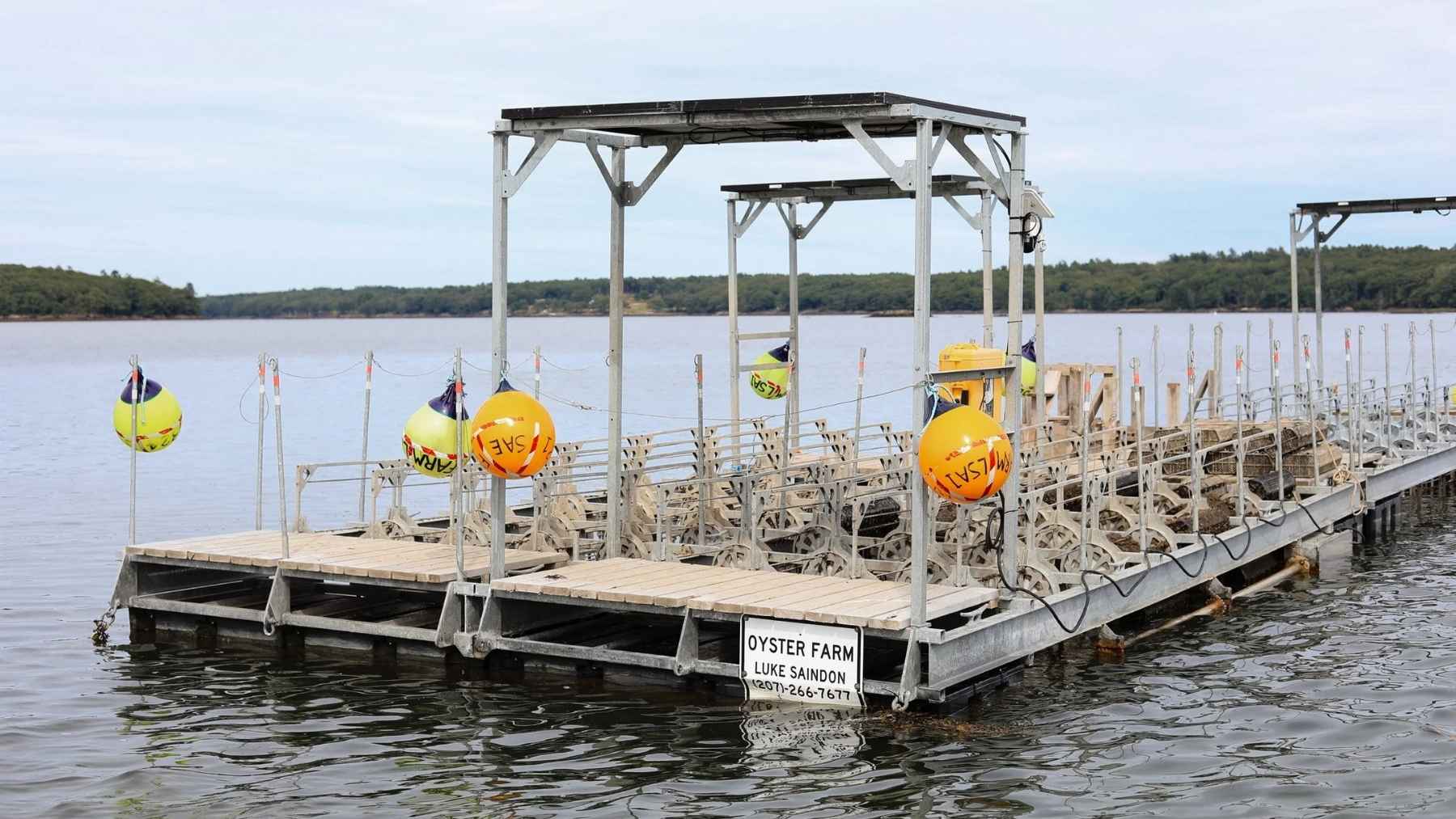
So a small farm near Wiscasset, Maine, built a raft that hands both jobs to the sun. It’s called 3D-COAST, short for 3-Dimensional Cultivation of Oysters Automated with Solar Tumbling, which is a pretty strong sign someone picked the acronym first. The World Is Your Oyster, the company behind it, grows oysters in Maine and runs a catering business in Brooklyn. Its farm director, Luke Saindon, has written up a full season on the rafts for the USDA-funded Sustainable Agriculture Research and Education program, or SARE.
I went through that SARE final report, and it’s a surprisingly candid read. Saindon is a licensed professional engineer who’s done prototype development for the Navy, NASA and the Air Force, and it shows. A good chunk of the report reads like a list of things that broke.
So how does a raft turn oysters with sunlight?
Think of a long bicycle chain hanging off a sprocket and down into the water, with a column of oyster baskets clipped to rungs along the loop. Each raft carries 24 of those loops, which the report calls solar rotators. As the drive wheel turns, the baskets ride down through the water, come back up, and hang in the open air at the top before they go back under.
The whole drive runs off two solar panels. According to the report, turning all the baskets on one raft takes about 100 watts on average, or about what an old 100-watt incandescent bulb pulled. Frankly, I’d have expected a bigger number for a raft full of shellfish, although a loop that sends baskets down one side while it brings others up the other probably helps a lot.
The sprockets turn at roughly one revolution an hour, and each basket’s supposed to get two to three hours above the surface every time it comes around.
So how often does a basket make the full trip?
That depends on which page you’re reading. The main text of the report and the farm’s own website both say every six hours, while the report’s introduction and one of its figure captions say three times a day. I’d call it three or four trips a day and leave it there.
Why haul them into the air at all? Barnacles, algae and the rest of the gunk that grows on oyster gear need to stay wet, and a couple of hours in the sun and breeze dries them out and kills them. You may be wondering whether the oysters mind. They mostly don’t. An oyster can clamp its shell shut and ride out a few hours in the air, and wild ones do it every low tide.
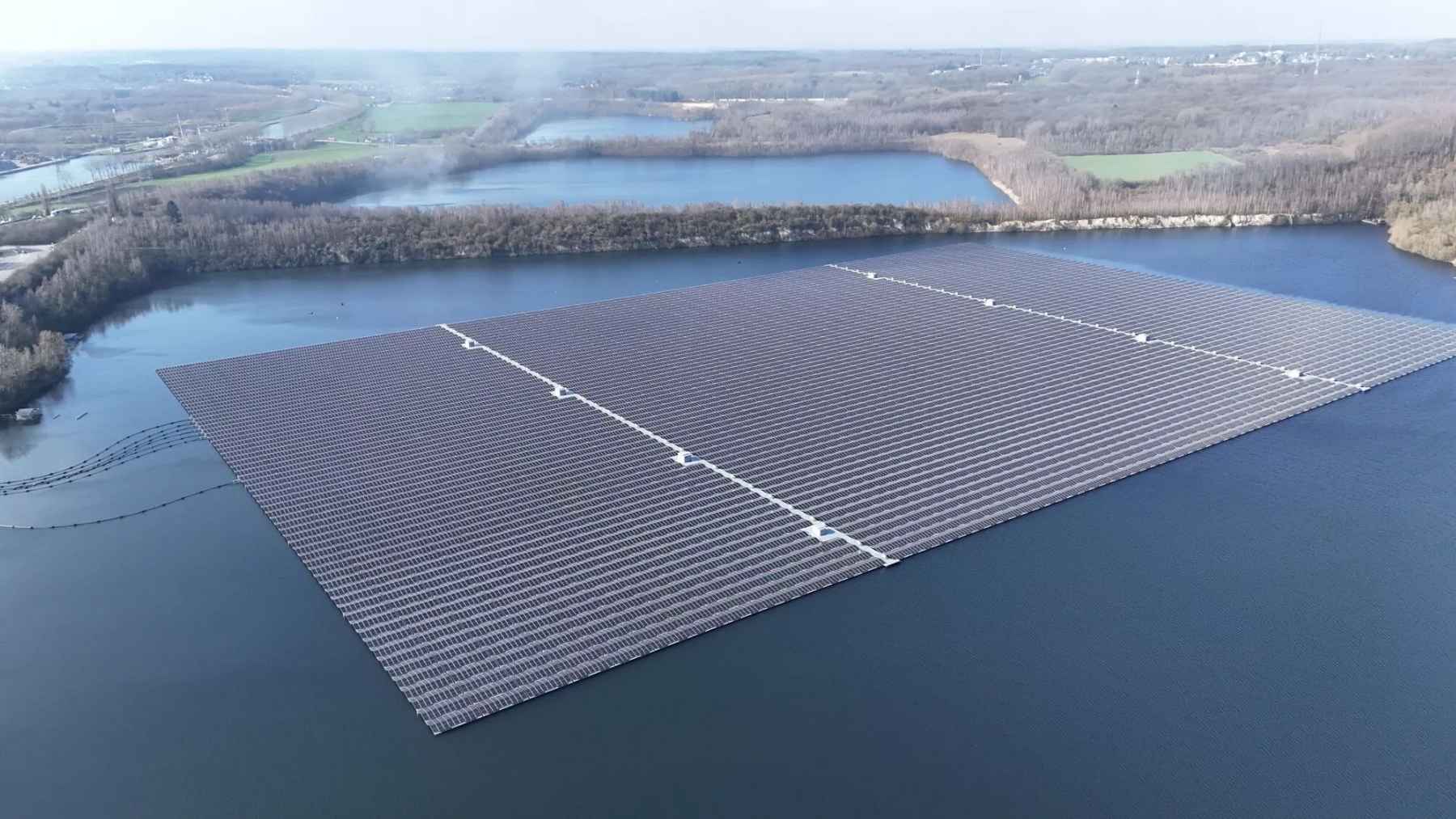
We’ve covered solar on aquaculture before, like the Norwegian salmon farm that ringed its pens with floating solar to sideline a diesel generator, and the Dutch floating solar farm with shell-filled cages hung underneath it. In both cases the panels were there to make electricity. On this raft, the sun’s doing a farmhand’s job.
The older rafts were a bit of a mess
Earlier versions of the raft linked every rotator to the gearbox with a steel cable running over pulleys, kept tight by hydraulic tensioners. That cable kept tangling and slipping, which isn’t ideal on a machine you can’t easily work on once it’s in the water. The team swapped it for a #60 stainless steel roller chain, which is basically a heavy-duty cousin of the chain on your bike, and got rid of the hydraulics entirely.
The gearbox had its own problems. A 1-inch output shaft fractured its coupling under the torque going into the main driveshaft, so the new design uses a 2-inch shaft and a sturdier bearing. The report says that fixed the problem permanently, which is a bold word to use about anything that lives in saltwater.
My favorite fix is the smallest one. The baskets hang on stainless steel snap hooks, and on the older setup those hooks sat on the same side of each basket as its door latch, so things kept snagging. Moving the hooks to the other side more than halved the raft’s breakdown rate. I’d argue that’s the most useful thing in the whole report, because you only learn it by standing on the raft.
Add it all up and the report says breakdown rates were 10 to 20 times lower than on the old setup. By the end of the test season, about 1% of the raft’s capacity needed attention on a given day. That works out to roughly one of the 48 rotators on the two working rafts every other day, at about 20 minutes a repair.
Saltwater still gets a vote
Not everything went to plan. A lot of the raft’s frame is hot-dipped galvanized steel, and over time more and more stainless parts got added, often underwater right next to it. If you’ve never run into galvanic corrosion, it’s pretty simple. Put two different metals in saltwater together and you’ve built a weak battery, and the more reactive metal slowly gets eaten.
Somewhere along the way, the amount of stainless reached a tipping point, and the galvanized gearbox cases started corroding badly. New gearboxes with stainless cases are part of the plan, and they’ll cost a bit more. The frame above the waterline is staying galvanized, since it’s held up well across two years in service.
Then there’s loading and unloading. In the current design, someone’s got to clip every basket on by hand while turning the rotator through its cycle manually, standing on narrow beams over the water. The report admits that’s slow, tricky for anyone new to the machine and a slip hazard. The team wants to try a gantry crane that hoists a whole rotator clear of the water and carries it across to the deck where the crew works, although the extra weight means the floats would need an upgrade to keep the raft stable. That’s arguably the bigger job, since skipping the barnacle scraping won’t count for much if a crew member goes into cold Maine water off a wet beam.
So will one raft actually grow 125,000 oysters a year?
That’s the plan on paper. The report projects that a pair of rafts can turn out 250,000 oysters a year on 400 square feet of water, which is the smallest lease type Maine offers and about the floor space of a two-car garage. For comparison, it cites a Maine Aquaculture Association benchmark that puts established suspended surface farms in the state at up to 144,000 oysters per acre, against 10 million to 20 million per acre for 3D-COAST.
But those are projections from a production model the farm built with its own growth and labor measurements, and you can download it for free from the farm’s 3D-COAST page. The whole farm harvested 72,000 oysters in 2025, against that 250,000 projection for a pair of rafts, though the freshly upgraded raft only got its seed that July. So I wouldn’t read much into the gap yet, in either direction.
What you can’t do yet is buy one. As of the report, the company hadn’t sold a raft to another farm, and it says selling them depends partly on a second-phase USDA small business grant it’s applied for. I couldn’t find any public record that the money’s come through yet.
The report puts the gantry crane and the stainless gearboxes on the farm’s 2026 to-do list, and SARE has the project’s projected end date down as March 31, 2027.