
Grand Coulee Dam is the largest power plant in the United States, an interesting headline on its own. Water falls, turbines spin, electricity comes out, and everyone’s happy.
But tucked against the west bank of the reservoir, right beside all that generating, sits a building whose main job is the exact opposite: it spends most of its energy pushing water uphill. And most of the building itself? You can’t see it. It’s underwater. The headline isn’t the whole story.
This building is called the John W. Keys III Pump-Generating Plant, named for a former Reclamation commissioner who died in a 2008 plane crash. It’s been quietly working since 1951. The Bureau of Reclamation runs it, with 12 enormous pumps operating inside it.
And six of them have a second career: they can run backward and serve as generators.
So why does a dam need pumps?
Because the farmland is upstairs.
Congress authorized Grand Coulee back in 1935, mostly to irrigate central Washington. But there’s a catch: the land that needed the water sits on a plateau well above the river.
World War II flipped the dam’s priorities to power production for a while, and Congress didn’t get around to authorizing the irrigation half until 1943. Once it did, the geography problem remained: water has to be lifted 280 feet out of Lake Roosevelt, the reservoir behind the dam, before gravity can take over and carry it anywhere useful.
That’s what this plant is for, and honestly, it’s my favorite kind of mid-century overkill. Each of the six original pumps is rated at 65,000 horsepower, and Reclamation’s brochure puts each one’s capacity at 1,600 cubic feet per second. The car with the most horsepower right now is the Yangwang U9 Xtreme, which has 2,978 horsepower. So… Yeah, that’s a lotta horsepower.
The water rides up the hillside through steel pipes 12 feet in diameter, spills into a 1.6-mile feeder canal, and lands in Banks Lake, a reservoir Reclamation created by damming 27 miles of an ancient dry riverbed called the Grand Coulee. From there, it fans out across the Columbia Basin Project. The first irrigation water went out in the spring of 1952 to about 66,000 acres.
Today, the project waters roughly 670,000 acres growing more than 60 different crops, with around 2.5 million acre-feet moving through Banks Lake in an average year.
That’s the day job.
Six of the pumps work both ways
The night job came later. In the early 1960s, the Northwest was staring at power shortages, and Reclamation’s studies showed the site was nearly perfect for something called pumped storage.
The idea is basically a giant battery made of water. You pump uphill to Banks Lake when electricity is cheap, usually overnight. When demand spikes, you let the same water fall back down through the same machines, which now spin as generators. Nothing’s consumed except the price difference.
So the last six units went in as reversibles. Each one draws 67,500 horsepower when pumping, and together the six can generate 314 megawatts when the water runs the other way.
The first pump-generators came online in 1973. I noticed in Reclamation’s own documents, there’s a disagreement about when the last ones arrived. The agency’s 2021 brochure says the final unit went in during January 1984, while its 2012 environmental assessment says the last two showed up in 1994. Pick your favorite federal paperwork!
Either way, the full dozen adds up to a machine room with few equals. With everything pumping, per that same assessment, the plant can withdraw around 22,000 cubic feet per second from Lake Roosevelt. Running in reverse, it’ll send about 14,000 cubic feet per second back through the generators.
Reclamation does most of its pumping at night and on weekends, when power is cheap. Then it generates on weekday peaks, when it isn’t.
The pipes shook so hard they had to shave the pumps
My favorite detail in this whole story comes from a 1964 Reclamation hydraulics report. When the original pumps first started up, the exposed sections of those 12-foot discharge pipes began vibrating, and not politely. Engineers measured the pipe shell flexing nearly half an inch, at a steady 23 and a third cycles per second. This is a frequency they traced straight back to the blades inside the pumps.
The fix took a lot of physical labor. Crews cut 12 inches off the leading edges of each pump’s five diffuser vanes, shaved three-quarters of an inch off its seven impeller vanes, and welded stiffening ribs around the pipes roughly every 11 feet. The original supports had sat 55 feet apart.
But the shaking stopped after this. The report notes the lines then delivered years of service without further distress. Sometimes the answer really is to grind bits off the machine and add more steel, which sounds more brutish than scientific.
Most of the building is underwater
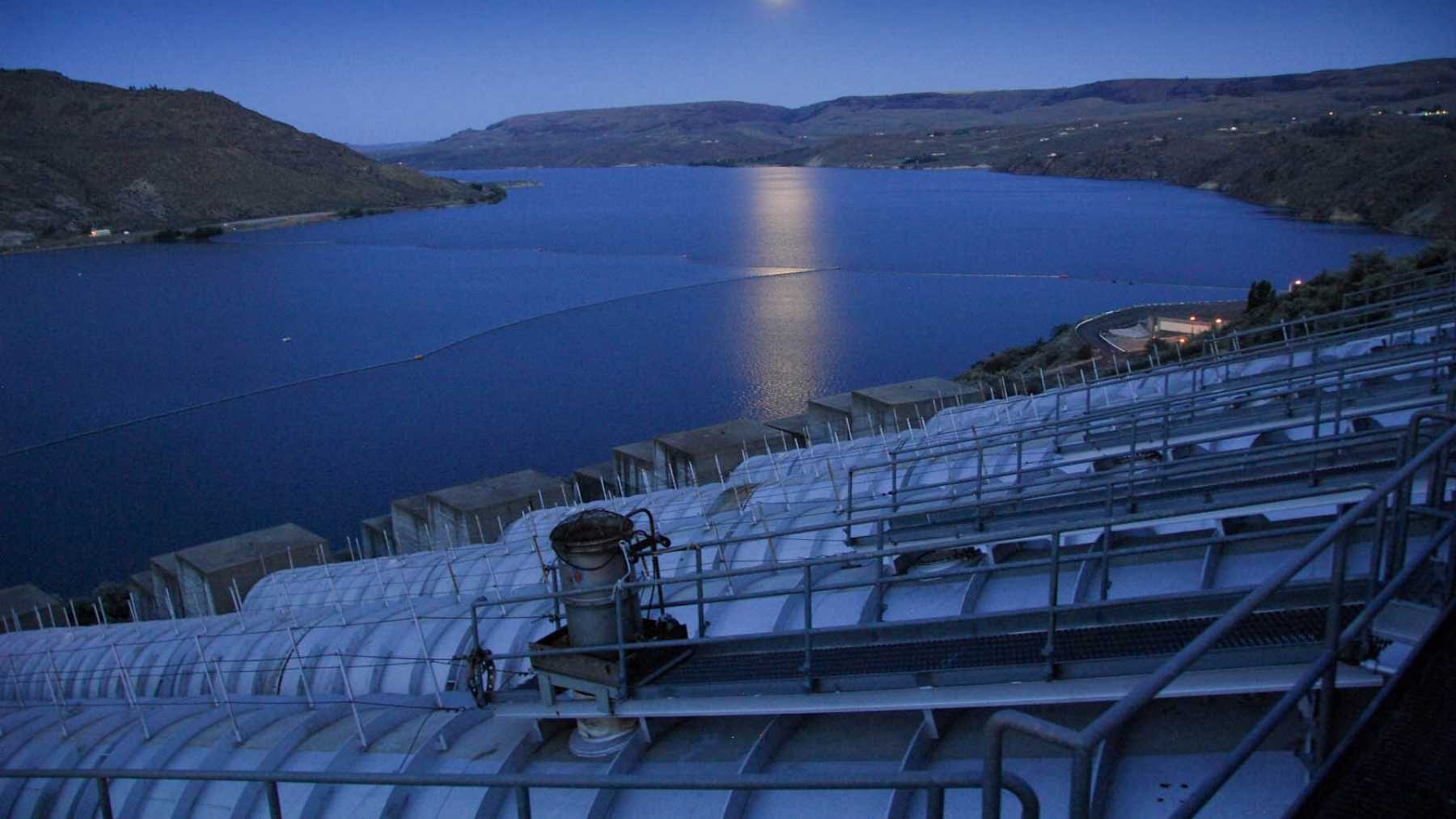
Now, about that building. Photos of the plant show a long, low structure at the water’s edge with a yellow crane on top, and it doesn’t look like much for something holding 12 units of this size.
That’s because you’re only seeing the attic.
A photo caption in Reclamation’s 2012 assessment states it plainly: the building is mostly submerged under Lake Roosevelt, out of view. The working floors run down below the surface of the very reservoir the plant pumps from, which is a surprisingly elegant way to hide one of the biggest pump rooms in the country.
Reclamation is now shopping for new electronics
None of this hardware is young, and Reclamation isn’t pretending otherwise. The Bonneville Power Administration, which leans on the plant to balance the regional grid, says in its project synopsis that much of the equipment is original.
If you’re an antique collector like me, that sounds cool. But it’s well past its expected service life, at risk of failure, and in many cases, obsolete.
Reclamation laid out a full modernization plan in 2012 with the goal of restoring the machines for another 30 years of reliable operation, on a schedule it estimated at 10 to 15 years, arranged so that the work would never interrupt irrigation deliveries.
The current phase of that plan is electronic. Reclamation has an open federal contract listing for replacing the plant’s excitation systems, governors, and protective relays and modernizing the unit controls, which basically means swapping the analog-era brains that tell each unit when and how to run for digital ones.
I couldn’t find a published completion date for the overall program. For a federal overhaul estimated to take 10 to 15 years, is about what you’d expect. After reporting on this kinda stuff for a few months, you start to really notice that everything gets delayed. Every time.
We’ve covered this trick before, from the six-turbine cavern Australia is digging into a mountain to the Colorado dam that just got permission to nearly triple its reservoir, and pumped storage keeps coming back for one reason: batteries this size don’t wear out, they just need paint and paperwork. This one has been at it for over 70 years.
You can also walk through it yourself. Reclamation runs public tours of the John W. Keys III plant every Friday, Saturday, and Sunday, first-come, first-served, through October 31st, 2026.