
You’ve heard every version of the battery argument that exists at street level. Range, charging times, what the grid can handle, whether the truck weighs too much. I’ve written my fair share of those stories myself. But there’s one place where that argument’s been over for years, and it’s a mile and a half straight down, under a nickel mine in Ontario most Americans have never heard of.
On August 27, Ontario Premier Doug Ford stood at Glencore’s Craig Mine northwest of Sudbury to mark two milestones at the Onaping Depth Project: the new mine shaft’s finished, and the ore body’s reachable for the first time. Glencore says the first mining areas, the stopes, are already prepared, first ore is expected before the end of 2026, and the whole project wraps up in 2027.
Onaping Depth’s a high-grade nickel and copper deposit sitting nearly 2,600 meters below surface, call it 8,530 feet, or about a mile and a half. It’s the deepest Glencore has ever dug in Sudbury and the first new mine developed in the basin in more than a decade. And when it ramps up, everything that drills, hauls, bolts and mixes down there will run on batteries.
So how do you sink a mine shaft from the bottom?
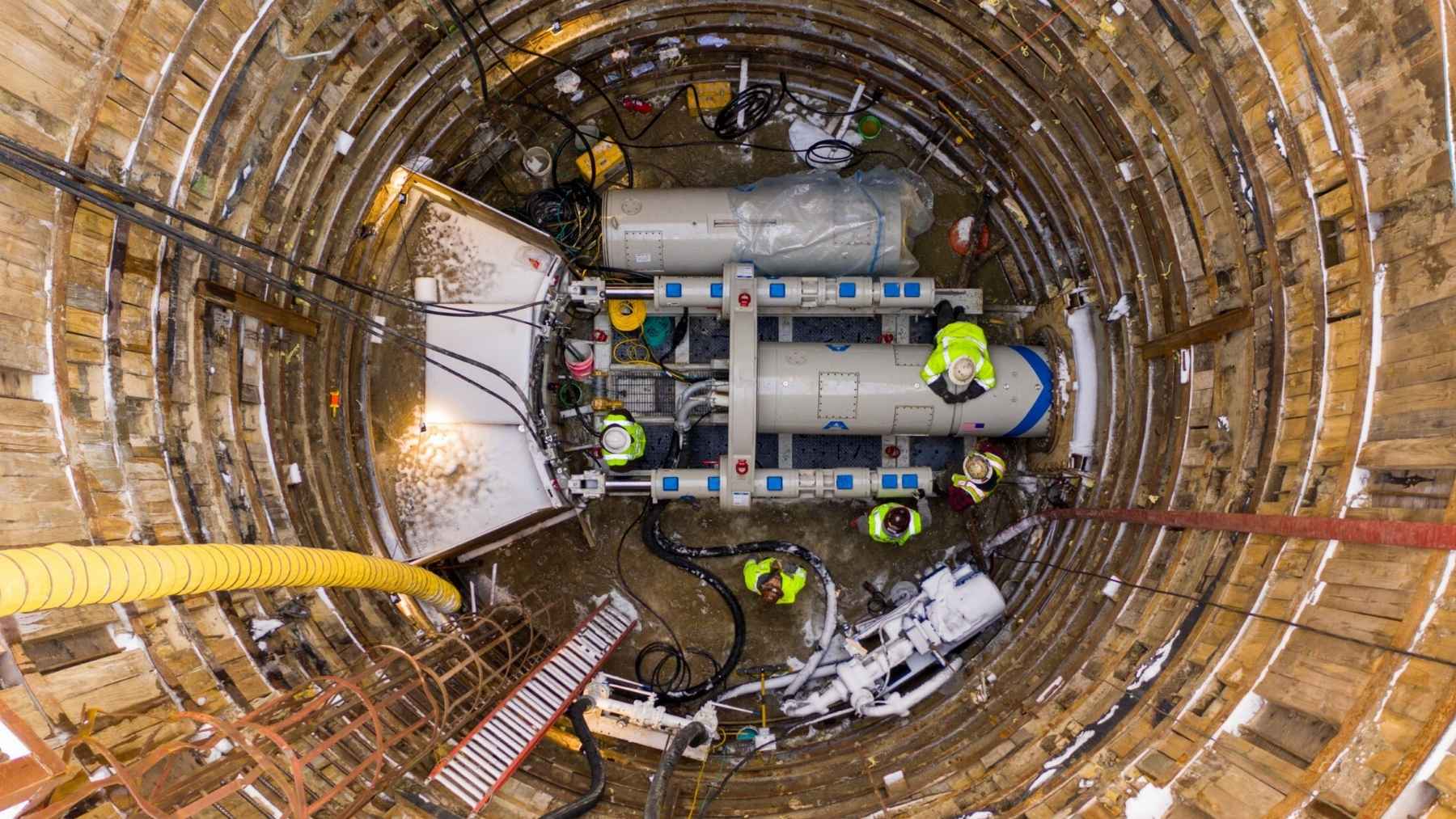
Here’s what got me interested before the batteries did. Nobody drilled this shaft down from an empty field. The old Craig Mine, which shut down in 2009, had already worked its way deep into the rock, so Glencore built the new shaft starting from the bottom of the old one and drove it farther down, until the finished shaft connected the surface to the new ore body in one run.
Why bother with the old mine at all? Because the upper stretch of any deep mine is money you spend before you see a gram of metal, and Craig’s workings gave the project a head start on that bill. The new mine’s main haulage level sits at 1,200 meters (about 3,900 feet) specifically because that’s where the old mine’s ore and waste pass system tops out. You inherit the plumbing. That’s frankly the correct engineering answer, and the project still took seven years and close to 2 billion Canadian dollars, somewhere around a billion and a half US. Deep is deep.
Glencore knows deep better than almost anyone. The company also runs Kidd Creek up in Timmins, where the bottom of the No. 4 shaft is the deepest point on land a human can stand, at 9,889 feet. Onaping Depth doesn’t take that record. It just parks an entire working mine, fleet and all, most of the way down to it.
Diesel at depth is mostly a heat problem
So why do batteries win underground while they’re still fighting for every point of market share up here? Run a diesel engine in a closed parking garage and you’ll have your answer inside a minute. A mine is that garage stretched over miles of tunnel, with warm rock on every side. Every diesel machine down there’s a heater with an exhaust pipe, and the mine has to push enough fresh air past it to keep people alive and cool enough to work.
The air itself works against you too. Push air down a shaft and it compresses, and compressed air heats up, at roughly 29 degrees Fahrenheit for every mile of depth (10 degrees Celsius per kilometer) in engineering studies of deep mines in Northern Ontario. At Onaping’s depth, the intake air shows up dozens of degrees warmer than it left the surface, before the rock or a single machine adds anything.
“Eliminating diesel emissions means less ventilation and cooling requirements,” Glencore Canada COO Peter Xavier said in remarks carried by Mining Weekly, calling those systems some of the largest energy demands in underground mining. Glencore hasn’t published a percentage for how much energy the battery fleet actually saves, and I’d genuinely like to see that number, because ventilation is arguably the most honest reason to electrify anything. Fans cost money every hour they spin.
The fleet reads like a battery trade show
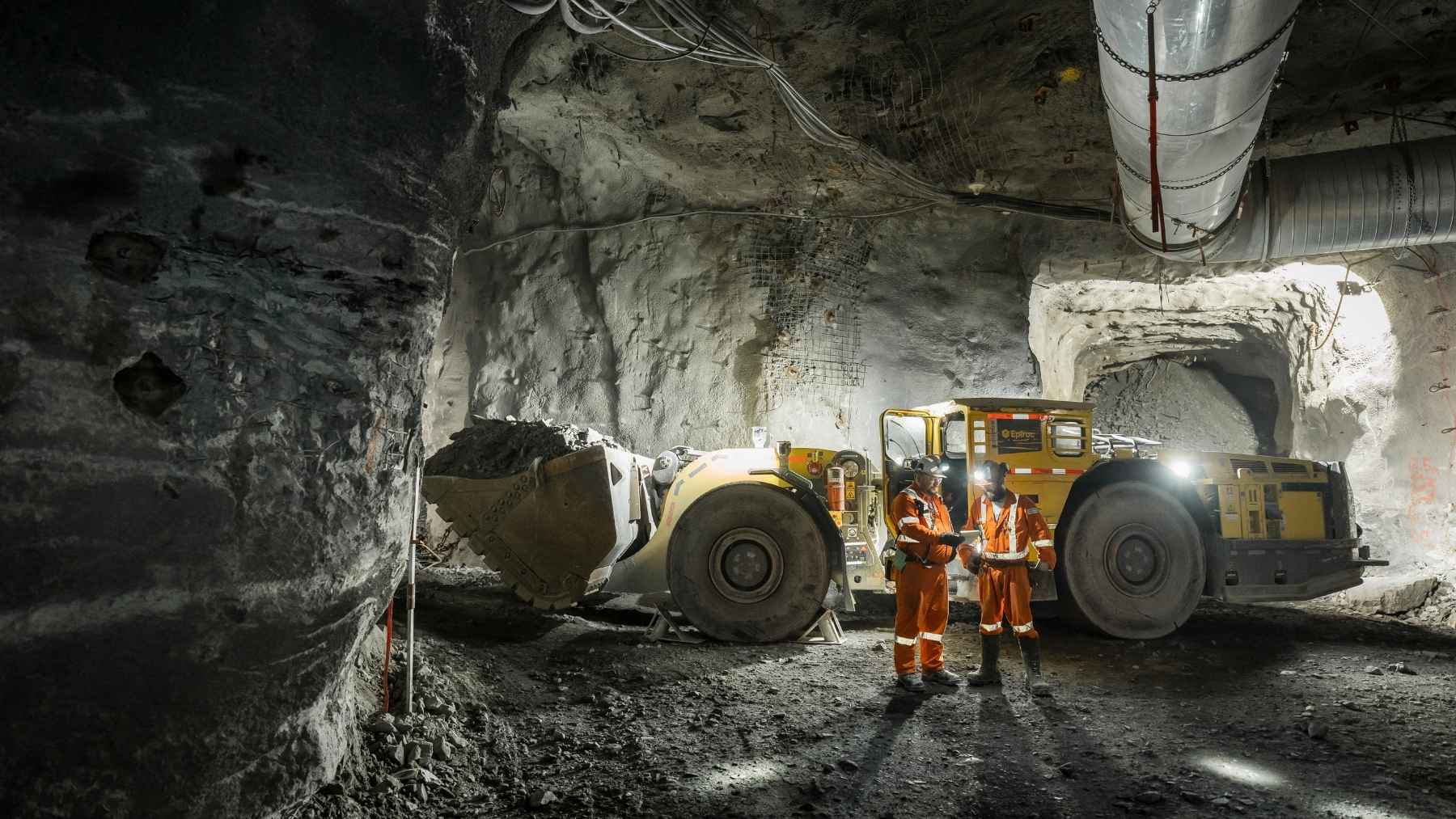
Glencore ordered the core of this fleet from Epiroc back in July 2022, a 23-machine batch the Swedish company filed as a “large order,” which in its books means at least 100 million Swedish kronor, roughly $10 million at the time. Epiroc called the site one of the world’s first all-electric mines, and that fleet covers pretty much the whole mining cycle. Scooptram ST14 SG loaders carry 14 metric tons a scoop and Minetruck MT42 haulers take 42 (call it 15 and 46 US tons). Boomer E2 rigs drill the mining face, Boltec and Cabletec machines bolt the rock so it stays where you left it, and Simba rigs handle the long production holes.
MacLean’s adding battery boom trucks and its TM3 transmixer, and that’s a battery-powered concrete mixer, a machine I didn’t know existed until this week. Kovatera supplies the battery people-movers.
Then there’s my favorite part. Down on that 3,900-foot haulage level, five Clayton CB12.5 lithium-ion locomotives, built by a British outfit that supplies mining railroads in more than 60 countries, will pull the ore trains, with an option for a sixth on the books. They were the first lithium-ion machines running anywhere on the site, and to my eye they’re the best detail in the whole project. A battery railroad, 3,900 feet under Ontario.
One thing jumped out when I went back through the paperwork: Epiroc’s 2022 announcement had production starting in 2024, and it’s actually starting in late 2026. For a shaft this deep I’d call that slip pretty much par for the course. The safety ledger over the build is the number Glencore keeps pointing at, more than 9 million work hours without a lost-time injury, and that’s frankly a hard number to put up on a job this size.
What comes out of the hole
Glencore’s numbers give Onaping Depth a working life beyond 2040, with 280,000 metric tons of nickel and 145,000 metric tons of copper over the life of the mine, about 309,000 and 160,000 US tons. More than 400 permanent jobs ride on it at full production, and Zachary Mayer, a Glencore Sudbury vice president, told CBC that over 7,000 workers and contractors touched the mine during construction. If your EV runs a nickel-rich battery chemistry, this is the very top of that supply chain.
The annual rate’s the number I can’t pin down. Coverage of the August event put output at a million metric tons of ore a year, while an engineering rundown from the project’s early days had 1.4 million, limited by hoist capacity. Call it seven figures of ore a year and let Glencore’s production reports settle it.
Surface mining got its robot revolution first, with 320-ton driverless trucks hauling billions of tons up in the daylight. Underground flipped a different switch. Down here the win comes from the batteries themselves, people still sit in most of the cabs, and Glencore runs remote monitoring and control from the surface wherever it can to keep workers away from the hazardous zones.
First ore’s expected before the end of 2026, and Glencore has the full project finished in 2027. Doug Ford cut his ribbon on August 27. The trucks get the next decade and a half.
 @riosul50 ROOKIE2 months ago