
Geothermal has had a pretty good run in the headlines lately. Fervo keeps drilling faster and hotter wells in Utah, Google keeps signing up for the output, and the oil-patch crowd has apparently figured out that hot rock pays about as well as hot shale did. Then there’s the other kind of next-generation geothermal, the kind that doesn’t frack anything and promises to work pretty much anywhere you can drill. Its flagship project, under a town in Bavaria, just sent its two drilling rigs home.
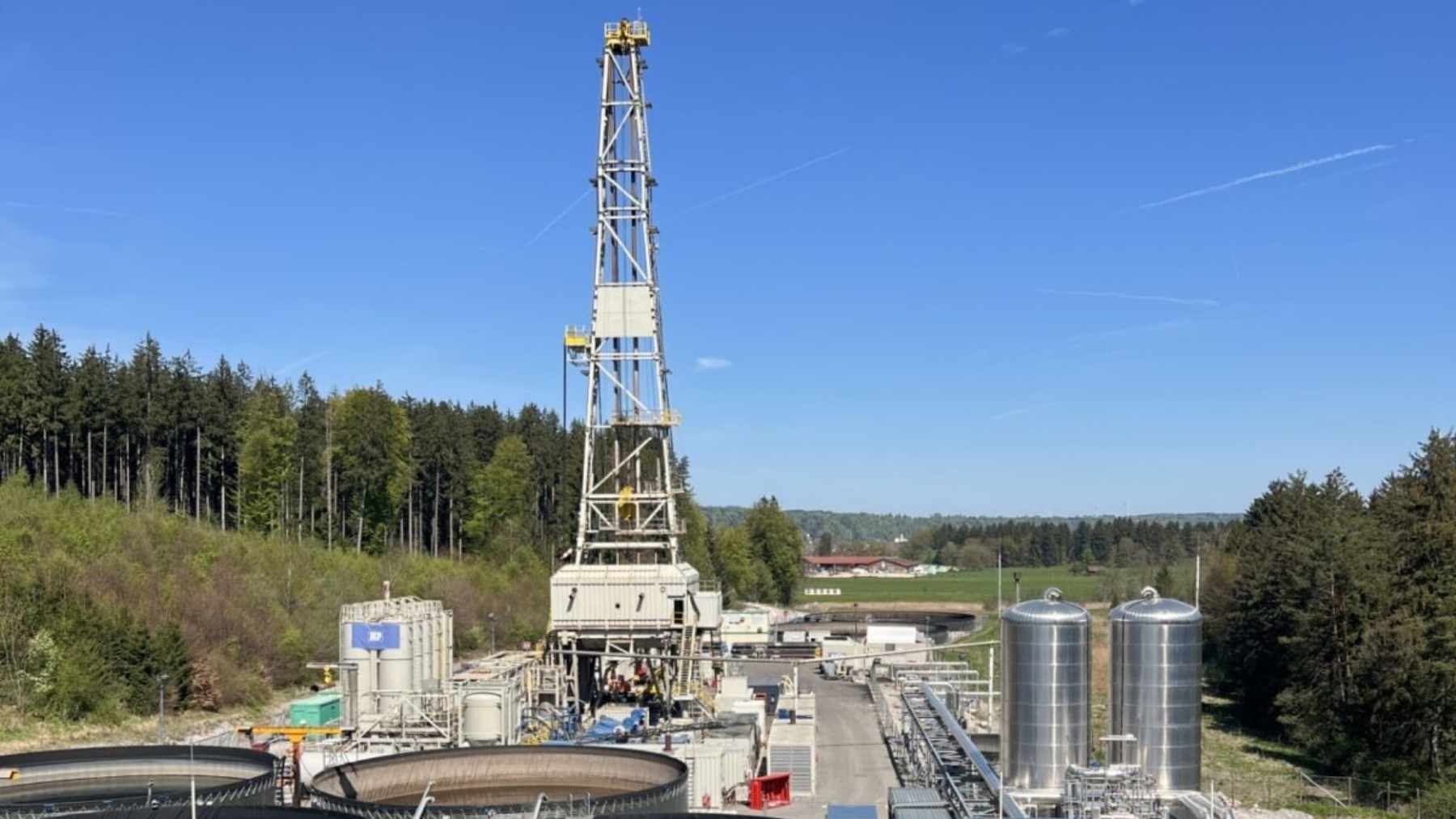
The company is Eavor Technologies, out of Calgary, and the project is in Geretsried, about 25 miles south of Munich. On October 13, Eavor told the town and its heating utility that the two rigs sitting on the site would be pulled out for now, and the utility, Isar Loisach Naturwärme, put that on its website under a notice that translates as “Delay on the second loop.”
ThinkGeoEnergy got the rest from Eavor by email on October 16: keeping two rigs and their specialist crews standing around costs money, the commercial side of the project is going to take a while to sort out, and the company would rather not pay for idle iron while it does.
That’s the news. What interests me more is what those two rigs did before they left, because it’s frankly one of the more impressive and more frustrating drilling jobs I’ve read about in a while.
So what did they actually drill?
Closed-loop geothermal is basically a radiator buried a few miles down. You drill two vertical shafts, branch horizontal tunnels off the bottom of each one, and steer the pairs toward each other until they meet in the middle. Then you pump water down one shaft, through the tunnels, and up the other. The water stays sealed inside the loop the whole way and just picks up heat from the rock around it.
Conventional geothermal needs hot water that’s already down there, and the Utah approach fracks the rock so water can flow through it. Eavor’s design needs neither, which is why the company sells it as “geothermal anywhere,” and why a town with no hot water under it signed up.
At Geretsried, the two shafts went down 4,235 meters, call it 13,894 feet, through limestone and dolomite, according to the paper SLB presented at the IADC/SPE drilling conference in March (SLB was Eavor’s drilling partner on the job). The rock at the bottom runs between 302 and 338 degrees Fahrenheit.
The two shafts sit about 330 feet apart down there, and from each one the crews kicked off six horizontal laterals, each about 3,500 meters long, or 2.2 miles, aimed at a matching lateral coming the other way. Twelve laterals, six pairs, six closed loops. By the time a pair met, the measured length of hole from the surface to the meeting point was about 8,000 meters, or roughly five miles.
Add it up and you get somewhere around 50 kilometers of hole, roughly 31 miles, drilled by two land rigs from KCA Deutag, each with 2,000-horsepower drawworks, a 7,500-psi mud system, and a hook rated to lift more than a million pounds. The rigs stood about 720 feet apart on the surface and were supposed to drill at the same time, one lateral from each side, so the two bits could find each other with a magnetic ranging tool.
I’ll admit I’d never thought hard about what it takes to get two drill bits to meet five miles out from the surface.
Early on, Eavor did it by running a wireline tool down the hole to sniff for the other bit’s magnetic field, then pulling it back out, over and over. By the fifth and sixth pairs it had a ranging tool built into the drilling assembly that talked to the other one in real time, and SLB says ranging time dropped by more than 70 percent. All six pairs hit on the first try. Whatever you think of the business, that part worked.
Then why did it take 27 months?
The original plan was 107 drilling days. The rigs actually drilled from July 2023 to October 2025. That gap is where the story is, and Eavor’s own chief technology officer, Matt Toews, wrote it up in May in a technical update that’s arguably the most candid post-mortem I’ve seen a startup publish about its own flagship.
The short version: the cement job around the steel casing in both vertical shafts was poor, by Eavor’s own description. Cement is what seals the gap between the pipe and the rock, so that each finished loop is walled off from the next one drilled above it. At Geretsried it didn’t, and after the second pair of laterals went in, fluid pumped down one rig started showing up at the other, having flowed through the loops already drilled.
So the two rigs couldn’t drill at the same time anymore. They had to go one at a time, which Toews says roughly doubled the time and the cost, and the mud they were pumping backed up into the finished loops and dumped rock cuttings in them.
Five of the six loops ended up with debris in them. Eavor flushed three clean. The first two it decided not to, because the time and money didn’t pencil out. So four loops are flowing today, and the plan to drill twelve pairs off this first set of shafts stopped at six.
There was plenty else going on, too. SLB’s drilling engineering head, Blaine Dow, said at the conference that the two rigs had barely worked in the previous four years and the crews were mostly new, because there aren’t a lot of experienced rig hands around a Bavarian lake town. The top hole needed a 28-inch bit, which is enormous for hard rock.
The drilling fluid wasn’t right for the formation until they swapped it for an engineered water-based mud late in the job. And once they did, the numbers moved fast: the first four lateral pairs averaged 54.5 days each, and the last two averaged 16.5. Progress went from about 180 feet a day on the first pair to about 920 on the last two.
So they figured it out. They just figured it out on pair five of six.
What’s the plant making now?
This is where the 8.2 megawatts comes in. Geretsried was designed as four of these loops, each with twelve lateral pairs, 48 pairs in all, feeding a power plant rated at 8.2 megawatts of electricity, or up to 64 megawatts of heat for the town’s district heating network. One loop with four flowing pairs is, by Eavor’s own arithmetic, about a third of the heat you’d expect from one full loop and a twelfth of the whole project.
The loop itself is doing what the physics said it would. Toews puts it at around 8.5 megawatts of heat out of the ground, which he says lines up with the amount of hole actually in contact with hot rock.
The problem is at the surface. The power plant is an organic Rankine cycle unit from Turboden, sized for a project many times this big, and an ORC running far below its design point gets inefficient in a hurry. Eavor’s figure for the conversion efficiency since startup is 4.3 percent. Take 4.3 percent of 11.8 megawatts of heat (the average thermal duty so far) and you’re at about half a megawatt of electricity.
ThinkGeoEnergy, citing Eavor’s own disclosures, puts gross generation at 0.5 to 2 megawatts, with practically no power delivered to the grid. Eavor’s December 2025 press release about the first electrons from a closed-loop multilateral well was accurate. It just didn’t say how few of them there were.
So is the town stuck with half a megawatt?
For now, pretty much, and that’s what stings in Geretsried. Isar Loisach Naturwärme, the heating company the town utility set up for this, signed a contract with Eavor in 2024 for 81,200 megawatt-hours of heat a year. The second loop was, in the utility’s own words, the central condition for starting district heating at all. The utility now says the assumptions behind that contract have changed on Eavor’s side several times, that it has no firm commitment from Eavor on when Loop 2 gets built, and that its shareholders will meet soon to decide whether to keep going with Eavor, look at other heat sources, or both.
Eavor, for its part, says Geretsried is still a priority, that it’s negotiating a firm heat offtake agreement, and that getting the rigs off the clock is what gives Loop 2 the best shot at being financed. Back in June its CEO, Mark Fitzgerald, told ThinkGeoEnergy “we are not stepping away from Geretsried,” while also saying the company wants an experienced drilling partner to run the next loop rather than running it itself. We covered that shift back when the rigs were still on site. Now they aren’t.
What Eavor hasn’t said is who that partner is, when Loop 2 starts, or where the money comes from. The project has a 91.6 million euro grant from the EU Innovation Fund and a 44 million euro loan from the European Investment Bank behind it, and I can’t find a current figure for what’s been spent or what’s left. The company also hasn’t said what two rigs of that size cost per day to keep on standby, which is presumably the number that drove the decision.
Does any of this mean closed loop doesn’t work?
Frankly, no, and I’d push back on anyone who says the rigs leaving proves it. The four loops that are flowing produce the heat the model predicted. The two bits met every time. The last two pairs got drilled in about three weeks each, which is the kind of number that starts to look like a business if you can do it from pair one instead of pair five. Toews says future pairs should take about three weeks each with the cement fixed, and that’s a reasonable thing to expect from a learning curve, though it’s also exactly what a CTO would say after a rough first loop.
What it does mean is that the first full-size closed loop anywhere took 27 months to drill, it’s running at a twelfth of its design, and the people who were supposed to heat their houses with it are now shopping around. The Utah crowd, meanwhile, is drilling 19,000-foot wells in 21 days with the frack trucks parked out back. Both approaches pull heat out of rock. One of them has a learning curve that’s a lot further along.
Eavor says the two rigs are leaving Geretsried so the project can be restructured for Loop 2, and Isar Loisach Naturwärme says its shareholders will decide soon what to do with the 2024 heat contract. Both notices went out the week of October 13, 2026. The first loop, four pairs flowing, is still circulating water through 338-degree rock under the town.