
A shipyard is built to do one thing at industrial scale: turn flat steel into something enormous, launch it, and start the next one. Container ships, oil tankers, the occasional aircraft carrier. What rolls out is standardized, floated off, and replaced on the line by the next hull.
A Danish company called Saltfoss Energy wants to add a nuclear reactor to that list. Not poured into a coastline over the better part of a decade, but assembled inside a shipyard and towed out on a barge, the way a cargo ship gets delivered. The machine is a Compact Molten Salt Reactor, and the plan is to bolt two to eight of them onto a single floating platform.
The concept has been kicking around since 2014, back when the company was still called Seaborg Technologies. What changed recently is where it sits in a very specific line. Saltfoss has moved into South Korea’s reactor-licensing pipeline as one of the first foreign developers to get there, which matters for a simple reason: Korea, not Denmark, is where these barges would actually get built.
The reactor is built to freeze, not melt
Nearly every power reactor running today works off the same basic setup: solid fuel rods, water pumped around them under high pressure, and a containment dome wrapped around everything in case the cooling stops. Lose the water and the core overheats. That single failure mode is most of what makes nuclear expensive to build and slow to approve.
The CMSR takes the water out of the equation. The fuel is dissolved into a liquid fluoride salt, and that same salt is the coolant. It runs at close to atmospheric pressure, not the 150-plus atmospheres a conventional water-cooled reactor holds. If the reactor loses power, the salt cools, hardens, and locks the radioactive material inside what is effectively solid rock.
A reactor that fails by turning into a rock is a far easier thing to insure than one that fails by melting. That is the entire pitch behind molten salt, and it is not new science. Oak Ridge National Laboratory ran a molten salt reactor in the 1960s before the idea was shelved in favor of the water-cooled designs the US military already understood.
Saltfoss did change one big thing along the way. The design was originally built around high-assay low-enriched uranium, or HALEU, a fuel that barely exists at commercial scale yet. In early 2023 the company switched its first barges to standard low-enriched uranium, on the logic that a reliable HALEU supply was not going to show up on schedule, according to World Nuclear News. Each reactor is rated at about 100 megawatts of electricity, a full barge runs from 200 to 800 megawatts depending on how many you stack, and the plant is designed to last 24 years.
The Danish part is the design. The building happens in Korea.
Saltfoss itself is a small operation, a Copenhagen team of around 100 people by the company’s own count. It does not own a shipyard, and it does not plan to bend the steel or weld the hulls. What it brings is the reactor design. Everything physical runs through a group of Korean partners.
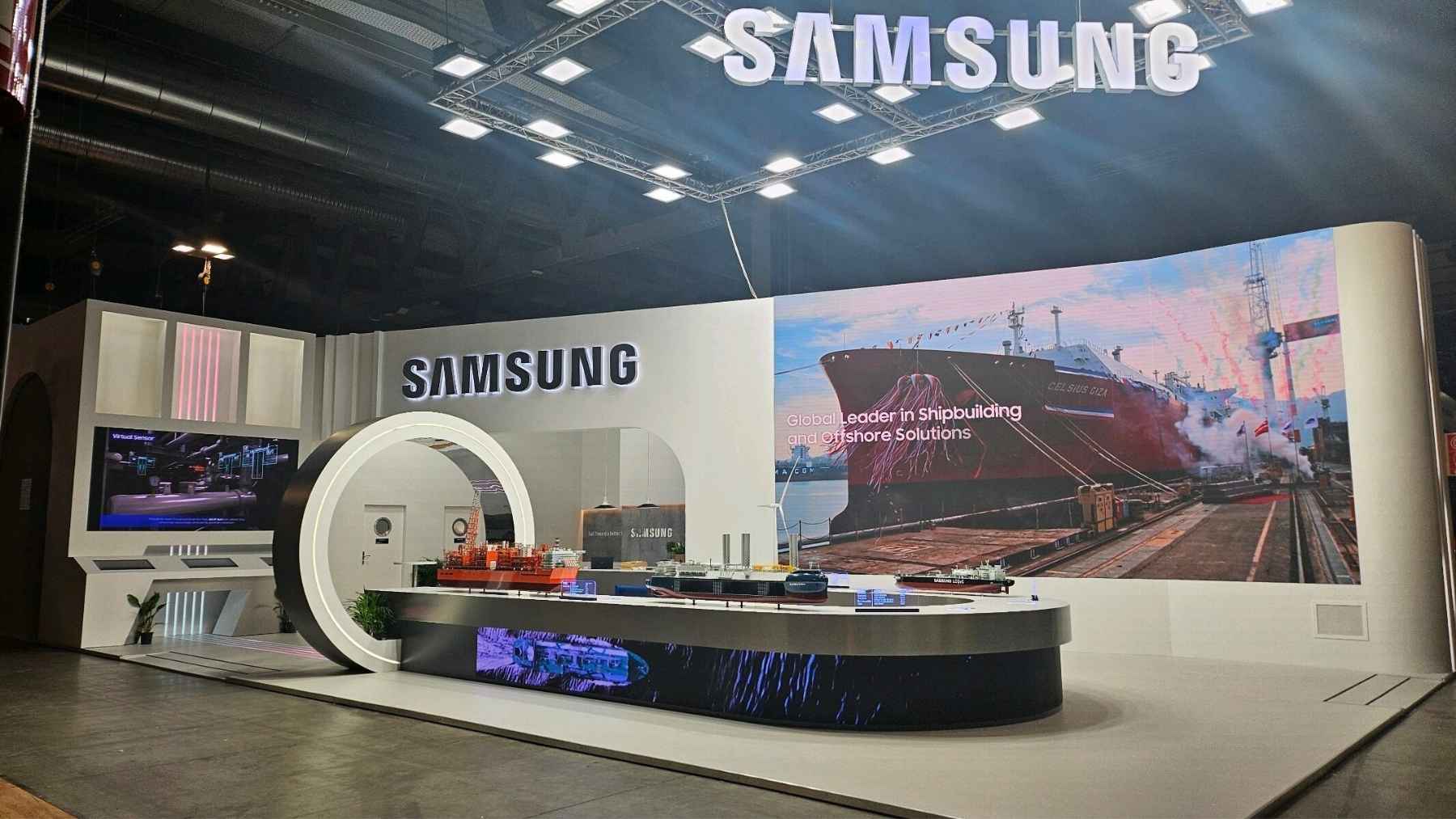
Samsung Heavy Industries, one of the largest shipbuilders on the planet, is the yard. Its site on Geoje Island is where the CMSR Power Barge would be assembled. Korea Hydro & Nuclear Power, which has run the country’s reactors for close to 50 years, handles the nuclear operations side. KEPCO Nuclear Fuel and GS Engineering & Construction cover fuel and construction, and Doosan Enerbility is in the mix as well.
South Korean industry reporting puts the split bluntly: the Danes design the reactor, and Korean firms handle all of the manufacturing, construction, and shipbuilding, according to Asia Business Daily. It is an unusual arrangement for a nuclear program, and a very deliberate one. The hard, capital-heavy part of the job sits with companies that already do it at scale.
The licensing is moving too. Korea passed a revised Nuclear Safety Act in April 2026 that adds a pre-review track for advanced reactors, set to take effect on November 20, 2026. Saltfoss and the US developer TerraPower have both reportedly asked to use it, which is how a Danish startup ends up near the front of a licensing line on the other side of the world.
The fuel salt gets tested in Idaho
There is an American piece to this, and it is not a barge. It is chemistry. Molten salt is corrosive and behaves in ways that are hard to model, so before anyone licenses a reactor full of the stuff, the salt has to be measured under real conditions.
Idaho National Laboratory opened a facility for exactly that in March 2026, the Molten Salt Thermophysical Examination Capability, run by its National Reactor Innovation Center. Among the first jobs on its list is fuel salt fabrication, analysis, and irradiation work for Saltfoss, according to the American Nuclear Society. Post-irradiation testing of fuel salt samples at Idaho’s Advanced Test Reactor is slated to begin in 2027.
So the reactor is Danish on paper, Korean in the shipyard, and its salt chemistry gets checked in a US national lab. For a design that has never gone critical, that is a lot of separate countries signing up to handle different parts of the same machine.
Russia already floated one. This is a different bet.
Floating nuclear is not hypothetical. Russia has been doing it since 2019. The Akademik Lomonosov is a 144-meter barge with two pressurized-water reactors on board, towed thousands of miles to the Arctic port of Pevek, where it has fed the local grid and passed more than a billion kilowatt-hours. Its crew of about 70 has a gym, a swimming pool, and a bar, for a town of a few thousand people.
That is floating nuclear as a one-off state project: a single bespoke vessel, built the slow way, welded to its reactors. Saltfoss is pitching the opposite, a standardized product coming off a shipyard line, molten salt instead of pressurized water, meant to be repeated rather than commissioned once.
It also is not the only company chasing this. Another Danish outfit, Copenhagen Atomics, is building thorium molten salt reactors sized to fit inside a shipping container. And out in China’s Gobi Desert, a small molten salt reactor has been running for years and last year bred thorium into usable fuel while still operating — the clearest proof yet that the chemistry works outside a 1960s American lab.
What has actually moved
None of this is in the water yet. There is no Saltfoss barge, no reactor running, and the company’s own timeline now points to its first unit arriving in the first half of the 2030s rather than the 2026-to-2028 window it floated a few years back. The barge in the renderings is still a barge in the renderings.
What has changed is the paperwork and the industrial backing behind it: a shipyard willing to build it, a licensing slot in a country that takes nuclear seriously, and a US lab measuring its salt. For a technology that spent a decade as a slide in an investor deck, moving to the front of a real licensing line is the most concrete thing that has happened to it. The steel just has not been cut.
 braddavis ROOKIE3 months ago