
If you’ve ever poured a jug of diesel exhaust fluid into the little blue cap on a truck, you’ve bought something a fertilizer plant made. DEF is basically urea and water, urea comes from ammonia, and the biggest ammonia and fertilizer plant in Europe sits in Sluiskil, a Dutch town in the province of Zeeland, right by the Belgian border. Yara, the Norwegian company that owns it, has been selling that plant’s leftover carbon dioxide for years, to greenhouses, to soda bottlers, and into the urea that ends up in the DEF jug in your garage.
Now it’s doing something stranger with the stuff. On September 7, Yara officially opened the largest industrial carbon capture unit in Europe at that plant, and the CO₂ it catches isn’t going into anyone’s soft drink. It gets chilled into a liquid, loaded onto ships and buried 8,530 feet under the North Sea.
The unit can capture and liquefy up to 880,000 tons of CO₂ a year (800,000 metric tons) from the plant’s ammonia production. The opening drew the prime ministers of both Norway and the Netherlands, plus the EU’s climate commissioner, which tells you how much Europe has riding on this working. Yara CEO Svein Tore Holsether said in the announcement that the facility “proves that large-scale industrial decarbonization is possible today.”
Why a fertilizer plant, of all things?
Because ammonia plants are the low-hanging fruit of carbon capture, and I mean that as a compliment. Making ammonia means stripping hydrogen off natural gas, and the carbon in that gas has to come out somewhere. It leaves as a nearly pure stream of CO₂, which is a lot easier to grab than the diluted exhaust drifting out of a power plant’s smokestack. You’re not fishing a needle out of a haystack here; the plant pretty much hands you the needle.
Sluiskil also had a head start. The plant was already capturing part of its CO₂ and selling it on, and the new unit deals with the share that used to go up the stack. Yara says catching those tons means it stops paying European carbon taxes on them. I’ll get to why that matters in a minute.
Two boat runs a week to Norway
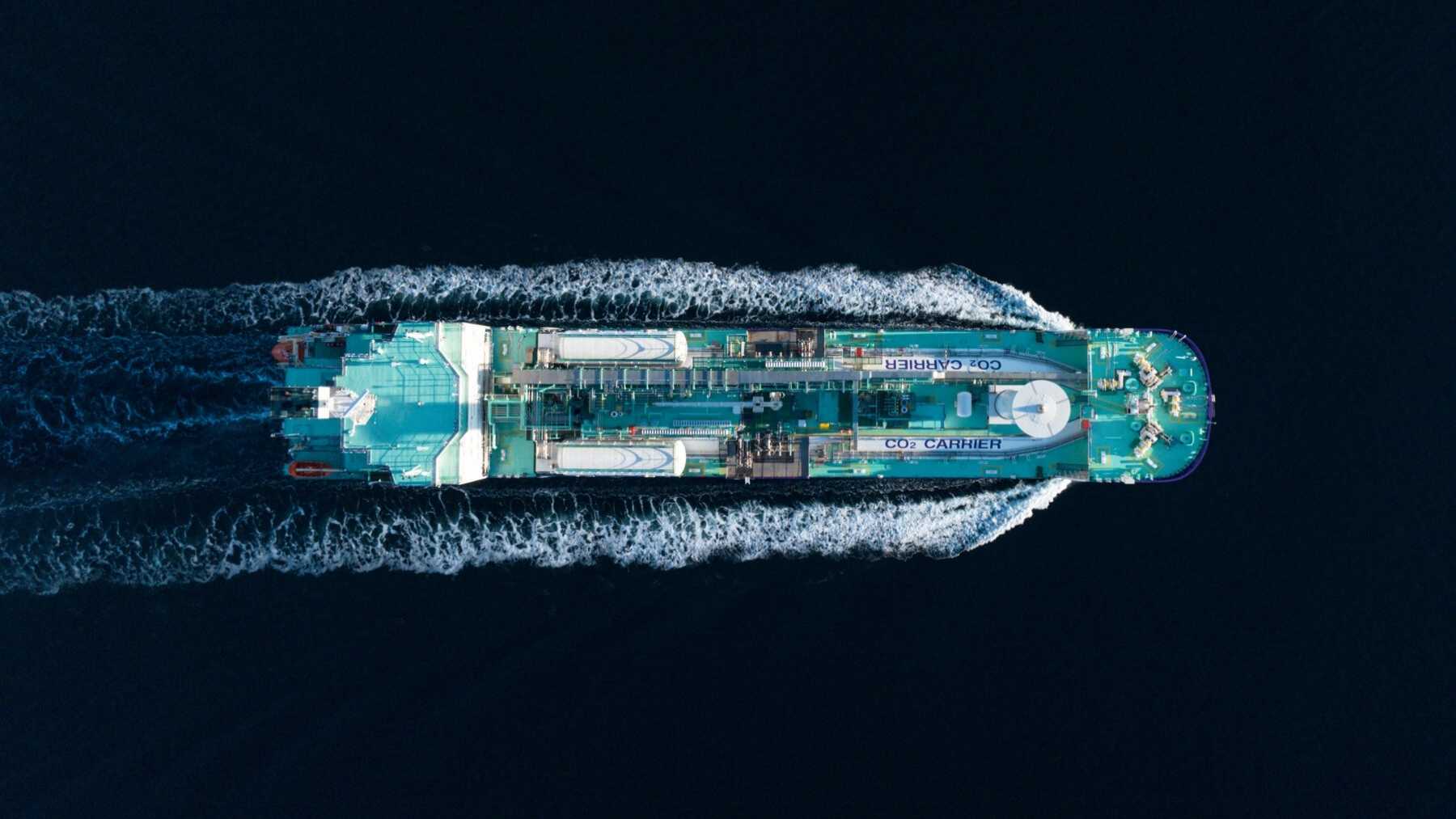
Here’s where it gets genuinely interesting for anyone who likes machinery. The captured CO₂ gets compressed and chilled until it turns liquid, then held in seven storage tanks at the plant. Twice a week, according to Yara, a ship shows up to empty them.
And these aren’t ordinary ships. Northern Lights, the joint venture between Equinor, Shell and TotalEnergies that runs the transport and storage end, had them purpose-built by adapting designs for liquefied petroleum gas carriers. Each one’s 427 feet long, holds just shy of 2 million gallons of cargo, and keeps the CO₂ liquid at 31 below zero and up to 275 psi, per the specs published by “K” Line, the shipping company that operates them. They burn LNG and carry rotor sails, those spinning cylinders that shave a bit of fuel off a crossing when the wind cooperates. Three sister ships have been delivered since late 2024, a fourth identical one arrives in 2026, and Northern Lights has already ordered bigger vessels for its next phase.
The ships sail to Øygarden, on Norway’s west coast near Bergen, where the liquid gets pumped ashore into more tanks and then sent out through a pipeline under the North Sea. At the end of that pipe, it goes down into a saline aquifer 8,530 feet below the seabed. That isn’t a cavern someone hollowed out, by the way. It’s a layer of porous rock soaked in salt water, sitting under a cap of rock that doesn’t let anything through, and the CO₂ gets squeezed into the pores and stays put. Northern Lights sent its first CO₂ down that hole in August 2025, from a cement plant in Norway. Yara’s Dutch tons are the first to cross a border to get there, part of what both companies describe as the first complete cross-border capture, transport and storage chain in operation. Neither company’s published the date the first loaded ship left Sluiskil, which I’d have led with if they had.
So what does Yara get out of it?
Money, mostly. And Yara isn’t shy about it. Europe makes industrial emitters pay for every ton of CO₂ they put in the air, and the company’s own announcement says capturing these volumes means avoiding carbon taxation on them. Frankly, that’s the most honest sentence in the whole press release, and it’s also the business model: the bet is that burying the gas costs less than paying to emit it. Selling lower-carbon fertilizer and ammonia on top of that is the bonus round.
How much gas are we talking about over time?
Yara expects the project to put roughly 13 million tons (12 million metric tons) under the seabed over the next 15 years, though it hedges that forecast on framework conditions staying favorable, which is corporate-speak for as long as the rules and the subsidies hold. For scale, the EPA figures a typical gas-powered car emits about 4.6 metric tons of CO₂ a year, so the plant’s annual catch works out to the exhaust of roughly 175,000 cars.
Northern Lights matters here beyond the boats. Its first phase can handle 1.5 million metric tons a year and is fully booked, with Yara’s contract taking up about half of that. A second phase, approved in 2025, should push capacity past 5 million metric tons a year.
Burying it isn’t the only path, either. Some American outfits would rather turn captured CO₂ into jet fuel, and the industries watching Sluiskil closest are the ones that can’t just switch fuels, like cement plants, or the people building a box the size of a school bus that makes steel without coal. For them, having somewhere to actually put the gas is the whole ballgame.
Yara inaugurated the Sluiskil unit on September 7, 2026, with the prime ministers of Norway and the Netherlands in the crowd, and says the ship runs to Øygarden will keep going for at least the next 15 years.