
We tow a lot of unlikely things across open water. Oil platforms the size of office buildings, floating dry docks, retired aircraft carriers headed for the breakers, the occasional research iceberg. A working nuclear power plant is a newer entry on that list, and Russia is the only country that has actually managed it.
Its floating plant has been moored off a tiny Arctic port since 2019, quietly keeping the lights on in a town most maps barely register. And as of late May, the four that are supposed to follow it stopped being a slide in a Rosatom presentation: the first reactor for them rolled out of a factory near Moscow, headed for a barge whose hull was built in China.
None of this is a render or a feasibility study. The plant up in Pevek is real, licensed, and feeding a grid. The four replacements are under construction right now. And the supply chain behind them runs through Chinese shipyards, which is a strange place for a Russian nuclear program to end up.
The plant in Pevek is basically a ship
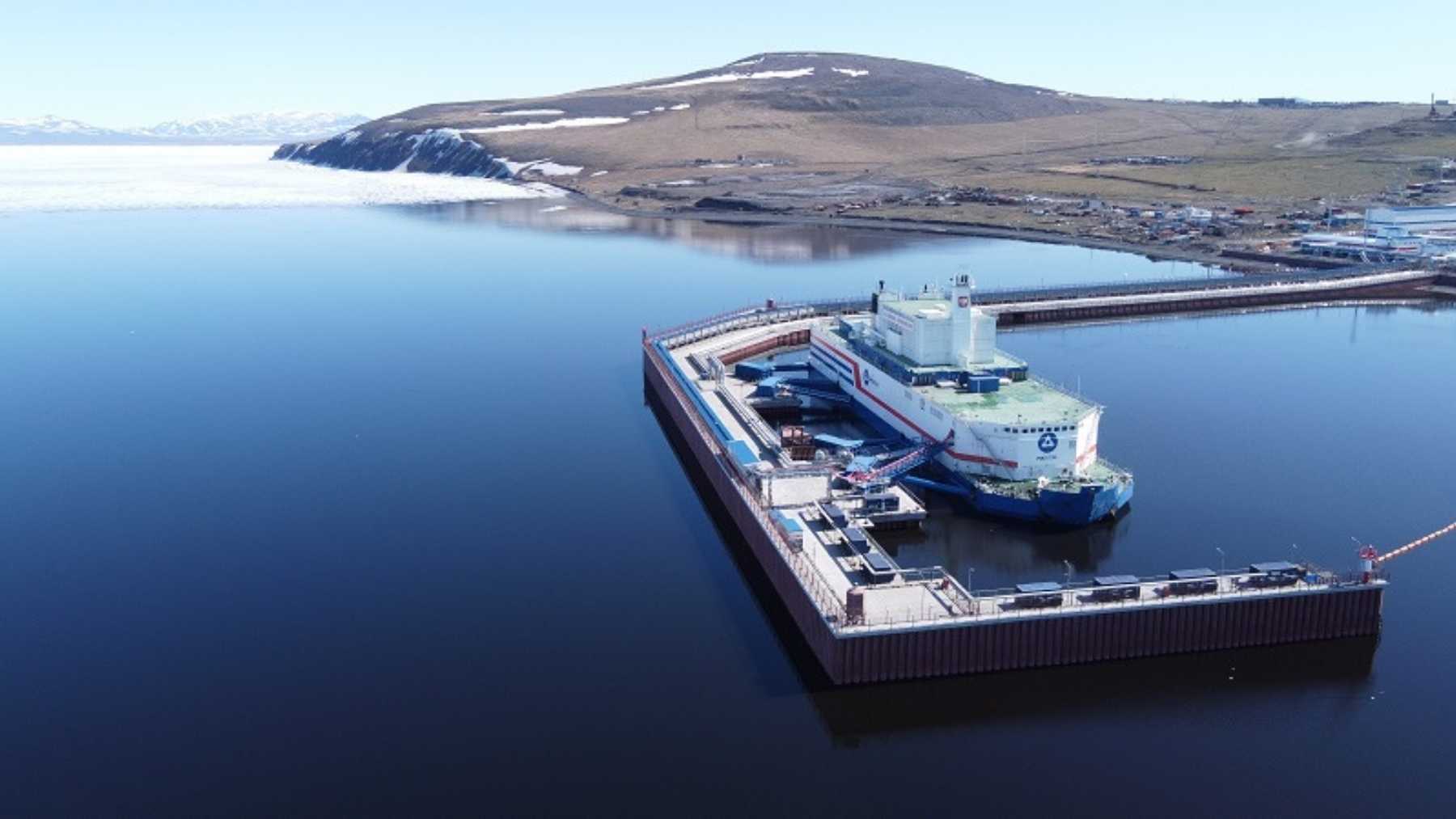
The thing moored at Pevek, on the northern coast of Chukotka in Russia’s Far East, is called the Akademik Lomonosov, after the 18th-century Russian scientist. It is a barge, 144 meters long and 30 meters wide, displacing around 21,000 tonnes, with no engine of its own. It was built the way you would build an icebreaker, at the Baltic Shipyard in St. Petersburg, then towed several thousand miles north and plugged into shore.
Onboard are two KLT-40S reactors, each rated at 35 MW of electricity, for 70 MW combined, or about 300 MW of heat if you run it for warmth instead. Those reactors are close cousins of the ones Russia has used on its nuclear icebreakers for decades, which is the whole reason this works: the country already knew how to put a small reactor in a hull and send it somewhere cold. The plant was connected to the local grid in December 2019 and fully commissioned the following spring.
Pevek itself has maybe 4,000 people, so the barge is not there to power a city. It feeds the isolated Chaun-Bilibino grid and, increasingly, the mining operations nearby. Its share of that small grid has climbed past 60 percent, up from around 20 percent when it started, according to figures reported by Interesting Engineering. Citing Rosatom, World Nuclear News reports the plant has now generated more than 1.2 billion kWh and avoided more than 400,000 tonnes of greenhouse gases. It replaced the aging Bilibino nuclear plant, which had been running since 1974, along with a thermal plant older than that.
Bolting a reactor to a barge is not unique to Russia, or to fission. A five-party alliance recently unveiled a barge built around a containerized fusion reactor for commercial shipping, though that one is still very much on paper. The Akademik Lomonosov is the version that exists, refuels every few years off a single core swap, and gets its fresh fuel hauled in by sea along the Northern Sea Route.
Four more are coming, and the hulls are being built in China
The reason Russia needs more of these is sitting under the tundra a few hundred miles inland. The Baimsky project is one of the largest undeveloped copper deposits anywhere, and turning a remote ore body into a working mine takes an enormous, steady supply of power that Chukotka simply does not have. Rosatom’s answer is four new floating plants, moored together off Cape Nagloynyn in Chaun Bay and wired to the mine through a transmission line running roughly 400 kilometers down through Bilibino.
These are a generation up from the Lomonosov. Each new unit carries two RITM-200S reactors, a power-plant version of the RITM series now running on Russia’s newest icebreakers, and is built to push 106 MW to shore. The barge is about 140 meters long and 30 meters wide, weighing roughly 9,500 tonnes as a bare hull and around 19,000 tonnes once the reactors and equipment are in.
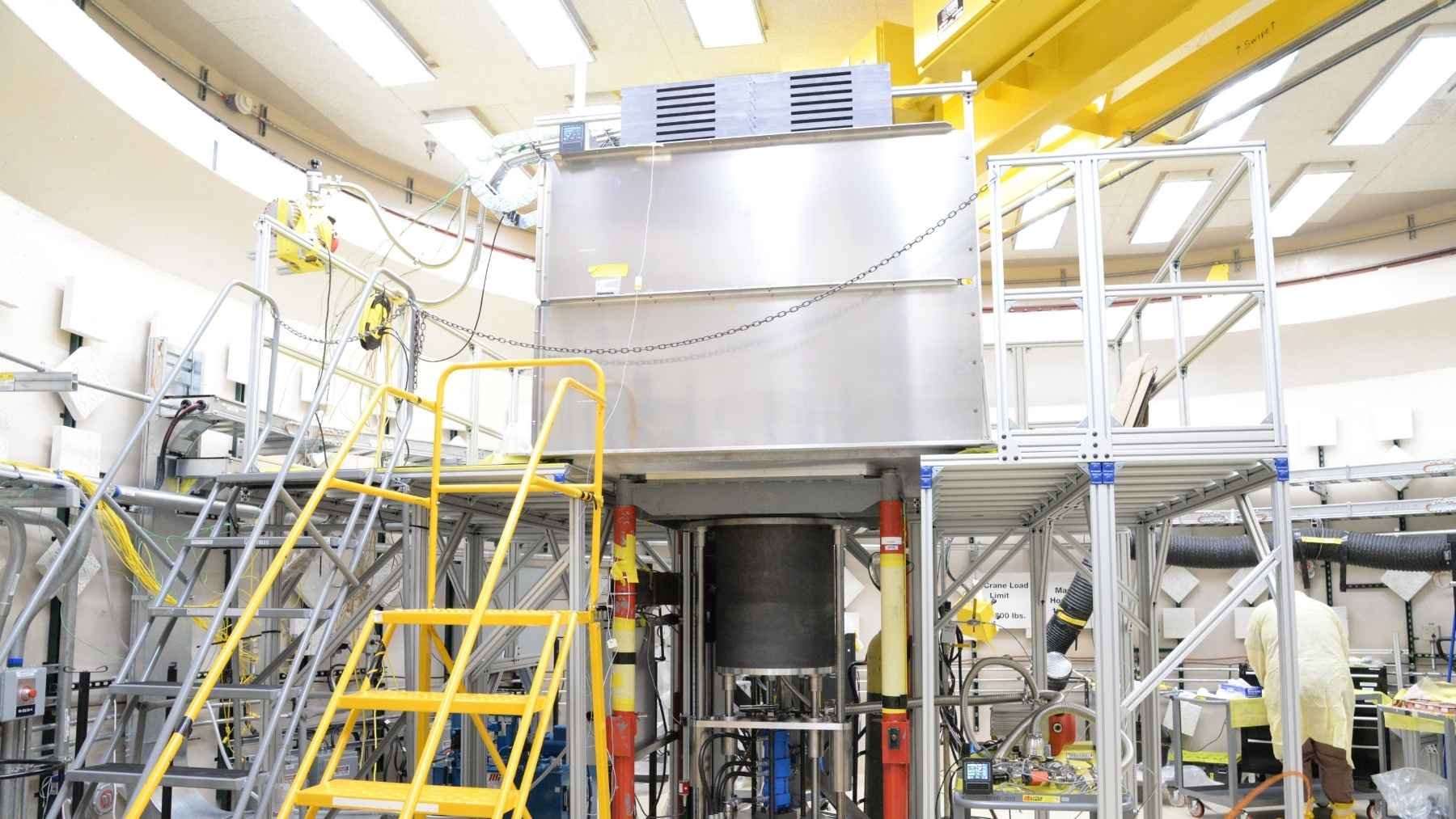
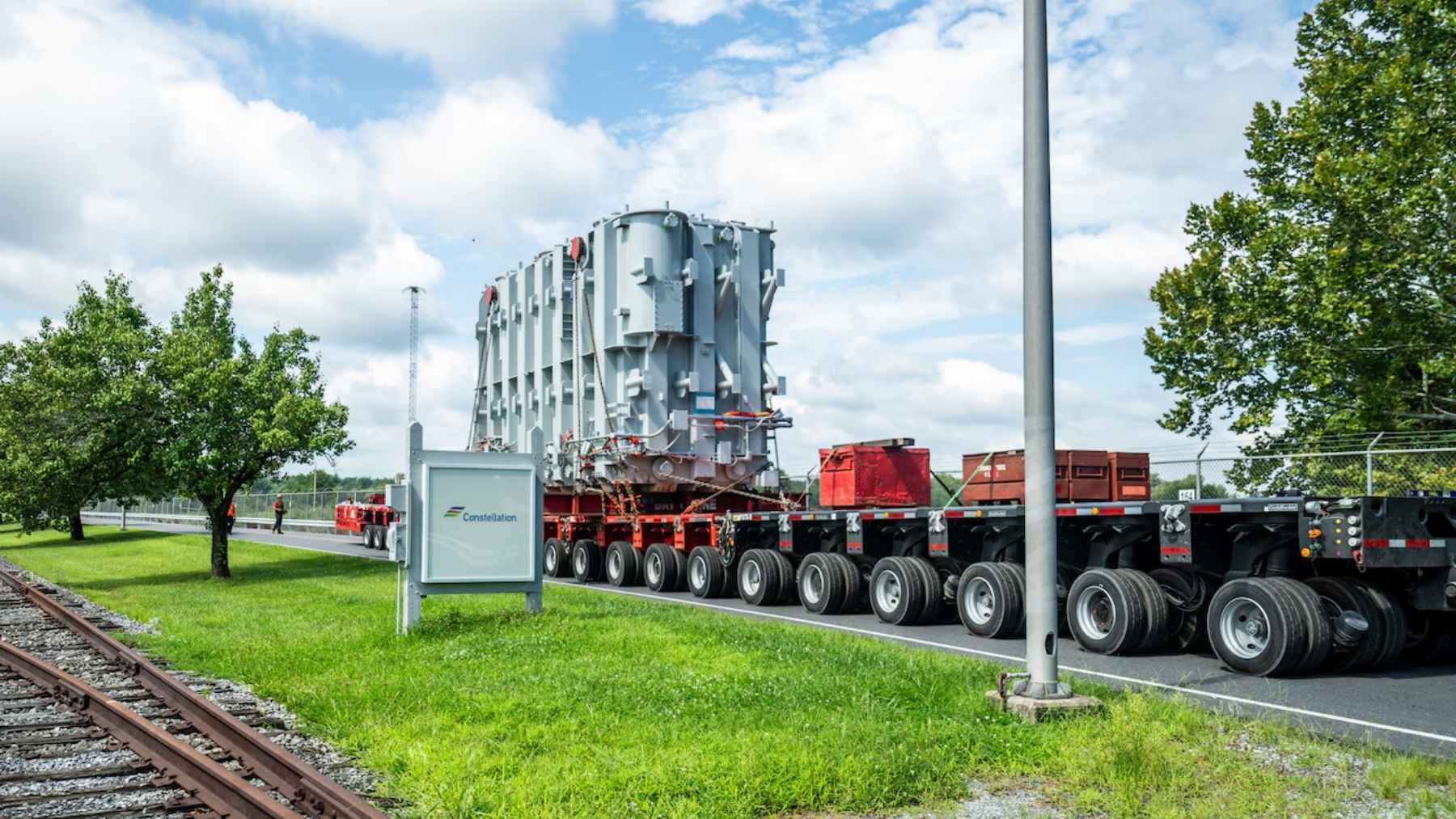
Here is where the supply chain gets interesting. The hull of the first barge was not built in Russia. It was built at a Chinese shipyard and towed to the Baltic Shipyard in St. Petersburg, where it arrived this spring for the reactors to go in. Then, on May 27, Rosatom said it had finished the first RITM-200S reactor at its ZiO-Podolsk plant south of Moscow and was loading it onto a rail wagon for the trip north, according to the Barents Observer. All four plants, eight reactors in total, are due in the Arctic by 2031.
Electric output shown. Sources: Rosatom, World Nuclear News, World Nuclear Association.
Why anyone would float a reactor in the first place
If this sounds like a wildly complicated way to build a power plant, the logic is actually about avoiding complications. Pouring concrete and assembling a reactor on Arctic permafrost, in a place where the building season is short and everything has to be barged or flown in, is brutally slow and expensive. A shipyard in St. Petersburg has cranes, dry docks, a trained workforce, and does not freeze solid for half the year.
So you build the hard part, the plant, in a controlled industrial setting, then tow the finished product to the edge of nowhere and connect it. The construction risk lives in the shipyard, not the tundra. It is the same instinct driving the new wave of small modular reactors elsewhere: build something compact and repeatable in a factory rather than as a one-off civil engineering epic. The reactors going into these barges sit comfortably in that category, under 300 MW each, the same broad class as the Bill Gates-backed Natrium plant breaking ground in Wyoming and the pebble-bed reactors headed for a Texas chemical plant.
The trade-off is that these particular units are built to run for 40 years and refuel only once every five to seven years, which suits a place you can barely reach. Hauling fresh fuel up the Northern Sea Route a couple of times a decade is a lot more manageable than keeping a conventional plant supplied year-round.
China keeps announcing its own and not quite launching them
China has wanted into this business for a while. Back in 2016, the state-owned China General Nuclear announced its first floating plant, built around a domestically designed ACPR50S reactor rated at 60 MW, aimed at powering offshore oil and gas rigs, remote islands, and desalination in the Bohai Sea. A year later, rival China National Nuclear Corporation followed with its own larger ACP100S design. The plans got national approval and a decade of engineering work, and the original timeline pointed at a first unit around 2020.
That unit never showed up. Reporting in 2023 indicated the South China Sea deployment had been put on hold, with construction approval withheld over safety and feasibility concerns, and as the Observer Research Foundation noted, public information on the program has been thin ever since. The World Nuclear Association still lists the ACPR50S as a 200 MWt, 60 MWe design intended for a barge, but listing a design and mooring a finished plant are different things.
So for all the talk of a Chinese floating fleet, the scoreboard is lopsided. Russia has one plant running and four under construction. China has drawings. The twist is that Chinese yards are the ones building the hulls Russia’s program leans on, the manufacturing turning up on one side of a project the other side has not managed to launch.
The part Rosatom is quieter about
A floating reactor moored in the Arctic raises questions a brochure tends to skip. The most immediate one, raised by the Barents Observer, is where the new reactors actually get loaded with uranium and tested: at the St. Petersburg shipyard before the barge is towed out of the Baltic and around Scandinavia, or up at Murmansk, the way the Lomonosov was. Towing a reactor, fueled or not, past the coastlines of half a dozen European countries is the kind of thing that makes neighbors ask pointed questions.
Then there is the waste, which is stored on the barge itself. Groups like Greenpeace and the Bellona Foundation have been critical of the design for years (the “nuclear Titanic” line gets used a lot), warning that an Arctic accident could damage the plant and its waste containers at once, in an environment where a cleanup would be close to impossible. Rosatom’s position is that each plant carries its own spent-fuel storage, is serviced entirely by sea, and after 40 years gets towed to a dedicated yard and taken apart, with nothing left behind in the Arctic.
Strip away the Arctic setting and the pitch is simple: stop pouring a power plant in place and start building it in a factory, then ship it where the power is needed. Russia has one of these running and four more in the pipeline. China has the blueprints and a decade of stop-start headlines. For a remote mine or an island with no grid and no appetite for a ten-year build, the question was never really whether a reactor on a barge is a strange idea. It is who is actually selling one.
 @groupwatchdog ROOKIE3 months ago