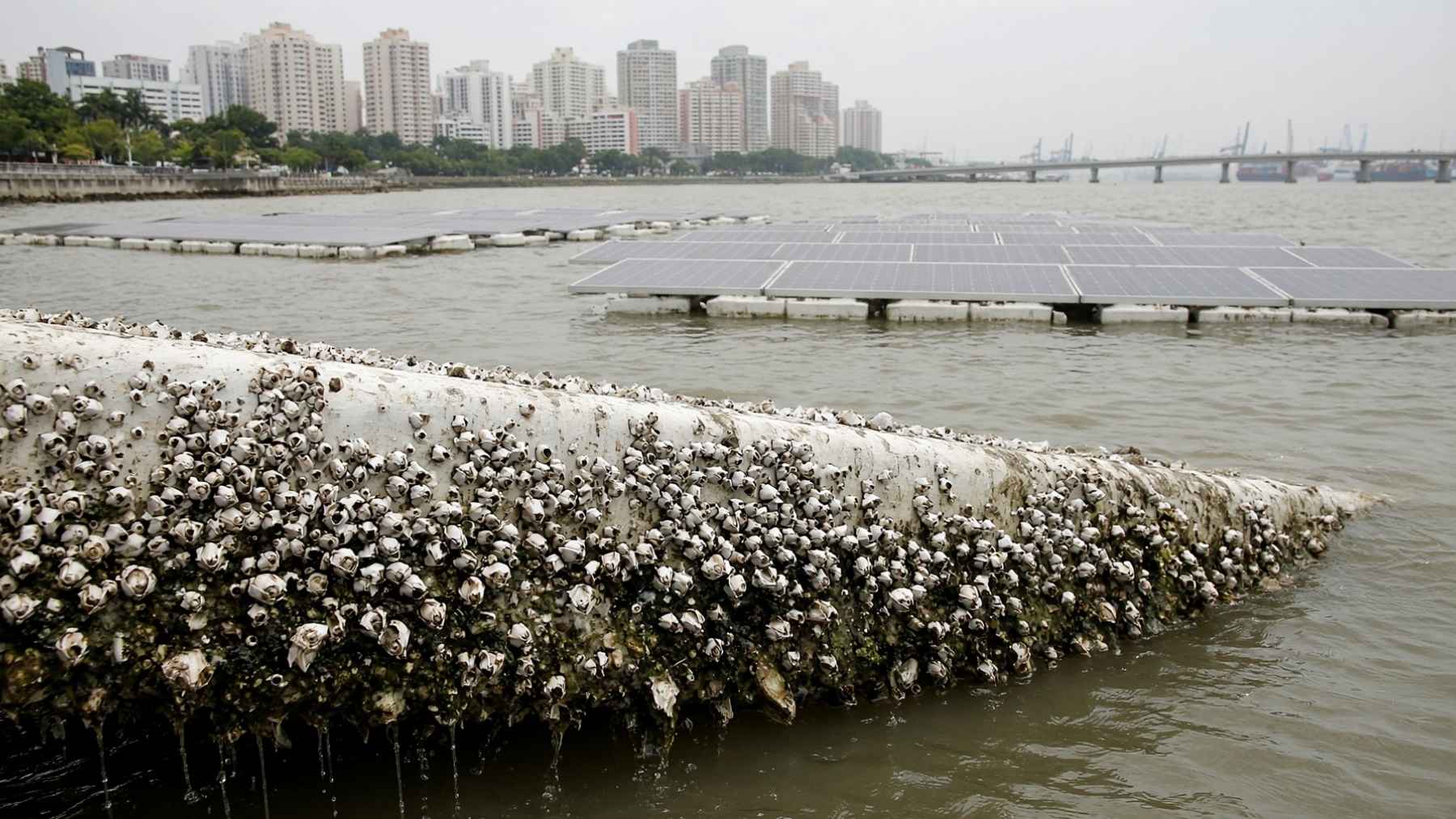

Anyone who has kept a boat in salt water knows what barnacles do to a hull. They arrive as larvae, cement themselves down, and getting them off means a haul-out, a scraper and a ruined Saturday. So when a story goes around about barnacles ambushing a solar farm in Singapore, the barnacles are not the surprising part.
The surprising part is that the people who built the thing had already tested for them. Before a single float went into the Straits of Johor, a scale model went into a wave tank and got checked for corrosion, wave motion and biofouling. Barnacles and algae, written out by name. That was 2020.
Five years on, the array is still on Singapore’s official generation list and still carries the same annual rating it was given at commissioning. What nobody has published is what the barnacles cost to manage across a 25-year asset life. That gap, not the crustacean, is the actual story.
What Singapore bolted into the Straits of Johor
The array sits off Woodlands, in Singapore’s North Region, in the channel that separates the island from Malaysia. Sunseap Group installed it between September 10 and December 31, 2020, west of Senoko Fishery Port and north of Woodlands Waterfront Park.
The build list runs to 13,312 solar panels, 40 inverters and more than 30,000 floats, rated at five megawatts-peak. A crane barge dropped mooring sinkers onto the seabed first. The floating platforms went down after that, and the panels went on last.
There is a 22kV transformer on board and a landing point for the subsea cable that carries the power ashore to the national grid. There is also an air-conditioned second deck that works as a visitor centre and viewing gallery, which tells you plenty about what the project was for.
Singapore’s Energy Market Authority still lists the site, now under EDP Renewables, at an estimated 6,022,500 kilowatt-hours a year. EDPR closed its acquisition of a 91% stake in Sunseap in February 2022 and operates it today. The Economic Development Board puts that output at roughly 1,100 four-room flats’ worth of electricity.
Worth being precise about the water, because the viral version usually is not. This is a strait with shipping in it, not open ocean. That distinction runs through everything that follows.
The barnacles were line item three, not the plot twist
Singapore’s Housing & Development Board and the National University of Singapore designed the floater module the farm sits on. HDB also worked with a firm called ISO Landscape specifically to develop and test a float built for marine conditions rather than a calm reservoir.
A finalised scale model of roughly 50 units then went into a wave tank for hydrodynamic testing. According to Offshore Energy, which covered the build before installation started, the test programme covered corrosion, the movement of waves, and biofouling. Growth of barnacles and algae, spelled out.
Then, at completion in March 2021, Sunseap listed the three things that had made the job harder than a rooftop or a field: the unpredictable nature of the open sea, the need to avoid shipping routes, and the presence of barnacles. Marine expertise, the company said, was needed for the mooring installation and the system design.
So the builder said the word out loud, in its own announcement, at the ribbon-cutting. The organism the internet later cast as an ambush was sitting on the risk register the whole time.
That matters, because it changes what the interesting question is. Not “did anyone see this coming.” They did. The question is why an organism everyone anticipated is still one of the hardest things to put a price on.
What a barnacle actually does to a float
Start with the mechanism. A May 2026 review in Nature Reviews Clean Technology, written largely by researchers at the Solar Energy Research Institute of Singapore, defines biofouling as the unwanted accumulation of microorganisms, algae and other aquatic organisms on surfaces such as floating PV floats and anchors, which can add structural weight and drag or degrade components outright.
Weight and drag are the words doing the work. A float is a buoyancy calculation. Hang enough calcium off the underside of one and you have changed the input to that calculation, along with how the whole array behaves when a container ship goes past.
A separate review of biofouling across offshore renewables, published in February 2026, lists the technical damage as increased hydrodynamic drag, corrosion, and shortened component lifespan. On floating systems specifically, it lands hardest on mooring lines and dynamic cables, which is to say the parts holding everything in place and the parts carrying the electricity.
The best hard numbers come from somewhere else entirely. Researchers spent four years filming the mooring lines of FLOATGEN, France’s 2 MW floating wind demonstrator, and published the results in 2025. They found the growth sorted itself into three depth bands: hard-shelled species near the surface, mobile organisms in the middle, soft-bodied ones like anemones down deep. Line thickness went up by somewhere between 7% and 32%.
Different country, different machine, different sea. But the depth finding travels, and it is not good news for floating solar. The zone the hard-shelled colonists prefer is the surface, and a solar float lives nowhere else.
Nobody has 25 years of receipts
Here is where the honest reporting has to stop short of the viral version. The claims circulating about crusts that are almost impossible to remove do not trace back to anything the operator or the research institutes have published. What the literature actually says is narrower and more damning.
The Nature review’s own summary of the field is that degradation rates for floating PV modules over five years look similar to land-based panels, but durability across the expected 25-year lifetime remains unproven and needs longer studies. Five years of evidence, 25 years of financial modelling.
The February 2026 biofouling review is blunter about its own field. It flags a shortage of in-situ offshore data, a limited understanding of how fouling and structure interact, and no standardised measurement protocols. There is no agreed way to even measure the thing consistently across sites.
Which is why the maintenance question stays open. Marine work is expensive because it needs boats, divers or remote vehicles, and weather windows. The industry knows barnacles will grow, knows roughly what they do, and does not have a public, multi-decade cost curve for scraping them off a 30,000-float array in the tropics.
The rulebook still stops short of the open sea
That uncertainty is now showing up in the paperwork, which is the clearest signal of where this technology really is. On May 14, 2026, DNV published two new floating solar standards: DNV-ST-C108 on the structural design of floats and DNV-ST-E309 on station keeping, covering the moorings.
They sit alongside DNV-RP-0584, the world’s first recommended practice for floating solar, issued in 2021 with an update scheduled for June 2026. Ditlev Engel, CEO of Energy Systems at DNV, framed the release by saying floating solar is “moving from niche applications to large-scale infrastructure”.
Read the small print on the recommended practice, though. It focuses on sheltered inland and near-shore water bodies, and explicitly defines the limits of where it applies for harsher offshore environments, in which it counts only as general guidance. Five years after the first global rulebook for floating solar, the open sea is still outside it.
Singapore has been pushing at the same edge from the research side. SERIS led the country’s national floating PV standard, TR100:2022, and presented the first draft of an international standard for floating PV array design at an IEC working group meeting in Singapore in spring 2025. Wood Mackenzie’s projection has global floating solar reaching 77 GW by 2033, so the standards are chasing a moving target.
Fresh water does not send this bill
None of this applies to the freshwater end of the business, which is where almost all installed capacity actually sits. A pond in Ontario where researchers kept ice off 40 floating panels with an aquarium pump has a maintenance list with no barnacles on it at all. Reservoirs get algae and bird mess, not calcified shells welded to the moorings.
The marine projects have each dodged the problem a different way. Taiwan’s 181 MW Lunwei East array sits in an intertidal zone and settles onto the seabed twice a day. China’s gigawatt plant off Shandong does not float at all, standing on steel piles driven into shallow seabed. The Dutch approach lifts the whole thing clear of the water on semi-submersible platforms.
Everything with a submerged surface gets colonised eventually. It is the same reef effect that turns offshore wind monopiles into mussel-covered habitat and draws seals in to hunt along the rows. The difference is that a wind turbine has one fat column in the water and a solar farm has thirty thousand small ones.
The prize is why anyone bothers. The same Nature review estimates that covering 10% of offshore areas inside exclusive economic zones could support more than 718 TWp of floating solar capacity, against 22 TWp from 10% of the world’s inland water. The ocean is where the space is.
What the Woodlands array is actually proving
The farm in the Straits of Johor is doing the job it was built for, and that job was never really five megawatts. It was a test article with a viewing gallery bolted on, put there to find out what breaks and what costs money when you take a reservoir technology into salt water.
On that measure it has been useful. It confirmed you can moor 30,000 floats in a working shipping channel and keep them there for five years. It also confirmed that the organism everybody predicted is the one still missing a number.
Anyone quoting the 718 TWp offshore figure is quoting a number that assumes somebody, eventually, works out what a scraper and a boat cost across 25 years in warm water. Until a developer publishes that, the barnacle is not an ambush. It is an unpriced line item, which in infrastructure finance is the more expensive kind of problem.