
Making hydrogen is expensive and a little absurd. The clean version, green hydrogen, means building electrolyzers and feeding them renewable electricity to split water apart, and it still costs somewhere between $3 and $8 a kilogram before you’ve shipped a single molecule anywhere useful. The cheap version, grey hydrogen, runs on natural gas and emits close to a billion tons of carbon dioxide a year worldwide. Either way, the whole business is built on one assumption: that you have to manufacture the stuff in a plant. The planet apparently never got that memo. Hydrogen has been forming on its own, deep underground, for hundreds of millions of years, and a French team drilling for methane near the German border walked straight into what might be the largest pocket of it anyone has ever documented.
The find sits under Folschviller, a former coal-mining town in the Lorraine region of northeastern France, in a basin that spent a century known for coal and steel and not much else. The last mine there closed decades ago. Now the same ground is the most closely watched hydrogen prospect in Europe, and as of late May, the Belgians have started showing up to look at it in person.
A methane project turned into the world’s biggest hydrogen lead
The discovery was an accident, which is how most of these stories go. Researchers from the GeoRessources laboratory at the University of Lorraine, working with France’s CNRS on a project called Regalor, were studying whether coal-bed methane in the basin could be tapped with a low carbon footprint. They lowered a probe into an existing well at Folschviller and found hydrogen instead, and a lot more of it than anyone expected. At around 3,600 feet down (1,100 meters), the gas was already running near 14% hydrogen. Deeper, at roughly 4,100 feet (1,250 meters), it climbed to 20%.
The pattern, where concentration rises the further you go, is the part that got people excited. Philippe de Donato, one of the GeoRessources researchers, told France’s CNRS the ground beneath the basin is “very rich in white hydrogen.” The team’s modeling suggested that down around 9,800 feet (3,000 meters), the gas could run past 90% purity. On the strength of the shallow readings, they estimated the Lorraine deposit could hold up to 46 million metric tons of hydrogen, which they pointed out is more than half of the entire world’s annual grey hydrogen output. An earlier figure from the Regalor work put the whole reservoir closer to 34 million tons, and some broader estimates for the wider region have been floated as high as 250 million. Those bigger numbers are guesses stacked on guesses, and the scientists involved keep flagging them as exactly that.
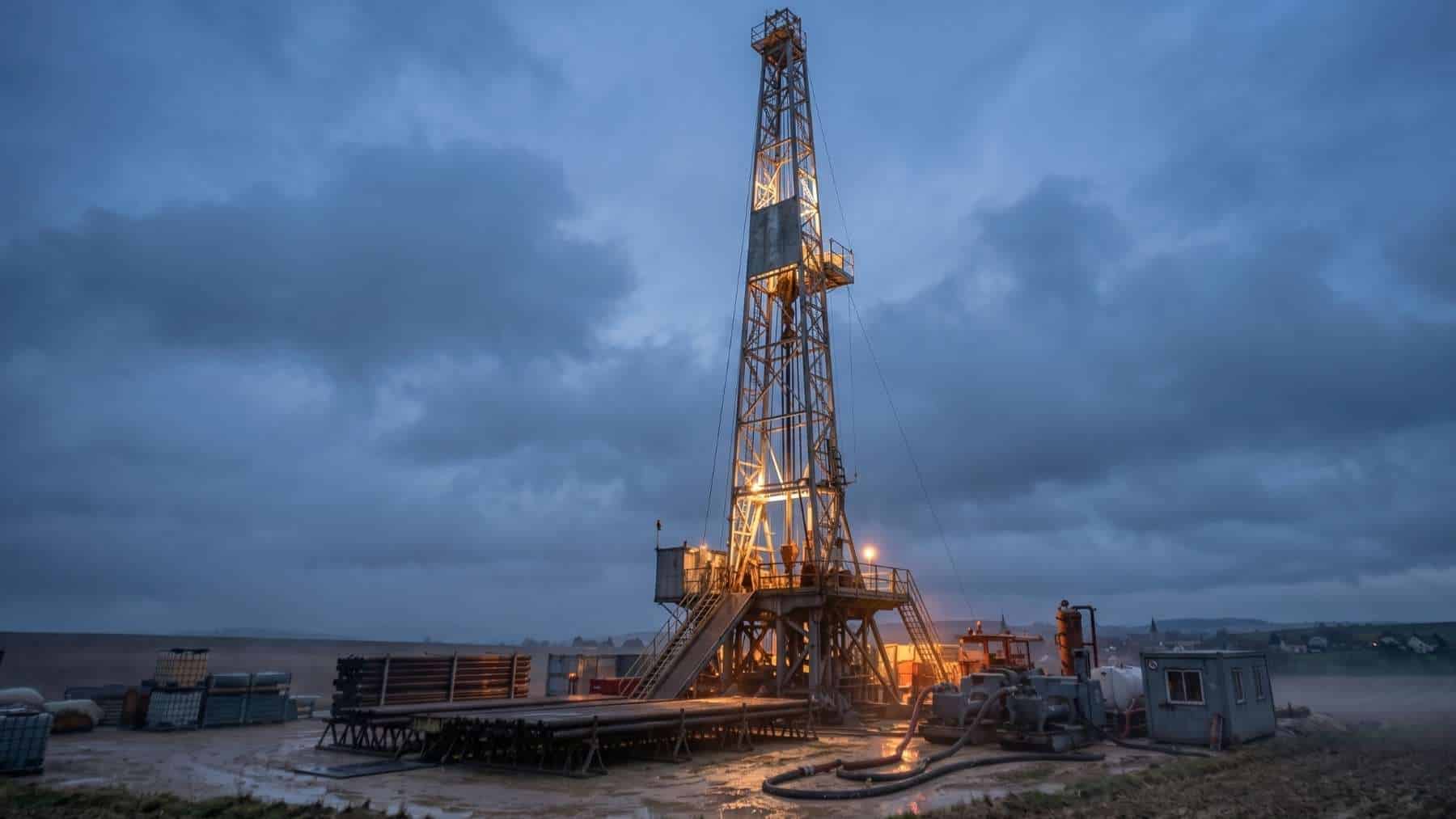
To test the deep part of the theory, Française de l’Énergie, the company that operates the site, spent the winter drilling a new well near the village of Pontpierre, about 25 miles east of Metz. The rig that did the work stands roughly 135 feet (41 meters) tall and was hauled in from Austria. The well reached about 11,990 feet down (3,655 meters), which for a stretch made it the deepest hydrogen exploration borehole in the world. The original target was the 4,000-meter mark, where the reactions that generate the gas are thought to be most active.
One detail matters more than the depth. The hydrogen here isn’t sitting in an open pocket the way natural gas does. It’s mostly dissolved in deep, salty water trapped in porous rock, which is a very different thing to pull out. That’s the question Pontpierre is built to answer: is this a fixed tank you drain once, or a system that keeps refilling itself, and can you get the gas to the surface at a price anyone will actually pay.
Belgium drove to the drill site in May
On May 26, Belgian energy minister Jean-Luc Crucke and a team from the Geological Survey of Belgium turned up at the Pontpierre site for a working visit, according to the Royal Belgian Institute of Natural Sciences. The trip was part of a national program Belgium has stood up to go hunting for its own natural hydrogen. The reason is geology, not courtesy. The rock formations under Lorraine don’t stop at the French border, and researchers think the same hydrogen-bearing system may extend under Belgium, Luxembourg, and Germany.
That cross-border angle is a big part of why a regional methane study turned into a continental one. A pipeline project called mosaHYc is already being built to shuttle hydrogen between France, Germany, and Luxembourg. If Pontpierre confirms a recoverable resource, the plumbing to carry it is partly drawn up. The next step on site is the first in-place measurement of dissolved hydrogen, using a probe the French team built specifically for narrow boreholes.
The ground has been making it the whole time
Natural hydrogen, sometimes called white, gold, or geologic hydrogen, isn’t manufactured and isn’t a fossil fuel. It forms when water meets certain iron-rich and magnesium-rich rocks deep underground, in a reaction that splits the water molecule and frees the hydrogen. (Radiation breaking down water does it too, more slowly.) The useful part is that in the right rock, the reaction keeps running, which is why some of these reservoirs look like they recharge instead of running dry.
The science behind that has been firming up fast. We covered the Canadian Shield measurements in May, where geochemists clocked sustained hydrogen leaking out of billion-year-old rock at a mine near Timmins, Ontario, and worked out it was being generated continuously rather than just sitting there. The French and Canadian stories are two ends of the same idea: the planet runs a slow chemistry experiment in its own crust, and we’re only now learning to read the output.
France isn’t the only one digging
The most aggressive player on the commercial side is American. Koloma, a Denver startup backed by Bill Gates’s Breakthrough Energy Ventures along with Khosla Ventures, Amazon’s Climate Pledge Fund, and others, has raised more than $400 million, which makes it the best-funded company in the space by a wide margin. Its operating arms have drilled test wells in Kansas and Iowa, and it secured a permit to drill in Canyon County, Idaho. The company stays deliberately vague about results, telling reporters it shares updates only when there’s meaningful news to share.
It has company. Natural Hydrogen Energy drilled an exploratory well in Nebraska. The Australian outfit HyTerra holds roughly 39,000 acres of exploration ground in Kansas, with mining giant Fortescue buying a 40% stake. Another Australian company, Gold Hydrogen, ran a campaign on the Yorke Peninsula in South Australia and reported gas that tested as pure as 86% hydrogen. By one industry count, there are now around 60 companies chasing this.
The only place actually using it is a village in Mali. In Bourakébougou, engineers drilling for water about 40 years ago hit a hydrogen reservoir instead, capped it after a cigarette set the gas stream on fire, and walked away. A Malian businessman had the gas analyzed around 2012, and today a producer called Hydroma runs the well, which powers the town. By one estimate, that hydrogen comes up for roughly $0.50 a kilogram, the kind of number that keeps the rest of the industry awake at night.
The USGS put a planet-sized number on it
In December 2024, two U.S. Geological Survey scientists, Geoffrey Ellis and Sarah Gelman, published a model in Science Advances estimating how much geologic hydrogen is locked in the Earth’s crust. Their range ran from 1 billion to 10 trillion metric tons, with a best guess around 5.6 trillion. For scale, that’s roughly twice the energy held in every proven natural gas reserve on the planet. The same model figured the ground manufactures something like 15 to 31 million tons of fresh hydrogen every year.
The line that number usually gets wrapped in, that this could power the world for centuries, comes from a thin slice of the total. Ellis has said that if just 2% of it turned out to be recoverable, it could cover projected global hydrogen demand for about 200 years. He’s also been first in line to wave people off the hype, cautioning in Chemical & Engineering News coverage of the study that most of that hydrogen is “probably inaccessible,” too deep, too far offshore, or too thinly spread to ever pull up at a profit.
“Free” is doing a lot of work in that sentence
White hydrogen is free in the sense that nobody had to build a plant to make it. It is not free to get out of the ground, and right now nobody has proven they can do that at scale at a price industry will pay. Pontpierre is a science well, not a producing field. Koloma won’t even say when it expects to sell anything. The Lorraine estimates swing from 34 million tons to 250 million depending on who’s holding the calculator, and they describe what might be down there, not what comes up.
Even if the gas flows, getting it from a borehole in Moselle to a paying customer is its own expensive problem. The hard part of any hydrogen chain has never been sourcing the molecule; it’s moving and storing the stuff without losing a fortune. Cheap hydrogen straight out of the rock fixes one half of that and does nothing for the other.
That’s why the first real buyers, if there are any, won’t be far from the wellhead. Heavy industry, the steel mills and fertilizer plants and refineries that already burn through most of the world’s hydrogen, sits close enough to a potential source to skip the transport headache, and it doesn’t care what color the molecule is as long as it’s cheap and steady.
So the French aren’t sitting on free energy, exactly. They’re sitting on a very large maybe, under a town that used to dig coal, and half of Europe is now driving over to watch them find out.