
Hurricane Isaias came ashore near Destin, Florida, on Friday. And by early Saturday, more than 726,000 utility customers across Florida and Alabama had lost power, according to the Associated Press. So you’d be forgiven for missing what went up on Okaloosa County’s Facebook page that same night.
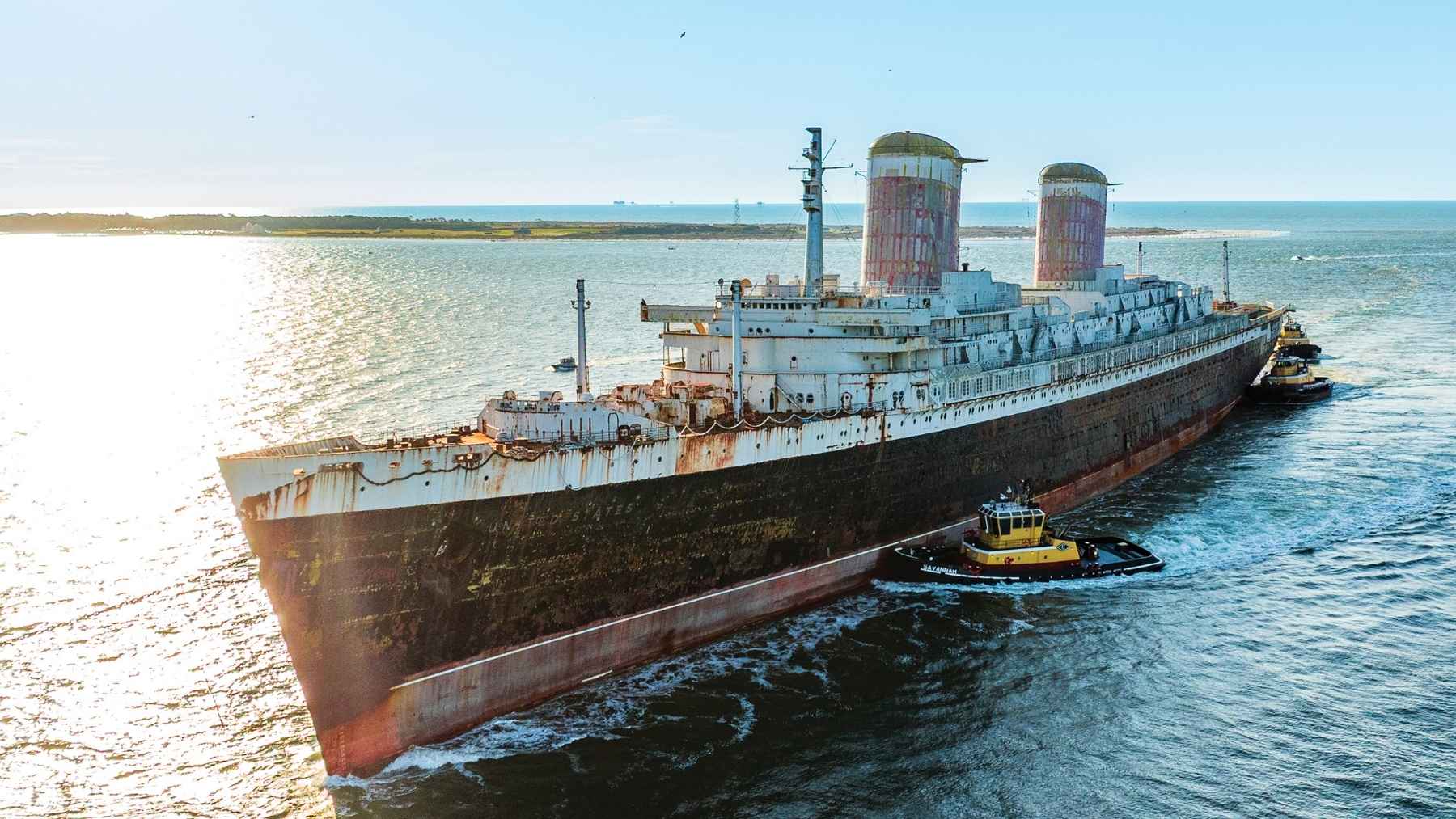
That post is the reason I’m writing this. Okaloosa County bought the SS United States to sink her as an artificial reef, and it’s finally put a date on it. The 990-foot ocean liner is set to go down about 22 nautical miles (roughly 25 miles) southwest of Destin-Fort Walton Beach during the second week of November. The county called the timing weather-dependent and said the dates could still change.
She’s now spent 19 months tied up in Mobile, Alabama. Two weeks ago, the county told FOX10 News it was still waiting on one signature from the U.S. Army Corps of Engineers.
The county’s post doesn’t say whether that signature came through, and I couldn’t find anything from the Corps about it. I’d read a firm date as a decent sign that something moved on the federal side, but that’s my guess, not the county’s.
The post didn’t mention the storm, either. As of Saturday morning, I hadn’t seen any reports of damage to the ship, though Mobile officials were dealing with trees and power lines down around town.
So what took so long?
She’s been ready, at least by the county’s count, since the spring. Crews in Mobile emptied every one of her fuel tanks and stripped out her wiring, portholes, and windows. Her two funnels and her radar mast came off last year, and they’re being saved for a land-based museum the SS United States Conservancy is planning in Okaloosa County.
The permit has been the holdup. Okaloosa County asked the Army Corps to modify an artificial reef permit that’s been on the books for about 30 years, according to FOX10, so the ship could go into deeper water with a different clearance requirement over the top of her.
A reef permit basically sets a minimum amount of open water between the highest point of a wreck and the surface, and that minimum is the clearance. It keeps a passing boat from finding the reef the hard way.
Okaloosa County’s own FAQ still lists a proposed depth of 180 feet to the seafloor and about 55 feet of water over her upper deck. Those figures first showed up before the county asked for the permit change, though, and I haven’t seen updated ones.
The county has paid for the wait, too. In mid-September, Okaloosa commissioners added $1.242 million to the project and locked in her berth in Mobile until the end of the year, according to Cruise Industry News. FOX10 reports that $944,000 of the new money is set aside just to keep her docked if she has to stay longer. That’s a fairly expensive parking spot, even for a ship this size. The county’s budget paperwork, as quoted by Cruise Industry News, puts it this way: “There is no precedent for a project of this magnitude.”
Its contract with Coleen Marine, the company preparing the ship, now totals $11.42 million.
How big is the SS United States, anyway?
Oh, she’s big. She’s 990 feet long, and the country says no larger passenger ship has ever been built here. Her design displacement of 45,400 tons is about the same as the 45,000 tons of the battleship Wisconsin, which tugboats nudged four feet off her museum pier in Norfolk last month so workers could swap two rubber fenders.
If you’re wondering what displacement means in this case, it’s the weight of the water a ship pushes aside when she floats, which works out to the weight of the ship herself. Gross tonnage (the 53,329 figure you’ll find on some spec sheets) measures the space inside the hull, so it isn’t a weight at all.
Her real weight today is lower than that design figure, since she’s lost her funnels, her mast, her fuel, and most of what was left inside her. The county hasn’t published a current number.
She earned the fame, too. She hit 38.32 knots (about 44 mph) on her full-power trial run, and her first eastbound crossing of the Atlantic took the Blue Riband, the unofficial prize for the fastest liner crossing, away from the Queen Mary.
Then the jets showed up. She hasn’t carried a paying passenger in almost 57 years, and she spent nearly three decades of that tied to a pier in South Philadelphia before Okaloosa County paid $1 million for her.
Figures: Okaloosa County, FOX10 and published specifications for the SS United States.
The county wants her to land upright
So how do you sink a ship this big on purpose and keep her right side up?
Okaloosa County’s FAQ says the plan calls for holes cut in carefully chosen spots around the hull, so she stays upright as she floods, plus passages opened up inside so fish and other marine life can move through her. Basically, you let the Gulf in on purpose, in the right places, so she doesn’t roll over on the way down. Her engines don’t work anymore, according to the county, so tugboats will have to haul her out to the site, just like they hauled her down from Philadelphia.
The Navy did something similar with the 32,000-ton carrier Oriskany off Pensacola two decades ago. Navy divers detonated charges to open her hull, and NBC News reported at the time that she was out of sight in about 37 minutes. She sits in roughly 212 feet of water today, according to the Florida Fish and Wildlife Conservation Commission.
The SS United States will land about 12 miles from her, by the county’s estimate. Okaloosa County says it’s already sunk more than 20 large ships as reefs, and as far as I can tell, none of them came anywhere near this size.
If you were hoping to watch, the county’s FAQ says it’s working on a way to make the sinking viewable, online or in person through the media. I know what I’ll be doing that day.
Not everyone wants her sunk
The SS United States Preservation Foundation has pushed the county to do more cleanup before she goes down, and its biggest worry is paint. Earlier this year, the foundation’s chief sustainability officer, Justin Ruby, read county commissioners a statement from University of Florida researcher Todd Osborne estimating that the ship’s coatings contained roughly 60,000 pounds of zinc chromate, according to FOX10. Ruby warned about the hexavalent chromium in that coating and how easily it moves around in seawater.
The county’s answer, on that same FAQ page, is that federal artificial-reef rules don’t regulate that coating, and that it’s followed the EPA and Maritime Administration’s best practices for preparing ships to be sunk. It also argues that the realistic alternative was to scrap the ship, with the ship’s history “lost to a razor blade factory.” That’s arguably the most effective line in the whole debate, whatever you think of the plan.
I’m not a marine chemist, so I can’t tell you who’s right about the paint.
If you’d like to see her before she goes, the county says she’s visible from the public street next to 601 South Royal Street in downtown Mobile, though the private property around her is off-limits. Mobile’s waterfront has another famous ship coming, too. As we covered last month, the Navy has hired a contractor to tow the old nuclear carrier Enterprise to a Mobile River yard near her berth and dismantle her there.
The Atlantic hurricane season runs through the end of November, so I’d take the weather caveat pretty seriously. As of Saturday, though, Okaloosa County still has the SS United States going down about 22 nautical miles southwest of Destin-Fort Walton Beach during the second week of November, and it says it’ll share more about the plan over the next few weeks.