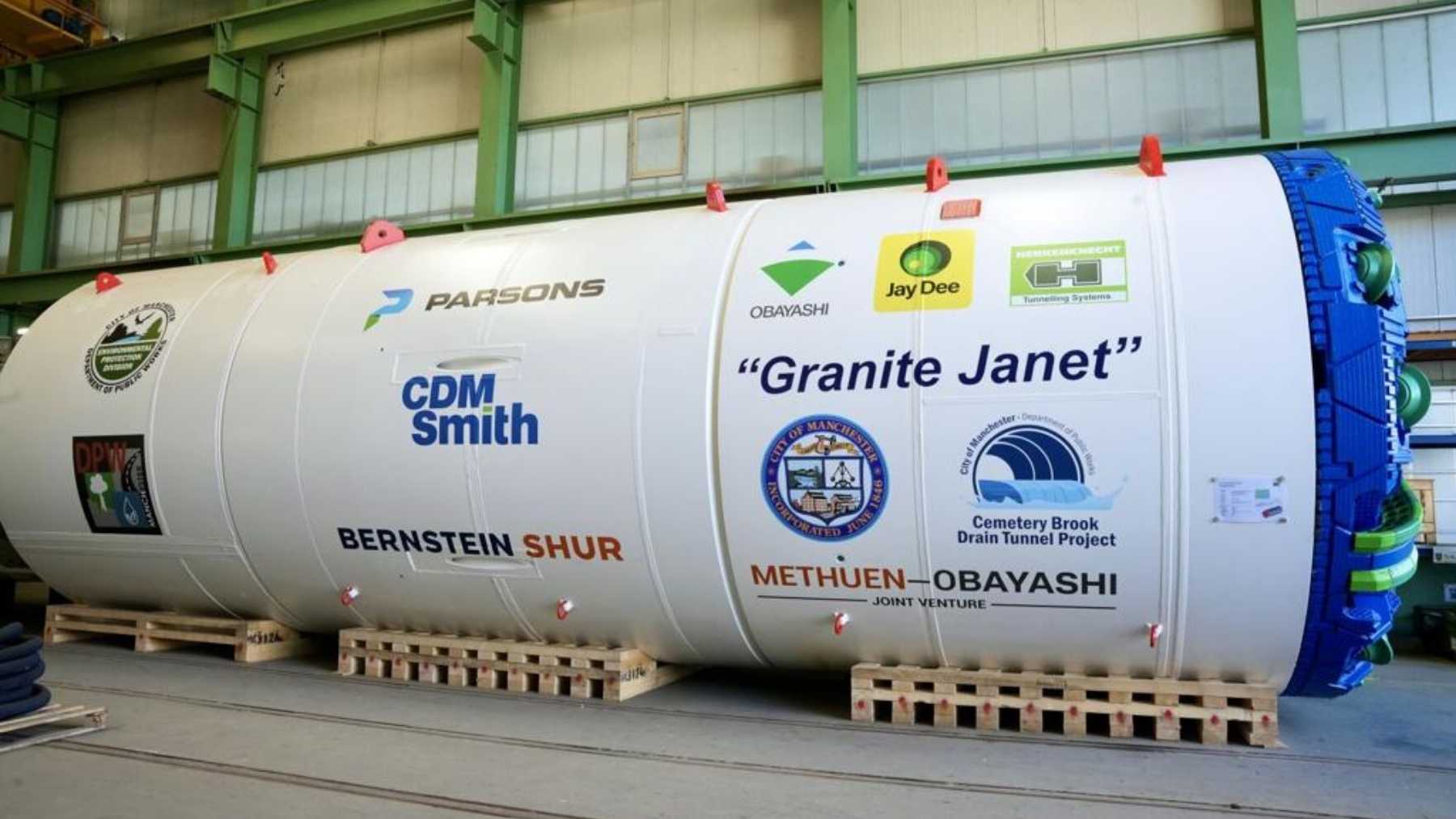

Big public works projects in this country tend to run at two speeds: late and later. So I’ll admit the latest update out of Manchester, New Hampshire, caught me a little off guard.
Granite Janet, the 281-ton boring machine we checked in on last month, is digging. She actually launched in late August, according to the New Hampshire Union Leader, which is earlier than we’d figured when we wrote that piece. By the end of September, she’d put just over 200 feet of tunnel behind her, and Manchester Ink Link reported that the job was running ahead of schedule.
That’s a pretty respectable start, especially since she’s been doing it with part of her own gear still sitting outside the tunnel. She’s also on the small side, for what it’s worth: each of the 1,680-ton machines lined up to dig the new rail tunnel under the Hudson weighs about six times her 281 tons.
So why is part of the machine still outside?
The spinning cutter and steel shield you see in photos are only the front end of a machine like this. Everything that keeps them running, from the slurry pumps to the water and compressed air, rides along behind on a line of trailer-like platforms called gantries. Granite Janet has 16 of them, according to Engineering News-Record.
And at this site, there’s nowhere to put all of them at once. She launched from a cramped pit beside the Merrimack River, practically under the Queen City Bridge, so the gantries get hooked on one at a time as the tunnel grows long enough to hold them. The city still lists installing them as active work on its project status page, and Ink Link says everything should finally fit inside once the tunnel reaches 580 feet. Progress is expected to speed up from there.
So how is a machine averaging something like six feet a day ahead of schedule?
Six feet a day is about what you get if you divide Ink Link’s 200-odd feet by its five-ish weeks, and it’s a long way from the roughly 35 feet a day that project engineers expect, according to what the city told the Union Leader in the spring. I’d assume the schedule already bakes in a slow start. No one runs at full speed with part of the kitchen still on the moving truck.
She’s building the tunnel’s walls as she goes, too. Every five feet, the machine stops to set six curved concrete segments into a ring, then pushes off that ring to cut the next five feet. Each segment weighs about 5,000 pounds, and the finished rings leave the tunnel with a 12-foot inside diameter. Parsons resident engineer Ed Pietrasz, whose firm manages construction for the city, summed up the routine pretty well for the Union Leader: “think about tunneling two and a quarter miles down, in five-foot increments.”
That’s roughly 2,400 rings for the whole tunnel, if you’re counting. I am, apparently.
Her first stretch runs under a railroad
Granite Janet didn’t exactly ease into this job. The tunnel’s first leg heads away from the riverbank under an active CSX rail line, and the Union Leader photographed a train rolling right over the tunnel near its mouth in September.
She also started out pretty shallow. When the paper visited in September, she was working about 15 feet below the surface with only 10 to 12 feet of ground overhead, while the finished tunnel will run as deep as 80 feet farther along.
Engineers worry about something called settlement here. Basically, when you dig a tunnel, the earth above it tends to sag a little, and the less dirt there is between the tunnel and the surface, the more of that sag shows up on top. Parsons says the job has to stay within strict settlement limits for the railroad, and the city has already finished ground improvement work under the crossing.
CSX even gets its own dirt pile. The railroad has separate testing requirements for anything mined from under its property, so the crew keeps that muck apart from the rest and tests it to CSX’s standards, Pietrasz told ENR. I suppose that’s one way to make sure no one argues later about whose dirt is whose.
What’s this tunnel for, anyway?
Like a lot of older American cities, Manchester has neighborhoods where rainwater and sewage share the same pipes. That’s fine on a dry day. But a heavy storm can overwhelm the system, and the overflow ends up in the Merrimack River instead of the treatment plant.
The new tunnel pulls Cemetery Brook, a stream that now drains into that combined system, out of the mix and gives its storm flows a route of their own to the river, according to Parsons. So, yes, a 281-ton machine built in Germany is basically building a brook its own private freeway.
Keeping that overflow out of the Merrimack matters, since the river is a source of drinking water for more than 600,000 people, according to ENR. The city puts the tunnel’s price at more than $360 million, which local ratepayers are covering through rate increases the Board of Mayor and Aldermen approved, Ink Link reports. The whole project grew out of a settlement Manchester reached with the EPA.
EPA Administrator Lee Zeldin toured the future outfall site at the end of September and said other local governments should be “looking at this project in Manchester and learning from it.” Admittedly, five weeks of digging is a pretty small sample for a 2.25-mile tunnel. Still, I’d guess plenty of cities would happily take that first report card.
Granite Janet is a better name than you’d think
Tunnel crews have been naming their boring machines after women for a long time. The Manchester School District, which helped run the naming contest, traces the custom back centuries to miners who counted on Saint Barbara to keep them safe underground. Which is a little ironic, since plenty of miners also considered a real woman in the tunnel to be bad luck.
Janet Bonnema, the woman Granite Janet is named after, ran straight into that superstition. She passed the Colorado Highway Department’s test for a job on the Interstate 70 tunnel that’s now called the Eisenhower Memorial Tunnel, and the offer letter came addressed to “Mr. Jamet P. Bonnema,” according to the Federal Highway Administration’s account of her fight. If you’ve ever driven I-70 west into the Colorado Rockies, you’ve been through that tunnel.
The state did hire her, but as a special technician who wasn’t allowed inside. It took a U.S. Department of Transportation ruling that keeping her out was sex discrimination, and then a lawsuit, before she finally walked in wearing coveralls and a hard hat. More than 60 workers walked out that day. The tunnel didn’t cave in. All but one of them were back the next day.
The kids who picked her were Aaron Nicholas and Jullien Santos, a pair of seventh graders at Hillside Middle School, and they won a contest that the mayor’s office, the school district and the contractor ran across all four of Manchester’s middle schools. The rules asked for a woman’s name connected to the project and to what the machine actually does. The Granite part does double duty, since New Hampshire’s the Granite State and the bedrock along her route includes actual granite, according to Parsons. Frankly, I’d put it near the top of the boring machine names I’ve come across.
Ink Link’s report is the latest footage count I could find, so I can’t tell you exactly where Granite Janet is today. As of the end of September, she had a little under 380 feet to go before her whole train fits inside, and a little over two miles after that to the far end near Mammoth Road. The contractor’s safety agreement with OSHA has the whole project wrapping up in 2028.