

- 3 MONTHS AGO · ENERGYAn 88,000-pound steel door came out of a Missouri River dam weighing 113,000, and the extra 25,000 pounds was a zebra mussel that tops out at 1.9 inches, had a generator offline twice a month by 2019, and can ride to the next reservoir on a single boat
- 2 MONTHS AGO · ENERGYA milling machine that drills holes for the steel biscuits bridging a fusion reactor’s seams took the tight bends of its D-shaped practice rails without a hitch, while the trolley for the X-ray head and the plate positioner both came back needing changes
- 1 MONTH AGO · ENERGYA 240-ton excavator named the Empress bites through steel I-beams at a former uranium plant in Ohio with 56,000-pound shears, took down the first corner of a 33-acre building a month ahead of schedule, and its blades last 40 to 80 hours before they get rotated like tires
- 4 WEEKS AGO · ENERGYThree 365-ton steam generators, each as tall as a six-story building, crossed the world by ship and rode a river barge and a special trailer into a French nuclear plant, where they’ll sit in storage until the reactor shuts down for an eight-month overhaul
- TODAY · THIS ARTICLEA 484-megawatt reactor on the Missouri River ran 43 years and took 10 more to tear down, its 500,000-pound steel vessel was cut into 43 pieces with a torch and shipped out by rail, and a six-bay garage is one of six buildings still standing where the plant used to be
Alright, there’s a reason I don’t work on my car or build things. I know, I know. Can I really call myself a car enthusiast if I don’t do a shoddy DIY fix? Enough about me.
If you are one of the weirdos who likes to do all that kinda stuff, you probably know how much work it is to knock down a backyard shed. Well, it’s not the knocking down part that’s hard. It’s the hauling. Trip after trip to the dump, and then that moment when you stare at a bare patch of dirt and wonder what goes there now. The Omaha Public Power District just finished that exact job on a nuclear plant, and it took 10 years.
OPPD says it reached what it calls substantial completion at Fort Calhoun Station on October 7. In plain English, that means the physical demolition’s over, every radioactive piece of equipment is off the property except the fuel, and what’s left is paperwork. The utility announced it on October 14 through its own news site, The Wire.
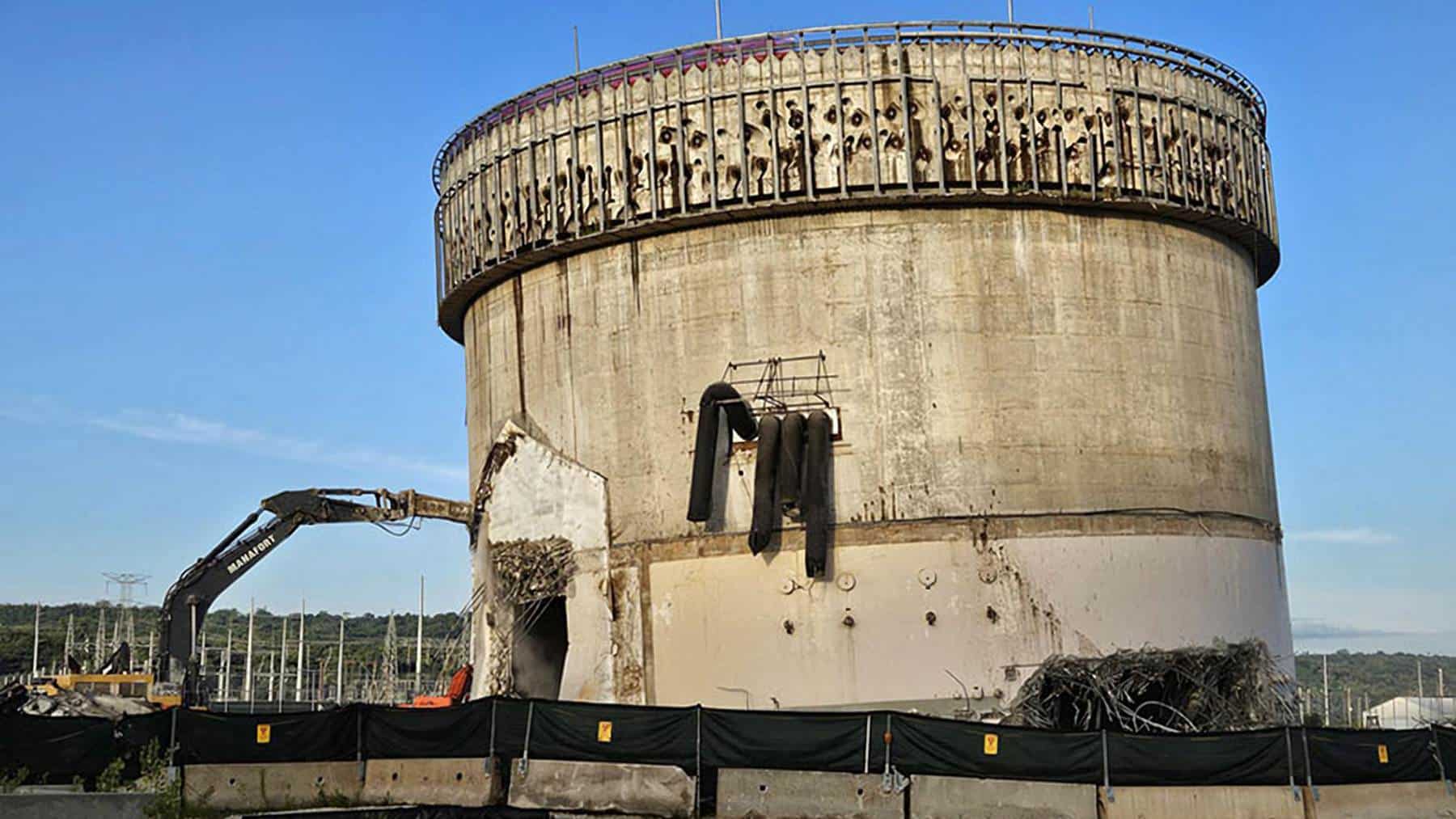
So what does a nuclear plant look like once you’re done tearing it down? Apparently, a lot like a rural equipment yard. OPPD lists what’s still standing on the site outside Blair, Nebraska, about 20 miles north of Omaha: a substation, the old training center now used as offices, a concrete storage building, a metal equipment shed, and a six-bay garage.
That’s a nicer garage than I’ve got.
There’s one more building on the property too, and we’ll get to it, because it’ll outlast the garage by a few decades.
So why did a working reactor get shut down at 43?
Fort Calhoun came online in 1973, and the Nuclear Regulatory Commission’s record shows the plant’s operating license dated August 9 of that year. It ran until October 24, 2016. The plant had a single pressurized water reactor, built by Combustion Engineering, which is basically the design most of the American fleet runs on. Uranium heats water that’s kept under enough pressure that it can’t boil; that water boils a second loop, and the steam spins a turbine.
The reactor put out 484 megawatts of electricity. OPPD says that was the smallest rated capacity of any operating commercial nuclear plant in North America, and that small size is pretty much what did it in. Tim Uehling, OPPD’s senior director of decommissioning, has said that running Fort Calhoun took as many people as a plant twice its size, and the numbers never worked. Cheap natural gas in the mid-2010s didn’t help either. OPPD’s board voted to close it in 2016, and it went dark that October.
Would that call look different today? With utilities in Michigan and Pennsylvania spending billions trying to restart plants they’d already shut down, I’d say probably, yes. But a 484-megawatt plant from 1973 is a different animal from those, and the reactor’s in 43 pieces at a disposal site in another state anyway.
That ship’s sailed, and it sailed on a rail car.
So what took 10 years?
Most utilities with a dead reactor do what the industry calls SAFSTOR: lock the gate and wait a few decades for the radiation to fade before anyone picks up a torch. OPPD started down that road and then changed its mind, which I think was the right call. In December 2019, it told the NRC it was switching to DECON, which basically means start cutting now, and it brought in a decommissioning contractor, EnergySolutions, the same year.
The fuel came out first. The last canister of spent fuel went into dry storage in May 2020, and that took the biggest hazard out of the building and put it in concrete. Then came the hard part.
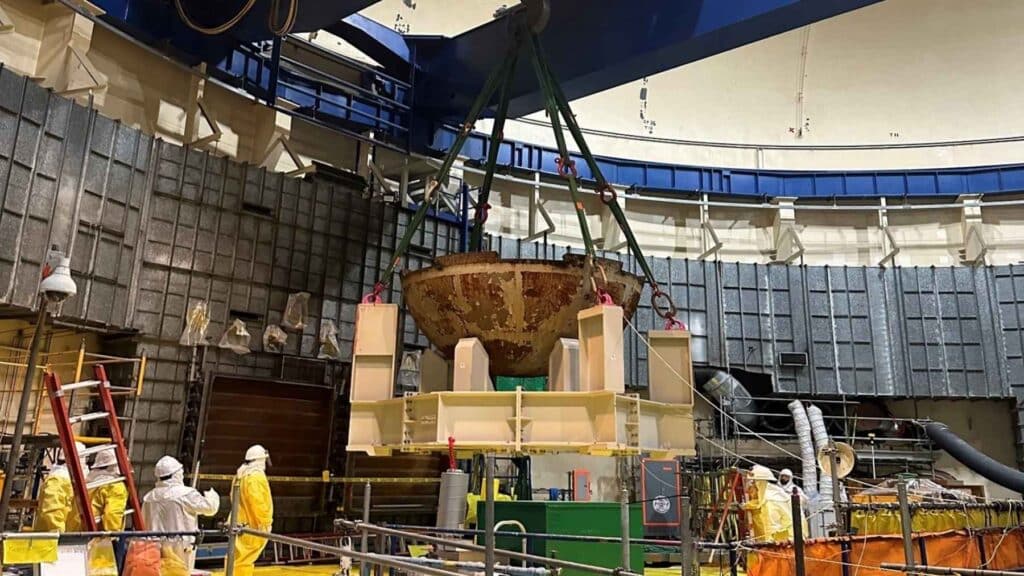
The reactor vessel at Fort Calhoun was a carbon-steel can about 32 feet tall and 14 feet across, with walls 7 to 10 inches thick, and it weighed in at more than 500,000 pounds. So picture a water heater built for a giant, except decades of neutrons have made the metal itself radioactive. Clearly, nobody’s buying it as scrap. Nobody even wants to stand next to it for long. Crews cut it into 43 pieces with an oxy-propane torch over two months and finished in early December 2023. The pieces ranged from 6,000 to 40,000 pounds apiece; the bottom bowl alone weighed about 80,000, and it all went out of state to a licensed disposal site.
The two steam generators, the coolant pumps and the pressurizer were next on the list for 2024, and the rest of the guts of the containment building came out through 2025. The containment building itself, the last big structure on the site, came down in the fall of 2025, a few weeks ahead of schedule, with crews hauling rubble to a waste yard next to a rail line through October and part of November. OPPD expected the last train out in the first quarter of this year.
Which brings us to this month. Workers pulled the final radiological samples in early October, and they’re headed to OPPD’s own lab and to an independent one-off site. That step will prove to the federal government that the dirt and water are clean. OPPD’s been sampling soil and water around the 600-acre property for years, and this round’s the last.
So is it done? Not on paper
OPPD’s sending its final decommissioning paperwork to the NRC in six phases. The commission’s approved the first two, and it’s reviewing the third, a process OPPD says takes about six months and comes with follow-up questions. The fourth’s in, and the last two should be on the NRC’s desk by January. If all of it checks out, the NRC releases the land for unrestricted use, and OPPD can do whatever it thinks serves its customers best with it. The utility says farming’s on the table. So, from the sound of it, is pretty much anything else.
I’d like to tell you what the whole decade cost. OPPD’s announcement doesn’t say, and I haven’t found a final figure anywhere else, so I’m not going to guess at one.
Hundreds of OPPD employees worked at the plant over the years, and many stayed on to take it apart. Uehling spent his whole career there in one role or another. “I think that, by and large, everyone is awfully proud of the legacy of Fort Calhoun,” he told The Wire. Frankly, spending a decade carefully dismantling the building you spent 30 years keeping alive sounds like a strange kind of grief, and he says as much: when your part of the plant came down, it got a little emotional.
The fuel stays, and it stays a while
Now, that sixth building. OPPD describes it as a highly secure storage facility for used fuel assemblies, and the NRC’s listing spells out what’s inside: steel canisters that hold 32 assemblies each, slid into horizontal concrete storage modules. Every fuel rod Fort Calhoun ever burned is sitting in there, because the federal government never built the national repository it promised to take it. Until that exists, the fuel belongs to the site. The NRC’s own plan to take apart that storage pad and restore the land is 2059.
That’s the deal at nearly every closed American plant, and we’ve covered a few of them lately. Vermont Yankee’s reactor building left the state as 28,000 cubic yards of concrete, and its fuel stayed behind in 58 casks. The Army just scraped its first reactor off a Virginia post down to seeded grass, and the only reason that field’s empty is that the fuel left in the 1970s. And Nebraska’s other dead reactor, a sodium-cooled one at Hallam, got buried under a mound in 1969, and the government still mows it.
So a garage, a shed, some offices, and a very well-guarded concrete pad is arguably about as clean an ending as an American nuclear plant gets right now. OPPD expects the last two batches of paperwork to reach the NRC by January, and the commission’s calendar has the fuel storage at Fort Calhoun coming out in 2059.
Image Credit: oppdthewire.com
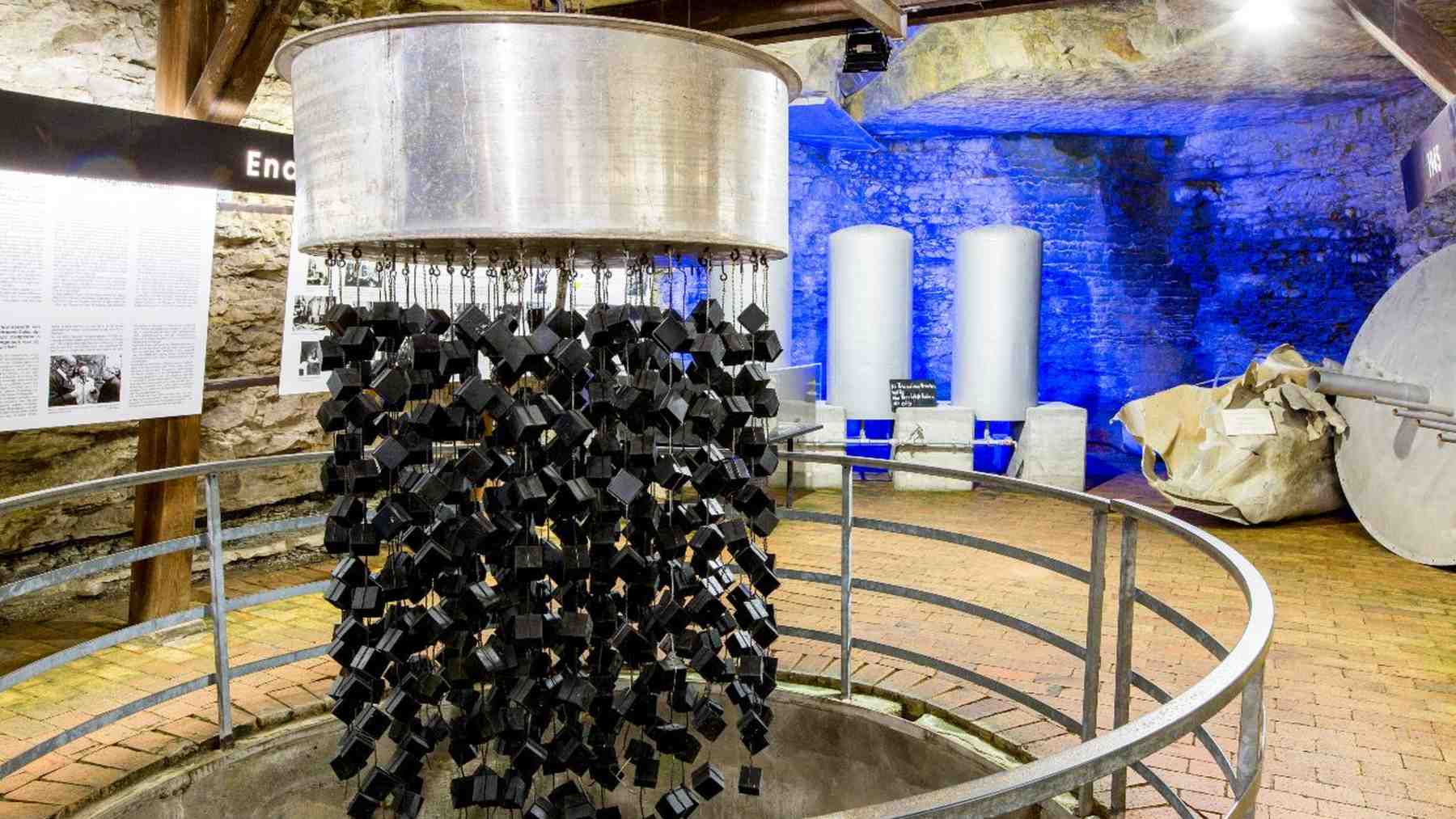
 A reactor built from 664 two-inch uranium cubes hung on wires in heavy water under a German castle was Heisenberg’s last shot at a chain reaction, and two of the surviving cubes now show it needed about twice the uranium and heavy water it held, more of both than Nazi Germany hadEnergy · 12 hours ago
 A 66-foot-deep gravel pit in Finland just started taking in about 100 million gallons of tap water, and once a nine-acre lid goes on top, it’s meant to hold enough summer heat at up to 194°F to cover as much as nearly a quarter of the town’s yearly heat demandEnergy · 13 hours ago
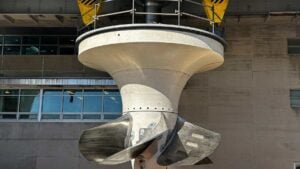 A 375,000-pound turbine now spins inside a Tennessee dam in place of one that ran for more than 80 years, and a federal watchdog just found that 196 of the 240 welds on the ring guiding water out of it failed on a job where some welders weren’t qualifiedEnergy · 16 hours ago














IT'S NOT CLEAR THEN IS IT!!!?
You say the containment structure has been cut into pieces and dumped at "a facility". This is still highly radioactive and dangerous material.
It has not "been disposed of". It's just some where else.
Your estimated costs are therefore total garbage, as they continue into the foreseeable future at an infinite cost, indefinitely.
I think we deserve the truth. Don't you?