
Ribbon cuttings usually mean a machine is about to run for the first time. Somebody hands the president a pair of scissors, a switch goes over, and the turbines start spinning while the cameras are still rolling.
On the Rufiji River in southern Tanzania, the last of the nine turbines had been spinning for sixteen months before the scissors came out.
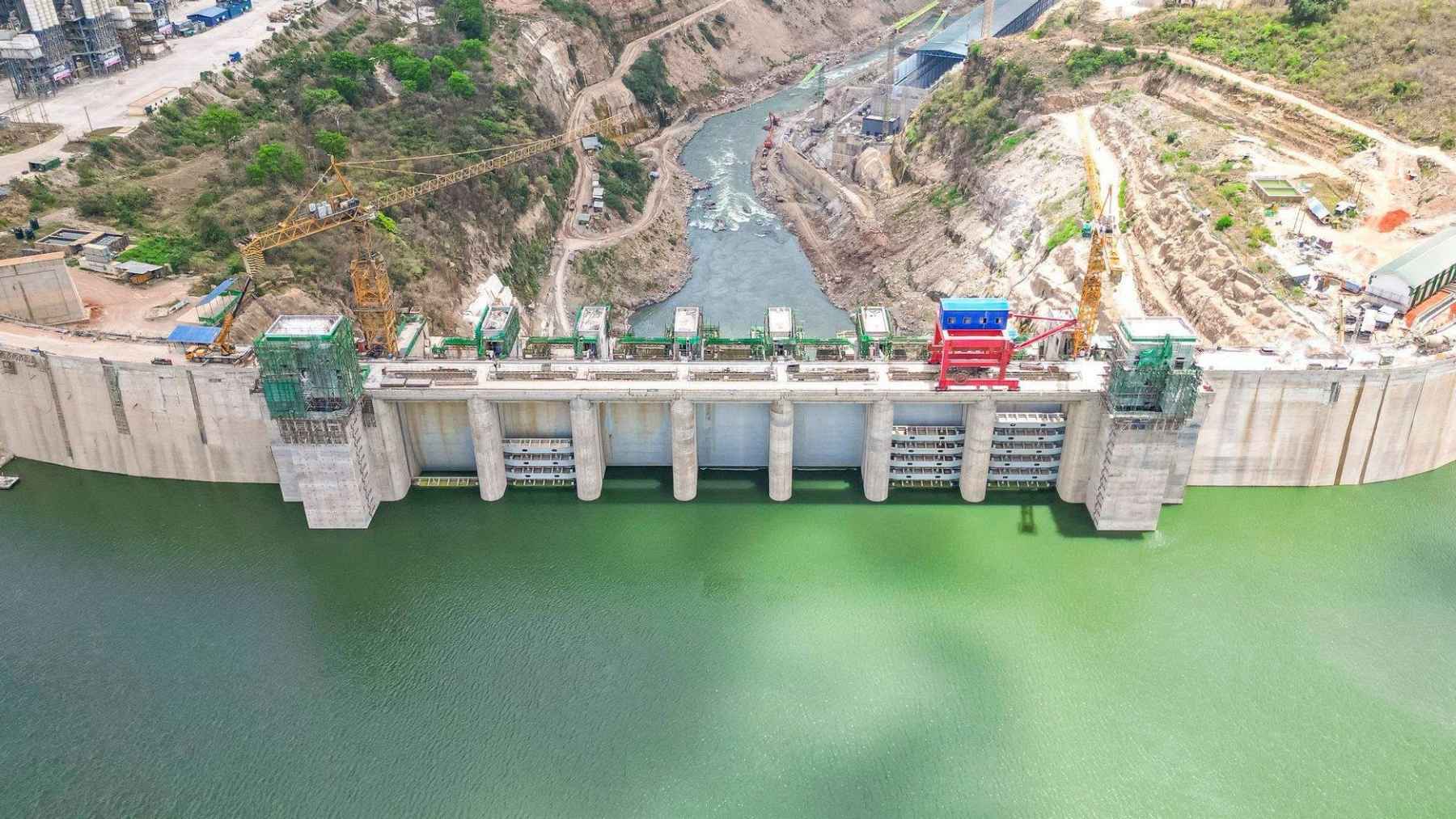
President Samia Suluhu Hassan inaugurated the 2,115-megawatt Julius Nyerere Hydropower Project on August 22, at the plant site in Rufiji District. Nine vertical Francis units sit in that powerhouse, 235 megawatts apiece. Egyptian Prime Minister Moustafa Madbouly attended in place of President Abdel Fattah El-Sisi, whose country’s contractors poured the concrete.
The plant is the largest in East Africa. It also sits inside a game reserve that UNESCO’s World Heritage Committee had voted, three weeks before the ceremony, to keep on its List of World Heritage in Danger.
The turbines beat their own ribbon by sixteen months
TANESCO, the state utility, put the first unit on the grid in February 2024. The ninth followed in April 2025, when Doto Biteko, then deputy prime minister and energy minister, toured the site and confirmed all nine were running, according to ESI Africa. That same report puts annual output at 5,920 gigawatt-hours.
Which means Tanzania spent most of last year drawing power from a plant it had not yet declared open. Nobody claps for a synchronized generator.
Construction ran from June 2019 to March 2025, about 69 months against the 42 the consortium had in its contract. Arab Contractors and Elsewedy Electric, the Egyptian pair, built the dam and the powerhouse, and the contractor’s own accounting puts the workforce at about 1,961 people, most of them Tanzanian.
Dongfang Electric supplied the turbines, the generators and the nine butterfly inlet valves, and China’s state asset commission describes that order as the largest single export of hydropower equipment ever sold under an independent Chinese brand. Tanzania paid the 7.45 trillion shillings out of domestic revenue with no external financing, a figure Reuters put at about $2.84 billion.
The wall holds more water than Lake Mead is rated for
The dam stands 440 feet tall and runs 3,363 feet across the gorge (134 by 1,025 meters), and its reservoir is designed to store 34 billion cubic meters, per Engineering News-Record, which handed the project its Best Project award for water and wastewater. That volume converts to 27.6 million acre-feet, roughly 9 trillion gallons.
Lake Mead runs on a capacity basis of 26.1 million acre-feet and was holding about 6.9 million acre-feet on August 27, according to Bureau of Reclamation gauge data. The largest reservoir in America is rated for 1.5 million acre-feet less than this one. Kidston, the Queensland gold pit an Australian utility filled with 6.6 billion gallons of water for pumped storage, would go into the Rufiji reservoir about 1,360 times.
Hoover Dam carries a nameplate around 2,080 megawatts against this plant’s 2,115. The last machine to pass Hoover on paper was SunZia’s 3,650-megawatt wind farm in New Mexico, which took eighteen years from first sketch to full operation in June.
The Rufiji units are the same family of turbine the Army Corps keeps replacing on American rivers, where a seven-blade runner is going in under the Cumberland to swap out a five-blade one from 1957. That one is 264 inches across and worth 45 percent more power. Each Tanzanian unit is worth 235 megawatts on its own.
Tanzania now has 2,375 megawatts nobody is using
Energy Minister Deogratius Ndejembi put installed capacity at 4,646 megawatts against peak demand of 2,271, which leaves a surplus of 2,375. Hydropower covers 60.3 percent of that installed base, 2,727 megawatts, and this single plant accounts for 2,115 of them. Hassan said the project had helped end the generation shortfall behind years of blackouts.
The wires are the bottleneck now.
Ndejembi said the government finished a 400-kilovolt line from Chalinze to Dodoma, and that national peak consumption climbed from 2,130 megawatts to 2,280 within three days of that line coming online. “We must have a network capable of receiving and transmitting all this power,” he said, in remarks reported by TanzaniaInvest. The Tanzania-Zambia interconnector, 383 miles of line (617 km) running from Iringa through Mbeya to Tunduma and Sumbawanga, is about 98 percent finished. Tanzania has signed an agreement to sell power to Zambia and holds a trading arrangement with Kenya. It still imports 47 megawatts from Uganda for the Kagera region and 20 megawatts from Zambia for Rukwa.
Ndejembi wants 8,000 megawatts installed by 2030, across hydro, gas, solar, wind and geothermal.
UNESCO kept the reserve on the danger list three weeks before the ceremony
The Selous Game Reserve went onto the World Heritage List in 1982 and onto the List of World Heritage in Danger in 2014, after poaching gutted its elephant population. Tanzania re-designated the northern section as Nyerere National Park in 2019, and Stiegler’s Gorge sits in that section, though the World Heritage property still carries the older name. In 2018 the Committee named the dam itself as further justification for the danger listing, in Decision 42 COM 7A.56.
At its 48th session in Busan, held July 19 to 29 this year, the Committee retained 52 properties on that list, Selous among them, and removed exactly one, the historic centre of Vienna. Fifty-eight sites carry the danger label today.
Tanzania set out its own case in a state of conservation report its wildlife authority filed with the World Heritage Centre on February 1. That report says the project has been “implemented in a relatively minor portion of the reserve”, cites ten commissioned scientific studies, and argues the dam now holds back floods that have hit communities downstream in the past.
The IUCN, which advises the Committee on natural sites, wrote in its 2025 outlook that the dam’s precise effects on the property remain unclear and require assessment, monitoring and mitigation. Tanzania has invited the joint monitoring mission that would go and check. Researchers presenting at the 2025 Ocean Sciences Meeting put the mangrove system in the Rufiji delta at 193 square miles (500 square kilometers) and tie Tanzania’s shrimp catch to the river’s seasonal flooding.
No party has alleged that the project violates any law.
Sixty years of surveys, six years of pouring
German surveyors looked at Stiegler’s Gorge in the early twentieth century. Julius Nyerere, the country’s first president, ordered feasibility studies in the 1960s, when the Japan External Trade Organization sketched a 620-megawatt plant on the site. Norway’s development agency, NORAD, produced detailed designs through the 1970s and 1980s. Money and politics killed it every time. TANESCO signed the EPC contract with the Egyptians in December 2018, and the concrete went in a few months later.
Hassan addressed the opposition to the project head on at the ceremony. “We had no way to abandon this project, given its importance to our nation,” she said, in remarks carried by Reuters.
Tanzania’s surplus stands at 2,375 megawatts. One new transmission line took 150 of them in three days, and Ndejembi said so out loud at the ceremony on August 22.