
Drone warfare has mostly been an aerial story for the last decade. Bayraktars over Ukraine, Switchblades in trunks, quadcopters dropping grenades into trenches. The Navy has dabbled with unmanned surface vessels for years too, mostly as tech demos and chase boats in the Persian Gulf. But the U.S. Army just did something different in the Philippines. It put crewless boats in charge of guarding a real cargo run, hundreds of miles across open water, with armored vehicles and Filipino troops riding on the ship they were protecting.
The drill happened during Exercise Salaknib 2026, the annual army-to-army workout the U.S. runs with the Philippine Army. According to USNI News, the Army deployed the drone boats to guard its logistics vessels as the service trains to sustain forces in the first island chain, part of a broader effort to experiment with tactics that could matter in a fight with China. This wasn’t a science fair. It was a rehearsal.
What Happened in Casiguran Sound
Soldiers from the 125th Intelligence and Electronic Warfare Battalion, part of the 25th Infantry Division, deployed a swarm of autonomous boats in Casiguran Sound, off the northeastern coast of Luzon. The boats screened a U.S. Army Logistics Support Vessel carrying Philippine Army armored personnel carriers and troops from Port Tabaco to Port Casiguran, more than 260 miles, roughly 420 km. That is not a quick harbor lap. It is a multi-day haul through northern Luzon waters that sit a stone’s throw from the Luzon Strait, one of the most surveilled maritime corridors on Earth.
The Hawaii-based unit launched at least three unmanned surface vessels to set up a maritime security screen as the landing craft moved the Philippine vehicles. The boats handed the ship off all the way to the dock. Pvt. Caleb Hannah, a soldier on the exercise, said the autonomous ISR boats provided security for the landing craft and “escorted the LSV to port from about six miles out.” Six miles is roughly the distance at which a small attack boat or a mine becomes a real problem if you can’t see it coming.
The Boat Is Tiny, Solar-Powered, and Cheap
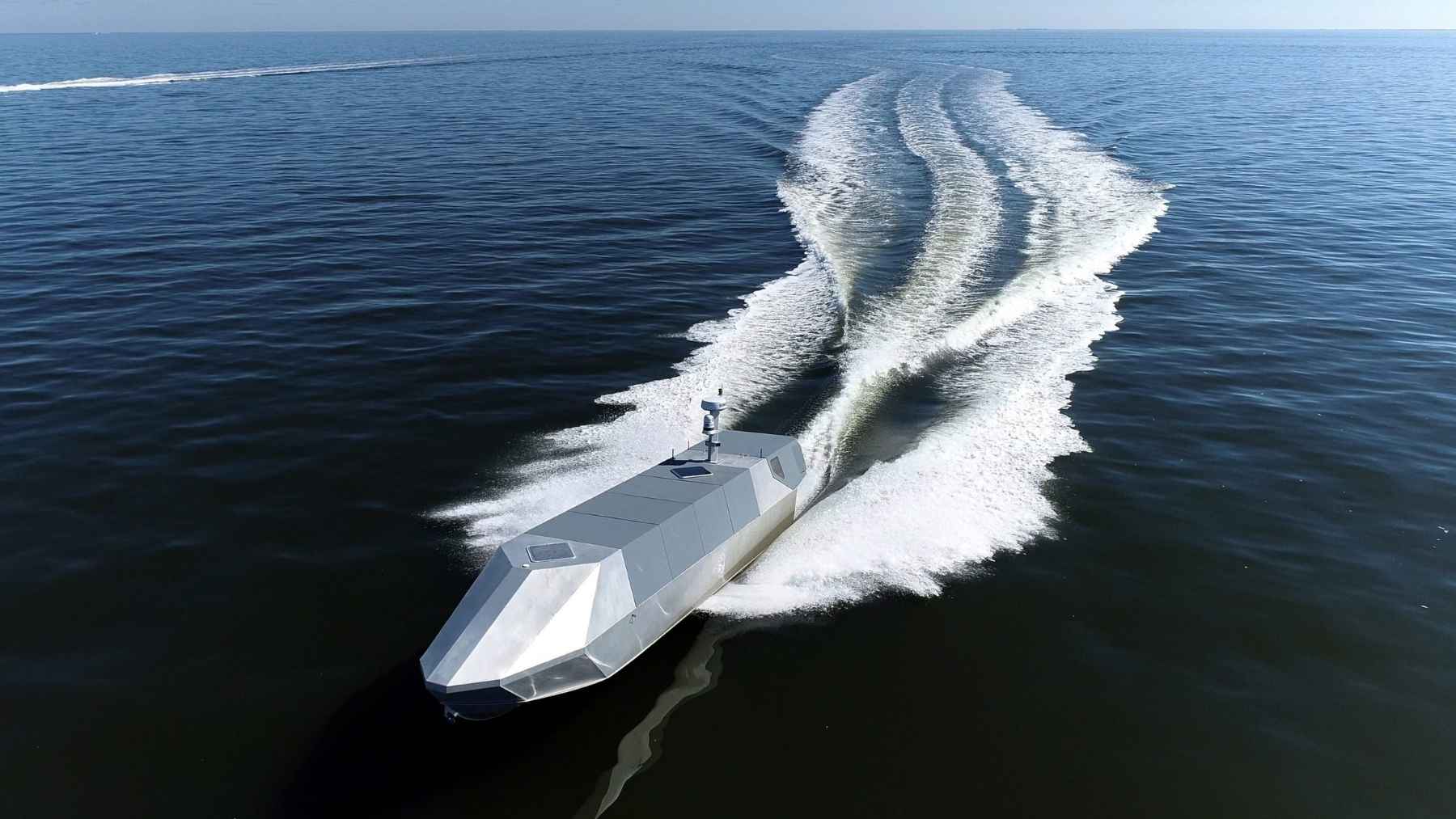
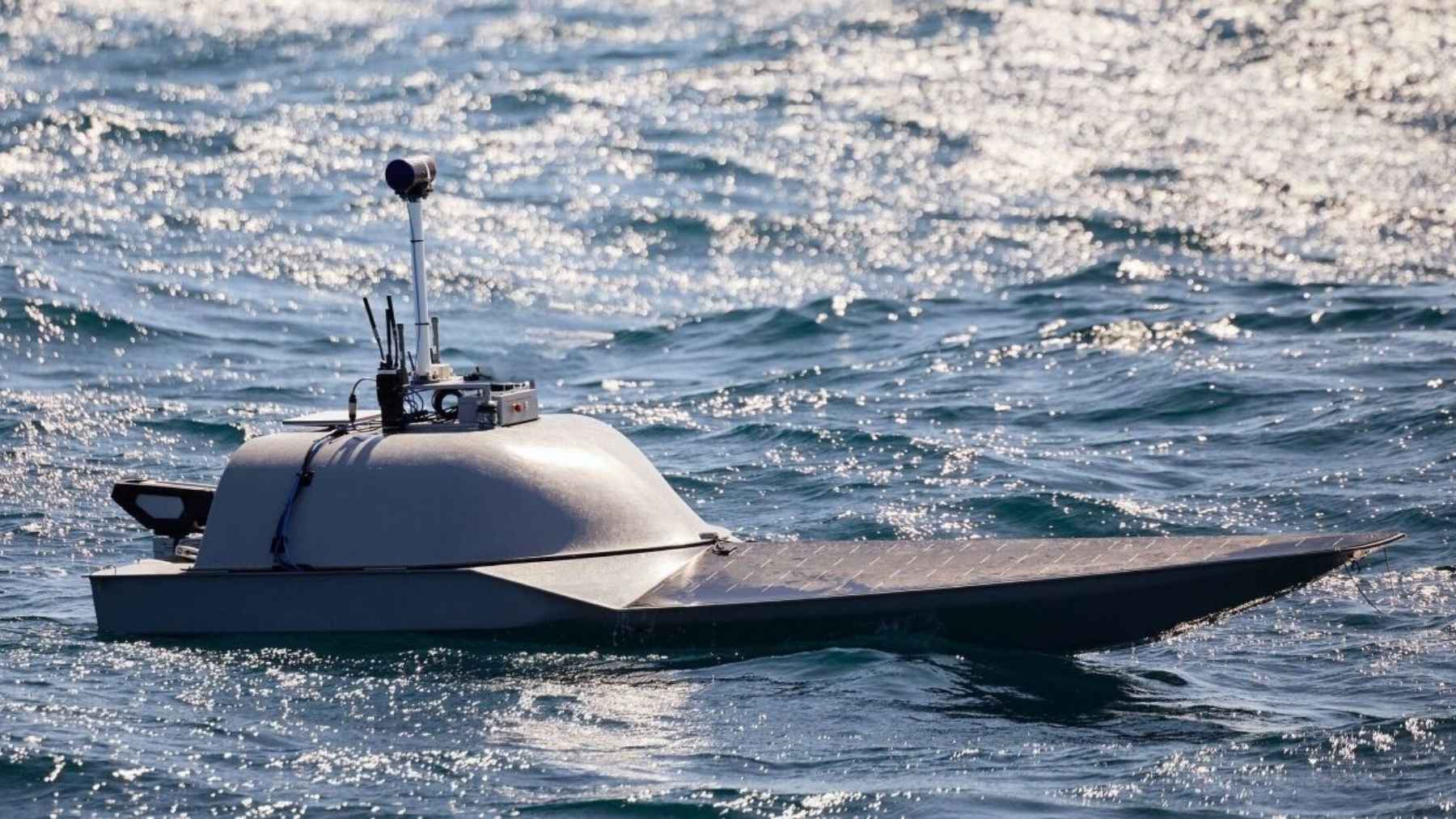
The drones doing the work here aren’t some billion-dollar destroyer-killer. They’re tiny. Defense Department imagery shows the Army used HavocAI’s Rampage, a 14-foot autonomous surface vessel that runs on electric power and solar panels and is built for maritime domain awareness.
The numbers are modest on purpose. The Rampage carries about 136 kg (300 lb) of payload, tops out around 15 knots (roughly 17 mph), and sips sunlight to stay on station. That small hull pairs the payload with satellite-linked control and mesh networking, so one operator can run several boats at once while keeping a steady watch. HavocAI, a Rhode Island startup, prices each Rampage at roughly $100,000 and pitches them the way you would pitch ammunition: cheap enough to lose.
That mesh networking piece matters more than it sounds. In a region where China has poured money into electronic warfare and GPS spoofing, your shiny satellite link is the first thing that gets fried. Mesh networking partly gets around that by letting the boats coordinate locally even if the satellite feed degrades. The link goes dark, the boats keep talking to each other and keep working.
The Boats Run Themselves and Phone the Shore
The Rampages don’t need a human on a joystick. Per the Army’s account, the boats navigated on their own, using onboard sensors to spot and report anything unusual in the operating area and passing it to shore in near real time. The chain runs simple: boat sees a thing, boat tells shore, shore tells the commander, commander acts. The Army’s own pitch is blunter than that. It says the boats let a commander find, fix, target, and confirm, compressing the decision cycle from hours to seconds.
As the LSV moved through Casiguran Sound, the boats fanned out across a wide perimeter, watching the water and relaying what they saw back to land. Picture a moving bubble of sensors riding alongside the cargo ship, the kind of standoff watch that used to take a destroyer or a P-8 patrol plane to pull off.
Why the Army Wants Boats With Sensors
Fair question. The Army has watercraft, Logistics Support Vessels and Landing Craft Utility boats, but the Navy usually owns the boats with guns. That’s changing fast because of one phrase in every Pentagon document lately: contested logistics.
The Pacific is a logistics nightmare. Thousands of miles of ocean sit between supply bases and any fight, and a peer adversary like China has plenty of anti-ship missiles pointed at anything that floats. Crewed ships hauling fuel, ammo, and vehicles between Philippine islands become targets. A Rampage can also carry supplies into contested water, cutting the need to send a crewed boat into the worst of it.
Same logic for using them as escorts. A $100,000 drone boat taking a hit is dramatically better than a manned LSV full of troops taking the same hit. It is the cheap-and-many bet now driving everything from hypersonic-armed drone ships to crewless attack boats any boatyard can build.
Congress noticed. A House committee has floated the idea that crewed Army watercraft could use dedicated unmanned boats for force protection, early warning, and sensing while keeping people out of harm’s way. The Pentagon is already moving on it. The Defense Innovation Unit has opened a solicitation to buy potentially dozens of autonomous resupply vessels for the Indo-Pacific. Casiguran Sound was, in effect, the field test for that pitch.
The First Island Chain Is the Whole Point
Salaknib isn’t a small exercise. The 2026 edition ran for nearly three months, from April into June, and pulled in about 7,000 troops, including soldiers from Japan, Australia, and New Zealand. Japan and New Zealand joined for the first time, with Japanese troops firing alongside Filipino and American forces for the first time since World War II. The drills covered jungle warfare, aviation, live-fire, and archipelagic defense. The USV escort was one slice of that, the part where the U.S. showed it can move Philippine armor up the coast under autonomous guard, in waters that look out toward Taiwan.
The Army had already been warming up. The same Rampage drones flew weeks earlier in a littoral deep battle demonstration at Balikatan 2026, in the northern Philippines near the South China Sea and the Luzon Strait, where planners had them identifying and cueing artillery, missiles, and attack drones against a mock enemy landing. So the same hull doing escort duty in June was, weeks before, playing forward spotter for HIMARS-style fires. That’s a versatile little robot.
There is a connected piece. During Balikatan, the Army used landing craft to put a High Mobility Artillery Rocket System on a Palawan island facing the South China Sea, with Army Secretary Dan Driscoll calling it a demonstration of regional deterrence. With the right munitions, that Lockheed Martin launcher can hold Beijing’s artificial island bases at risk from Palawan.
Put it together and the picture is clear: small boats see the threat, big launchers handle the threat, and crewed cargo ships keep moving men and machines through the islands. China’s own crash program in unmanned systems is the reason every one of those pieces is being rushed into the water.
What the Drill Proved, and What It Didn’t
The Casiguran Sound run showed the Army can stand up an autonomous escort screen for a real logistics mission, in a foreign theater, alongside an allied military, with nobody aboard the escorts. That’s a genuine first for an Army resupply run in the Pacific, and the fact that the boats handed the LSV off all the way to a working dock is the part that matters operationally.
What it didn’t prove: how the swarm holds up in an actual contested electromagnetic environment, or against fast attack craft trying to punch through the screen. The 136 kg (300 lb) payload limit caps how many sensors and how much gear each boat can carry, forcing trade-offs between endurance, communications, and sensing. You can’t bolt a Phalanx onto one of these. The Rampage is a sensor and a screen, not a gunboat, and the imagery released from the exercise showed no gun mount or missile rail.
Still, the trajectory is obvious. The Army has been saying for a while that it wants to experiment with drone boats in its Pacific logistics, and Salaknib 2026 turned that into a working capability, with armored vehicles on the deck and Philippine soldiers in the wardroom. If a future LSV ever has to make that same 260-mile run while somebody is actively trying to sink it, the playbook for keeping the crew alive just got its first real page.