
A 155mm artillery shell is about as simple as a modern weapon gets. It is a hollow steel body a little over two feet long, filled with explosive and capped with a fuze. No engine, no guidance, no software that needs a security patch every few weeks. The kind of thing you would assume a country that builds stealth fighters and nuclear submarines could stamp out by the thousand without breaking a sweat.
It can’t. The United States decided in 2024 that it needed 100,000 of these shells a month, poured billions into making that happen, and as of this spring was managing about a third of it. The holdup is not the explosive, and it is not a shortage of steel. It is the empty can. Forging the plain metal body that the explosive goes inside is the part America can’t do fast enough.
That is the finding of a new report from the Defense Department’s Office of Inspector General, released on July 13, and an Army spokesperson told CBS News the numbers still hold this month.
The goal was 100,000 a month. It is making 36,000.
The target came out of plain arithmetic. Over four years the Pentagon drew its own stockpile of 155mm rounds down by about 3.6 million, most of it shipped to Ukraine after Russia’s 2022 invasion, with roughly 112,000 more spent on training and testing and another 218,000 sold to other countries. To refill that hole, the Army set a plan in 2024 to climb from 14,000 rounds a month to 100,000 by October 2025.
October 2025 came and went. By March 2026 the Army was making about 36,000 rounds a month, according to the inspector general. That works out to roughly 432,000 a year, a little over a third of the pace it was aiming for.
The jump from 14,000 to 36,000 is real. Production more than doubled, and the round is the backbone of Western field artillery, the shell the Army fires from the M777 howitzer and the M109 Paladin. It is just nowhere near the number on the plan, and the inspector general says the Army spent $4.5 billion between February 2022 and September 2025 getting there.
The plant that cost $469 million and hasn’t made a usable part
Most of the shortfall traces back to one building. In Mesquite, Texas, General Dynamics Ordnance and Tactical Systems opened a plant in May 2024 that was supposed to forge 30,000 projectile metal parts a month, close to a third of the entire 100,000-round goal from a single site.
As of March 2026, nearly two years after it opened, it had not delivered a single part that met the contract’s specifications. Not one. The Army spokesperson confirmed to CBS News that this was still the case this month.
The watchdog’s verdict on the $469 million was dry. The money, it wrote, “could have been used to address other Army or [Department of Defense] priorities.”
General Dynamics says it is not walking away. The company told CBS News it has “reached an agreement on a path forward” with the Army for the Mesquite plant, one that includes putting more of its own money in to finish the job. No party has accused the company of breaking any law, and the report spreads the blame around.
The hard part isn’t the explosive. It’s the empty steel body.
Loading a shell with explosive and screwing on a fuze is the step the Army has mostly solved. Forging the plain steel body it goes into is the one it can’t do fast enough. The report named the bottleneck directly: projectile metal part production is the limiting factor for reaching 100,000 rounds a month.
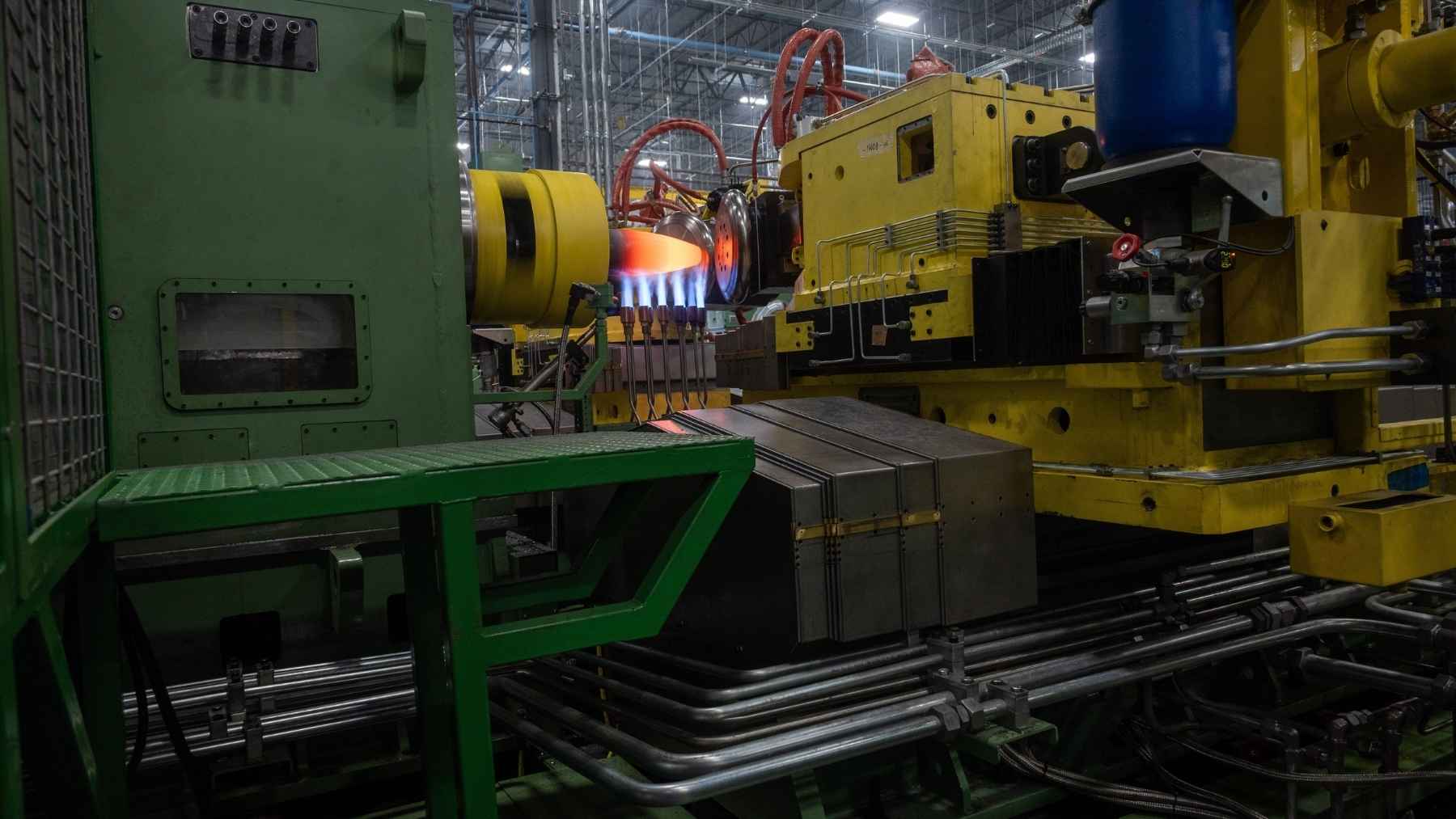
Forging that body sounds like it should be trivial. It is steel, and it is a cylinder. But the Army is not making the old shell anymore. It wants the newer, larger M795 round, and the equipment at Mesquite had to be adapted from an older projectile to make it. The inspector general found that acquiring and adapting that equipment to the M795 is exactly where the trouble started, and that the Army had accepted the risk on gear that was never proven out.
The gear did not cooperate. The contract dates to November 2022, and defense reporting on the report notes the company was missing milestones within months and drew a string of formal warnings long before any of this went public. The first production line failed its first-article testing over and over, and never turned out parts that passed. The Army’s contracting office ordered work stopped on two lines in August 2025, then kept extending that stop-work into 2026 while it decided what to do.
Three plants get you to 71,000, not 100,000
Even with Mesquite fixed, the math comes up short. The inspector general found that with only three facilities making the required projectile metal parts, the Pentagon will reach only 71,000 rounds a month, about 71 percent of the goal, by September 2026.
The Army is still building out the rest of the chain. It is modernizing the Iowa Army Ammunition Plant and standing up new load-assemble-pack sites in Kansas and Arkansas, with the aim of handling 140,000 rounds a month by December 2027. The plain steel bodies still have to show up for any of that capacity to mean anything.
One thing is working in the Army’s favor, and it is a strange one. Demand has softened. Ukraine has leaned harder into drone warfare and away from the massed artillery duels of 2022 and 2023, so the pressure to hit 100,000 a month right now is not what it was. Refilling the international stockpiles could still take years.
Shells aren’t the only thing America struggles to build fast
The shell is the least sophisticated thing in the arsenal, which is exactly why the miss lands the way it does. If a plain steel body backs up the line for two years, the expensive hardware is not in better shape.
The same story keeps turning up. The Navy builds its Mk 48 torpedo, a 1.9-ton weapon that runs into the millions per copy, only about 79 times a year, and two Rhode Island startups are now pitching cheaper, mass-produced torpedoes to close the gap. The service also can’t build underwater drones at anything close to automotive scale, and it is buying from more than one supplier at once partly because no single one can deliver in volume.
Meanwhile the Pentagon is asking for more than $70 billion in its latest budget for missiles and related gear, nearly three times what it wanted last year. The appetite for a bigger arsenal was never the hard part. Forging one, a single dumb steel shell at a time, apparently is.