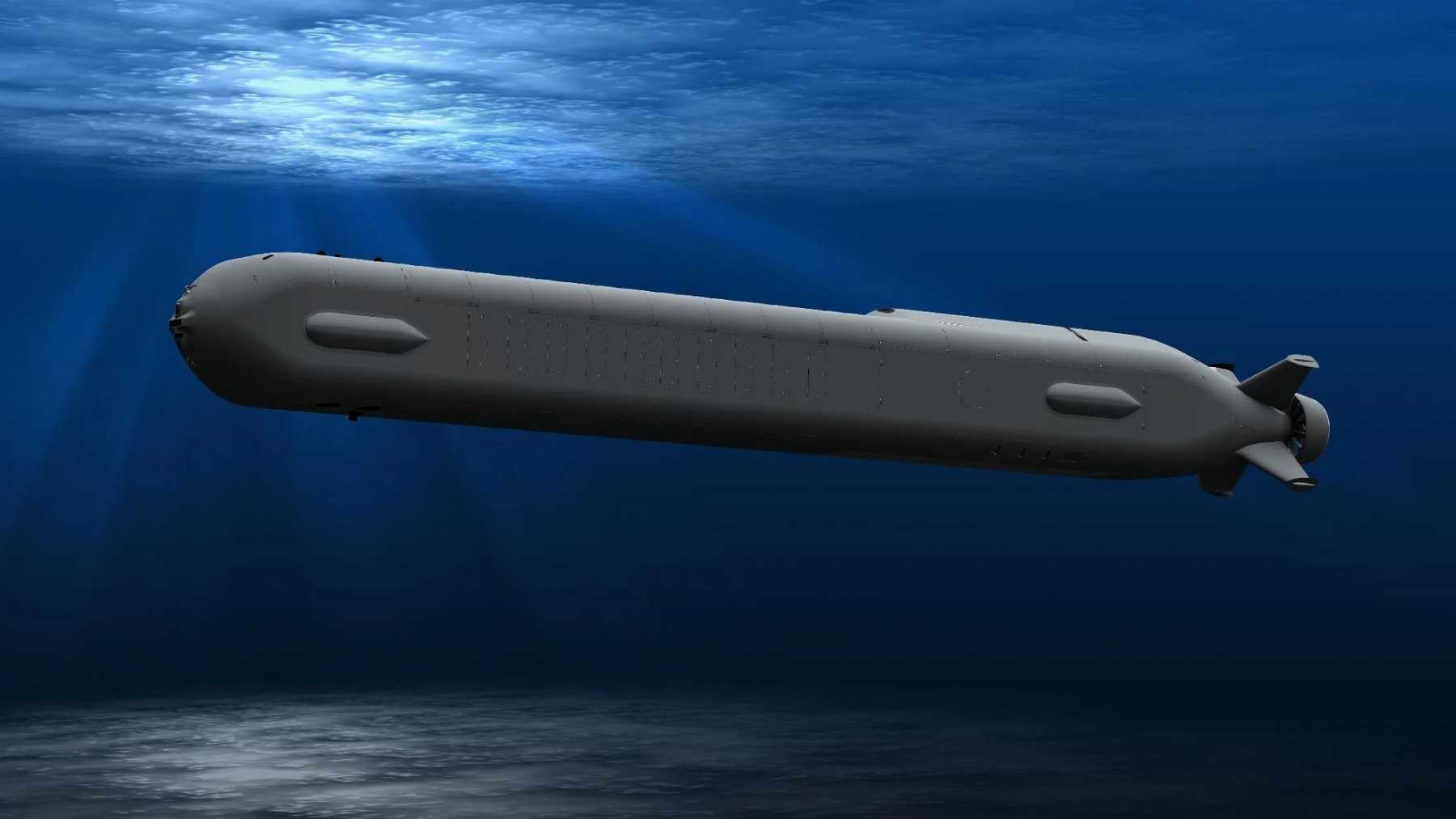

For as long as anyone has war-gamed a fight with China, the Pacific Ocean has been America’s best defense. It is more than 5,000 nautical miles of open water, and the working assumption has always been that Chinese warships and submarines simply could not cross it in any numbers, which kept the West Coast a long way from any shooting. China is now building underwater drones the size of submarines, and crossing that ocean is more or less the entire point of them.
Two of these machines are in sea trials in the South China Sea right now. Each is roughly 45 meters (about 148 feet) long, putting them in the same size bracket as a crewed diesel submarine, and they are the largest uncrewed underwater vehicles anyone has ever built. Their estimated range is around 10,000 nautical miles, enough to reach the U.S. coast. US defense analysts have started naming Seattle, Oakland, Los Angeles and the Panama Canal as the kind of targets these drones could one day threaten. The Chinese scientist who leads the program says that is not what they are for. Both of those things are worth taking seriously, so let’s take them in order, starting with the hardware.
The drones are submarine-sized, and that is the whole point
Open-source naval analyst H.I. Sutton has been tracking China’s underwater drone effort for years, and his reporting is the spine of what the outside world knows about these vessels. According to Sutton’s analysis for Naval News, the two prototypes are being tested in absolute secrecy, hidden inside specialized floating docks near Gangmen Harbour, just west of the Sanya naval base on Hainan. That secrecy is itself a tell. Chinese shipyards usually want the world to see their experimental designs, in the hope it helps future export orders. These ones are being kept under cover.
Size is the headline, but size is really a stand-in for range. Making an underwater drone this big is expensive, slow to build, and harder to maintain, so the design has to buy something in return. What it buys is reach. The drones are believed to be diesel-electric, with a diesel generator and an unusually large bank of lithium-iron-phosphate batteries filling most of the hull where a crew would otherwise sit. The figure Sutton works with breaks down to roughly 7,000 nautical miles running the diesels at snorkel depth, plus around 3,000 nautical miles fully submerged on batteries alone, which is about six times what a conventional diesel-electric submarine can manage underwater. That submerged endurance is the part that matters, because it is how a vessel slips past the anti-submarine defenses strung between China and the open Pacific.
The defense-show model these estimates are drawn from was armed with torpedoes and naval mines, and could carry smaller underwater drones in its own payload bay. For comparison, the U.S. Navy’s only equivalent is the Boeing Orca, a 51-foot platform that stretches to about 85 feet (26 meters) with its modular payload module bolted on, and carries an operational range of 6,500 nautical miles. The Chinese XXLUUVs are bigger than that and, per Sutton, are the largest underwater drones in the world by a wide margin. He writes flatly that no other country has deployed or is even developing an equivalent.
Eight smaller ones rolled through Beijing last fall
The XXLUUVs are the new and secretive end of the program. The rest of it has been on public display. At the September 3, 2025 parade in Beijing, marking the 80th anniversary of the end of World War II, China rolled out eight extra-large uncrewed underwater vehicles. They were five AJX002 minelayers and three larger HSU100s, with one of each serving as a spare. These are the cigar-shaped drones roughly the length of an 18-wheeler that you may have seen towed through Tiananmen Square, somewhere around 18 to 20 meters (59 to 65 feet). The HSU100 carries retractable masts for intelligence and reconnaissance work. The AJX002 was described in the official parade commentary as a dedicated minelaying system. Sutton’s point about all this is blunt: other navies do not have eight XLUUVs at all.
What makes that lineup remarkable is how fast it came together. When China first unveiled a large drone submarine for its navy in 2019, it was the HSU001, a 5-meter machine that looked like a careful first step while Western navies were clearly ahead. Six years later the situation has flipped, and that early model looks like a toy next to what followed. The fact that there are two competing 45-meter XXLUUV designs being tested side by side at the same port points to a competitive procurement program, the kind you run when you intend to pick a winner and build it, not a research project you might quietly shelve.
What has US planners worried
Here is the case for alarm, stated as the analysts state it. The XXLUUVs give China a low-risk way to put pressure directly on the U.S. West Coast in a conflict, because an uncrewed vessel that nobody has to die on can be sent on a one-way trip across the Pacific to blockade a port or a chokepoint. China’s nuclear-powered attack submarines technically have the range to do this on paper, but they are too valuable and are needed elsewhere, so they are not reported to patrol the Eastern Pacific. A fleet of comparatively expendable drones changes that math. The South China Morning Post reported that some Western analysts have flagged Seattle, Oakland, Los Angeles and the Panama Canal as the sort of targets this capability could reach.
The more immediate worry is closer to China. A 2024 report from the Center for Strategic and International Studies, led by Bonny Lin, found that covert mine-laying around Taiwanese ports would be central to any Chinese effort to isolate the island. The AJX002 minelayers are built for exactly that role, dropping mines along the shipping lanes of the First Island Chain without a submarine having to surface or a surface ship having to show up. There is a seabed-warfare angle too. These drones could be used to cut or tamper with the undersea fiber-optic cables that carry the world’s internet traffic, a vulnerability that has Western navies buying their own subsea drones to guard them. Testimony delivered in March 2026 to the U.S.-China Economic and Security Review Commission described Beijing investing heavily in large uncrewed underwater systems for denial operations in the South China Sea and around Taiwan.
What China’s lead scientist says they are actually for
Now the other voice, and it deserves the same weight. Yan Zheping is China’s leading authority on submersibles and the director of unmanned systems at Harbin Engineering University’s College of Intelligent Systems Science and Engineering. In peer-reviewed research published in the Chinese Journal of Ship Research, he addressed the West Coast fears directly and stated the program’s purpose publicly for the first time. The ultra-large drones, he wrote, prioritize regional security and near-coast defensive reconnaissance, alongside civilian uses like research and environmental monitoring. In his account they are a regional and defensive tool, not a weapon aimed at American cities.
That is not the kind of claim you simply accept or dismiss, but there is a sober analytical case that lands somewhere in between, and it is worth knowing. Even treated as a threat, the West Coast scenario has hard limits. A drone built to creep across the Pacific is slow, and could take days or even weeks to arrive on station. China already has the DF-41, an intercontinental ballistic missile that can reportedly reach the U.S. mainland in around 30 minutes, so a drone submarine is a strange tool for any time-sensitive strike. These vessels are far better suited to coastal targets, to minelaying, and to interdiction inside clearly defined zones than to opening a war. The capability is real and it is genuinely new. The intent behind it is contested, and the worst-case framing is bounded by basic physics.
Everyone else is scrambling to keep up
None of this is happening in isolation, which is the part that gets lost when the story is told as China versus a defenseless coastline. The U.S. Navy formally moved its Orca program out of experimental development and into planned fleet acquisition under its May 2026 shipbuilding plan, with a target of 16 vehicles through 2031 and roughly $1.13 billion budgeted across the program. America’s allies are further along in some respects. Australia already has production Ghost Shark drone submarines in the water under a A$1.7 billion (US$1.1 billion) program, with a dedicated uncrewed-only naval unit standing watch. The U.K.’s Royal Navy took delivery of its experimental Excalibur drone sub in December 2025. The race to field large autonomous submarines is on, and China is leading it rather than running it alone.
It also is not finished growing. TWZ and Naval News reported that a new, unidentified large Chinese submarine appeared at the Jiangnan shipyard in Shanghai at the end of May 2026, caught on satellite imagery from Vantor in early June. Its designation is unknown and its low-profile hull is a different concept from the XXLUUVs off Hainan, but it fits a clear pattern: a country methodically wiring and populating the seafloor it cares about, one prototype at a time.
So here is the honest read. The machines are real, they are in the water, and the range estimates are plausible enough that serious people are planning around them. The two-prototype bake-off says Beijing intends to build the winner, not file it away. But the loudest version of the story, the one where these drones surface off Los Angeles, is a claim the people building them flatly deny, and even the hawks concede that a weapon which takes weeks to cross an ocean is a clumsy way to start a fight. What nobody disputes is the part that should focus the mind in Washington and Canberra alike: the largest underwater drones on Earth are Chinese, they are being tested behind floating-dock curtains off Hainan, and the Pacific is no longer as wide as it used to be.