
Solar power has always had a real estate problem. Every panel has to sit somewhere, and the cheapest, sunniest places to put one (open fields, hillsides, the occasional stretch of desert) are usually the places people would rather not bury under glass and aluminum. So the smart play lately has been to stop hunting for new land and start using surfaces that are already spoken for. We’ve bolted panels onto rooftops, floated them on reservoirs, and even tried laying them straight into a road in France.
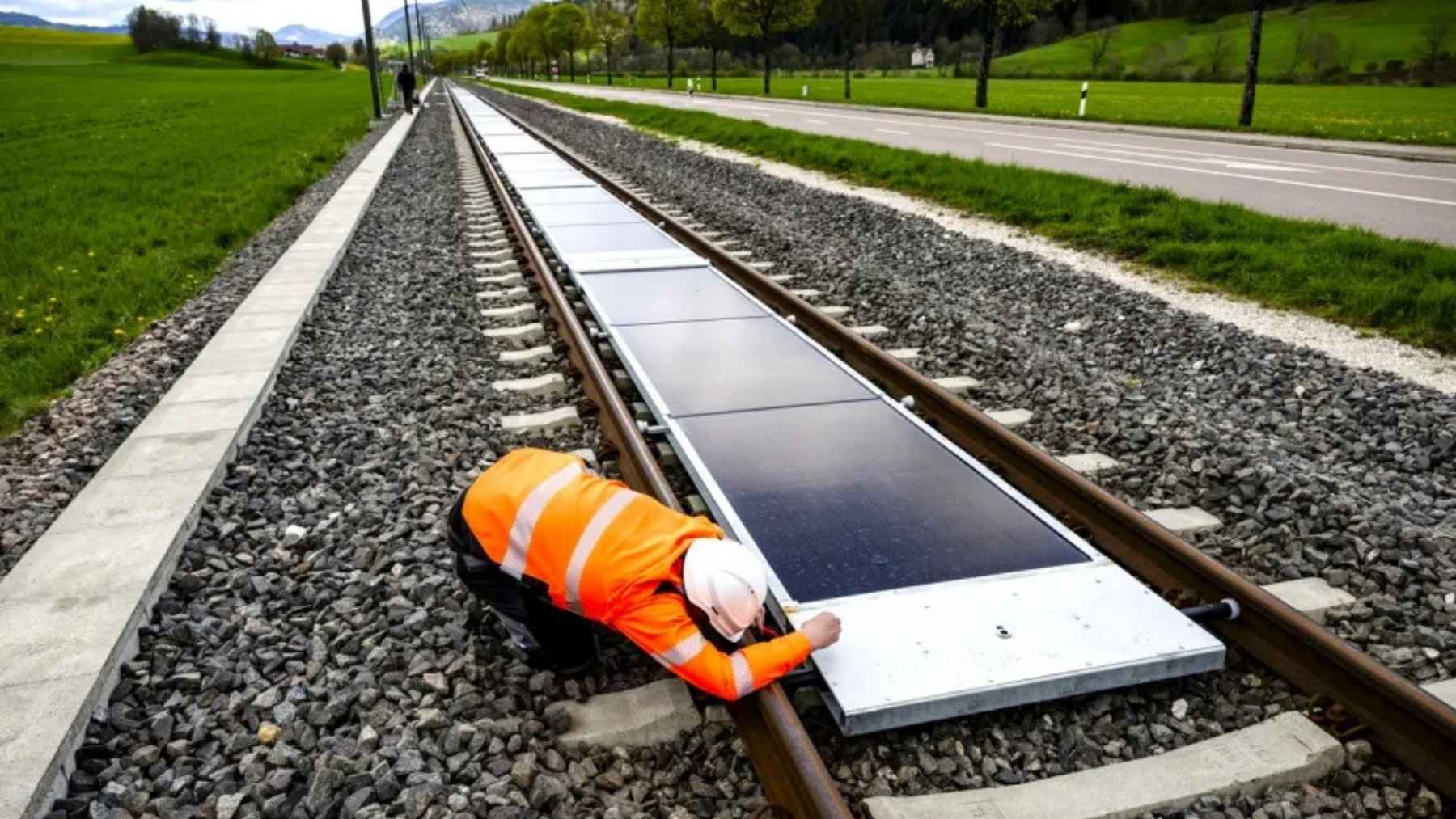
A Swiss startup called Sun-Ways just found one more of those surfaces, and it’s a strange one. The company has laid 48 solar panels in the gap between the two rails of an active train track, low enough that the trains roll right over the top of them. The pilot runs along a 100-meter (about 330-foot) section of Line 221 near the village of Buttes, in the canton of Neuchâtel, and it has been live since April 24, 2025. It is small on purpose, and it is being watched by rail operators on several continents, including in the United States, which happens to own more train track than any country on Earth.
The Panels Sit Between the Rails, Not On Them
The panels don’t touch the steel rails. They rest on the sleepers, the crossbeams that hold the track in place, filling the flat strip in the middle that normally does nothing but collect gravel. Each module is about a meter wide and rated at 380 watts, and there are 48 of them, for a total of roughly 18 kilowatts. Over a year that comes out to about 16,000 kilowatt-hours, which Switzerland’s public broadcaster, SWI swissinfo.ch, puts at the yearly draw of four to six households. Nobody is powering a city with this.
The clever part isn’t the wattage, it’s the installation. Sun-Ways worked with the Swiss track-maintenance firm Scheuchzer to build a machine that rolls along the line and drops the prefabricated panels into place. The company describes it as laying them “like carpet.” That same machine can pull them back up, and swissinfo reports it can lay or remove close to 1,000 square meters of panels in a few hours. Removability is the whole pitch. Track needs grinding, snow clearing, and the occasional full replacement, so panels glued permanently between the rails would be a maintenance disaster. Panels you can peel up in an afternoon are a different proposition.
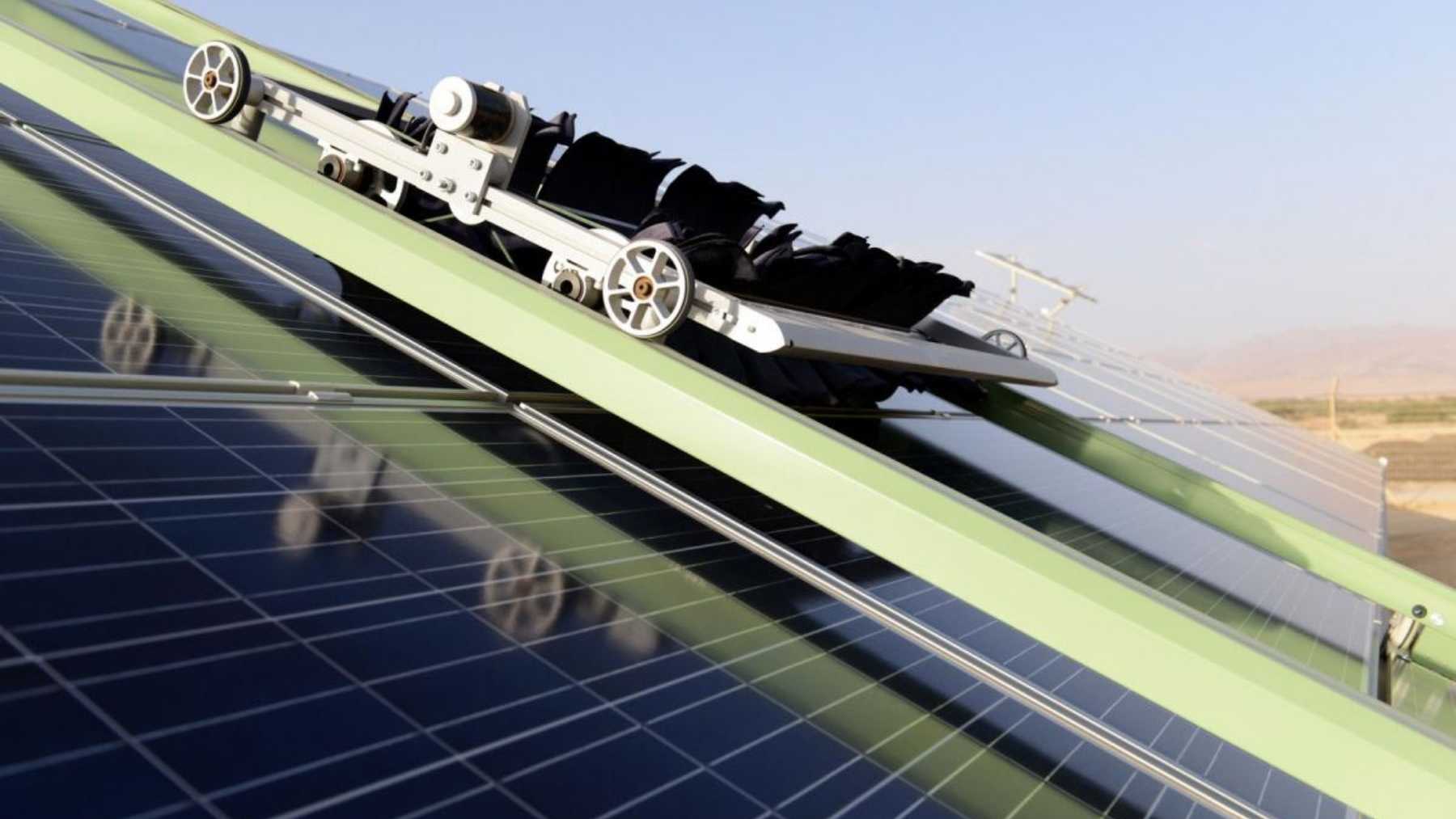
Keeping them clean is handled by a cylindrical brush that can be fitted to the back of a train and sweep the surface as it passes. The system also carries sensors to flag faults, and glare is one of the specific things the pilot is studying, since the last thing any rail authority wants is a panel dazzling a driver at speed.
The idea came to Sun-Ways founder Joseph Scuderi back in 2020, while he was stuck waiting for a train near Lausanne and staring at the empty space running down the middle of the track. At the unveiling last April, with rain falling on his brand-new solar plant, Scuderi kept it modest: “We installed solar panels as we would on the roof of a house.”
18 Kilowatts Now, Maybe a Billion Later
The Buttes plant cost about CHF 585,000, or roughly $705,000, covering the research, prototypes, and construction, per swissinfo. For 16,000 kWh a year, that is a terrible deal, and everyone involved knows it. A pilot exists to answer questions, not to pay for itself.
The real argument lives at the scale of an entire network. Sun-Ways figures that Switzerland’s roughly 5,320 kilometers (about 3,300 miles) of rail, once you subtract the tunnels and the shadier stretches, could generate around a billion kilowatt-hours of solar power a year. That works out to roughly 2% of the country’s electricity, or the consumption of 300,000 homes. The company goes further and reckons half the rail lines on the planet could carry panels between the rails, though that one is Sun-Ways talking up its own technology rather than an independent finding. Rooftops are still the easy win for solar, whether it’s a warehouse roof or the plug-in panels a homeowner can hang off a balcony. The hard part is finding flat, empty, sun-facing space nobody is using, and a rail corridor is full of it.
Why the Regulators Wanted Three Years, Not Six Months
Switzerland’s Federal Office of Transport did not wave this through. Sun-Ways was turned down the first time it applied, in 2023, and only got the green light after independent engineers ran safety assessments on the prototypes. Even then, the regulator picked this exact line for a reason: trains through Buttes top out at 70 km/h (about 43 mph), which is slow as rail goes. And where Sun-Ways originally wanted a six-month trial, the FOT insisted on at least three years, so the panels would be watched through every season and the track underneath could be checked for wear. That is why the test is scheduled to run all the way to April 2028.
The skeptics aren’t only regulators. Martin Heinrich, a researcher at Germany’s Fraunhofer Institute for Solar Energy Systems, likes the basic idea of putting panels on built-up land instead of out in nature, but he isn’t sold on the removable design. His view, given to swissinfo, is that a solar module should ideally go down once and stay untouched for 20 or 30 years, because every time you lift one you add cost and a chance of damaging it. The International Union of Railways has flagged a separate worry about fire risk along the lines, as Yale Environment 360 noted, which Sun-Ways answers by pointing to the built-in sensors meant to catch a panel before it misbehaves. None of these are dealbreakers yet. They are exactly the things three years of running trains over the panels is supposed to settle.
America Has More Track Than Anyone, and It’s Just Sitting There
Switzerland is the test bed, but the interest is global, and Sun-Ways has been collecting partners. In February 2026 it signed a collaboration agreement with SNCF, the French national rail operator, which under the deal gets access to the Buttes performance data and is studying whether removable solar could work on parts of the French network, as pv magazine reported. The company is also working on projects in South Korea, Spain, and Romania, and swissinfo says it has held exploratory talks with potential partners in China and the United States. Japan’s transport ministry is watching as well.
That last one is the interesting part for American readers. The U.S. runs the largest freight rail network on the planet, almost 140,000 route miles of track, according to the Federal Railroad Administration, reaching every state but Hawaii. Most of it is privately owned, most of it cuts through open country, and the strip between the rails spends the overwhelming majority of its life doing nothing but facing the sky. Nobody here is laying panels yet, and “exploratory talks” is a long way from a signed contract. But if the math ever pencils out, the country with the most rail in the world also happens to have the most of this very specific kind of empty space.
Buttes is tiny, and that’s easy to lose track of. Eighteen kilowatts is a rounding error on a national grid, the panels cost far more than the electricity they make, and the experts who like the concept still argue about whether lifting modules on and off for track work will ever pay off. None of that is what a three-year pilot is for. The point isn’t the 100 meters in Buttes. It’s the 140,000 miles of American track, the 3,300 miles of Swiss track, and all the rail everywhere else that currently grows nothing but weeds down the middle. If a train can roll over a solar panel without the driver noticing it’s there, that empty stripe stops being wasted space. And that’s a far bigger number than 18 kilowatts.












1) The panels seem to be fixed so they won't maximize the use of the sun.
2) They probably have not considered the damage an animal will do when hit and dragged along the rails. Sure there is a front guard, but the guard doesn't deflect all wild life.
3) The wild life alone would destroy it.
4) How are they going to clean the panels and the expenses. I honestly doubt they will generate enough electricity to benefit from the costs.