
Welding means striking an electric arc hot enough to melt steel. Seawater conducts electricity just fine. Put those two facts in the same sentence and underwater welding starts to sound like something you’d invent on a dare.
It is a real trade, though, and one of the most dangerous jobs anyone does for a paycheck. A diver drops into cold, near-black water with a torch, burns through a stick electrode every few centimeters, swaps in a fresh one, and repeats that for hours. The ways it can go wrong are the obvious ones and then some: drowning, electric shock, and pockets of hydrogen the arc splits out of the water that can go off like a small bomb.
That job has barely changed in decades. A German research consortium just showed a robot arm that does the whole thing on its own, with no diver in the water at all.
The job is deadly, and there aren’t enough people to do it
Underwater welding keeps ports, bridge footings, ship hulls and offshore platforms from quietly falling apart. There are nowhere near enough people qualified to do it, and demand runs well past the supply of trained divers. That gap is a big part of why a robot is worth building in the first place.
The danger isn’t a sales pitch. Commercial diving has run at roughly 40 times the fatality rate of the average American job, according to CDC data, a figure that comes from a study of the 1990s and, oddly, hasn’t been refreshed since. Drowning was the leading cause of death by a wide margin.
Underwater welding sits at the sharp end of that trade, because you’re adding a live electric arc and explosive gas to everything else that can already kill a diver. Take the human out of the water and most of that risk leaves with them.
An AI camera finds the seam, the arm does the rest
The system comes out of a project called MARIOW, short for Maritime AI-Guided and Remote Operated Welding, led by the German Research Center for Artificial Intelligence (DFKI) in Bremen and funded by Germany’s Federal Ministry for Economic Affairs and Energy.
Here’s the sequence. A stereo camera built by the Fraunhofer IGD institute sits right next to the torch and feeds high-resolution images to an AI trained to recognize a weld joint, including where it starts and where it ends. Software works out the path. A modular robot arm from DFKI then runs the torch along it.
The arm has six axes of movement, a reach of about six and a half feet (two meters), and is rated to work as deep as nearly 20,000 feet (6,000 meters), close to four miles down. That depth is the arm’s design envelope, not where it has welded so far. Most of the structures it’s meant to fix sit far shallower than that.
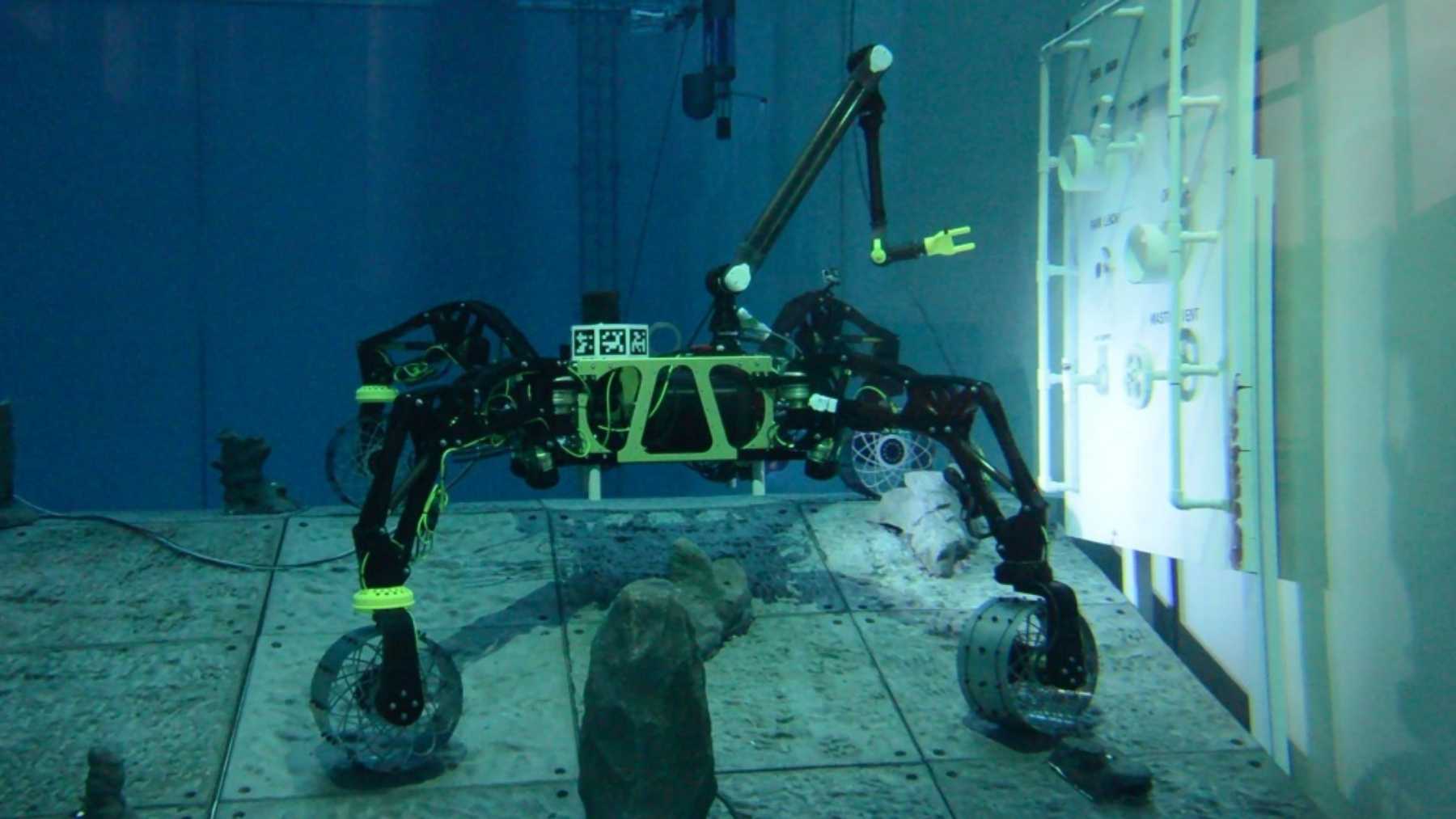
It isn’t a free-swimming robot, either. It rides on a carrier, either a seabed crawler the team calls SherpaUW or a rig that lowers it down something like a sheet-pile harbor wall to reach the work.
The continuous wire is what makes it work
The clever part isn’t the AI. It’s the welding.
Traditional wet welding uses stick electrodes that burn down and have to be swapped after a few centimeters. A diver can do that. A robot stopping every few centimeters to reload is useless.
So the consortium, with TH Köln’s materials institute working alongside a firm called AMT GmbH, built an underwater flux-cored arc welding process that feeds a continuous wire instead. The material never stops flowing, which is the whole reason a machine can lay a long, even seam without someone babysitting it. In the tank the robot ran lap joints and fillet welds, the bread-and-butter joins you’d find on any pier or platform.
It ran in a tank, not the ocean
The demonstration happened in DFKI’s Black Basin, a saltwater test tank in Bremen, not on a real harbor wall or an offshore platform. That distinction is not a small one. The team also describes the welding as semi-autonomous rather than fully hands-off.
Christian Koch, who managed the project at the DFKI Robotics Innovation Center, told Marine Technology News the demonstration showed the process is “not only feasible, but commercially promising.” That’s an engineer’s way of saying it worked in the lab and might sell someday.
Robots welding underwater isn’t new, for the record. Mechanized rigs have handled subsea pipeline tie-ins in oil and gas for years, and dry hyperbaric welding inside a sealed chamber has been around for decades. What DFKI is claiming is the first system to do wet welding largely on its own, with AI picking out the seam.
Getting from a tank to open water is the hard part. Salt currents shove the arm around, waves move everything topside, and deeper water leans on every seal. The next build also adds a laser to burn off the slag the welding leaves behind. None of that is solved yet.
The seabed keeps going crewless
This fits a pattern. Navies and energy firms have been dropping robots onto the ocean floor to watch pipelines and cables that keep getting cut. Italy has put a seabed drone in the water for exactly that, and a startup’s tethered SU10 is built to sit on the bottom and guard those lines. Offshore, machines like the Saab Sabertooth already live on the seabed and turn valves with nobody aboard a ship.
All of those are about looking. MARIOW is about fixing. If it gets out of the tank, the last job on an offshore platform that still put a human in the water might not need one for much longer. That’s a big if, and right now it’s a robot arm in a test basin in Bremen with the actual ocean still ahead of it.