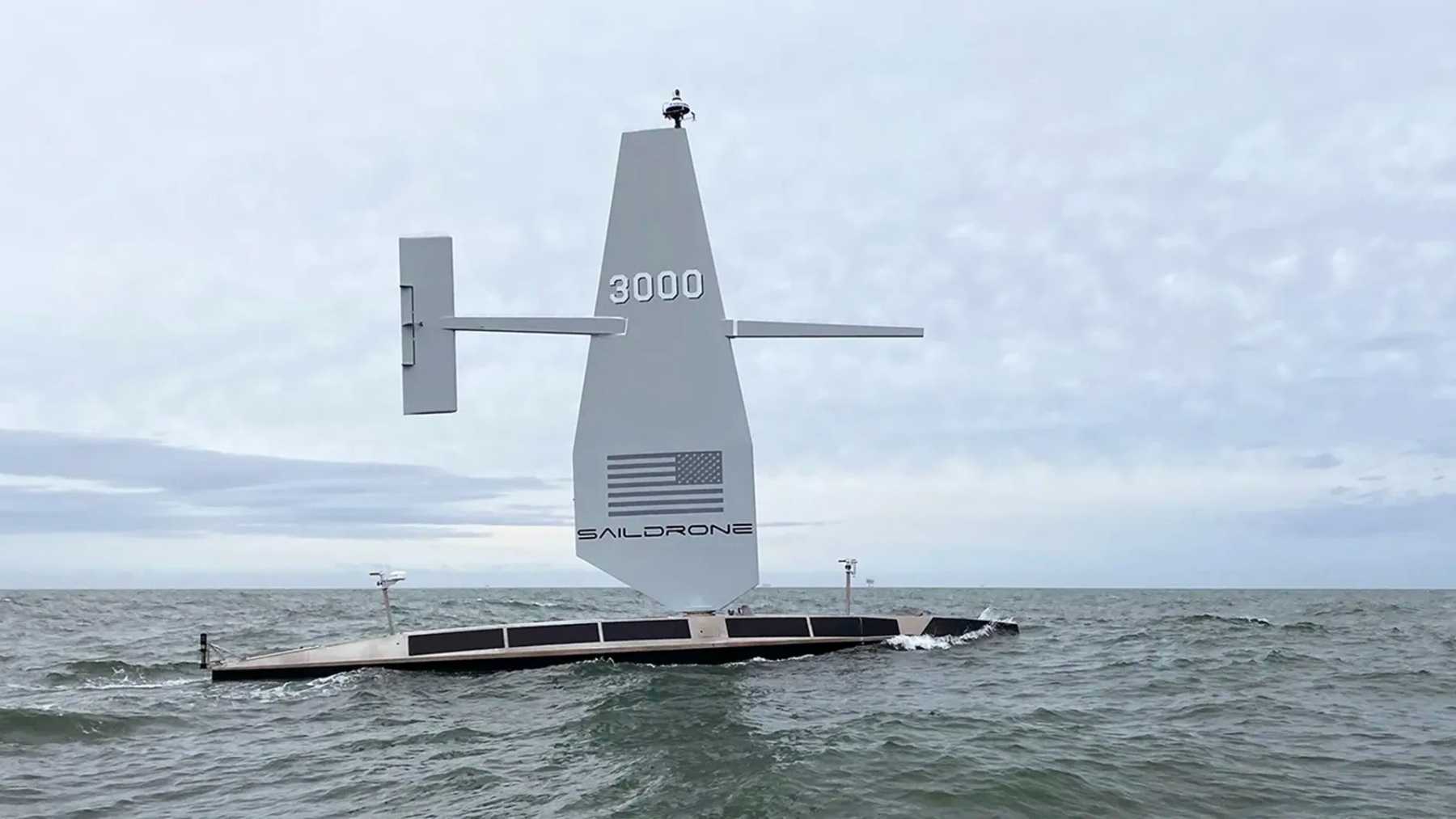

Most of the drone boats the U.S. Navy has put in the water so far have one core job: looking at things. They sweep for mines, watch sea lanes, relay video, and occasionally shadow a suspicious vessel from a polite distance. Useful work, but fundamentally the work of a very expensive pair of binoculars.
The Tsunami just got hired for something different. On April 30, the Pentagon’s Defense Innovation Unit awarded Textron Systems a contract to produce and deliver multiple Tsunami uncrewed surface vessels, according to Naval News. The boats will run through the Navy’s Fleet Experimentation exercise, known as FLEX, in Key West, Florida, and then spend three months on joint operations with U.S. Southern Command (SOUTHCOM) and the Navy’s Fourth Fleet.
The Fourth Fleet is the one covering the Caribbean and the waters around Central and South America, which tells you roughly where this story is going. And the word doing the heavy lifting in the announcement is “interceptor.” Textron is supplying long-dwell interceptor USVs, boats designed to loiter out there for extended stretches, find something worth chasing, and go chase it.
By late May, the company was already reporting that a Tsunami had put precision-guided munitions on surface targets during the Key West runs. So the armed part is not a concept slide either.
A bass boat with a defense contractor’s brain
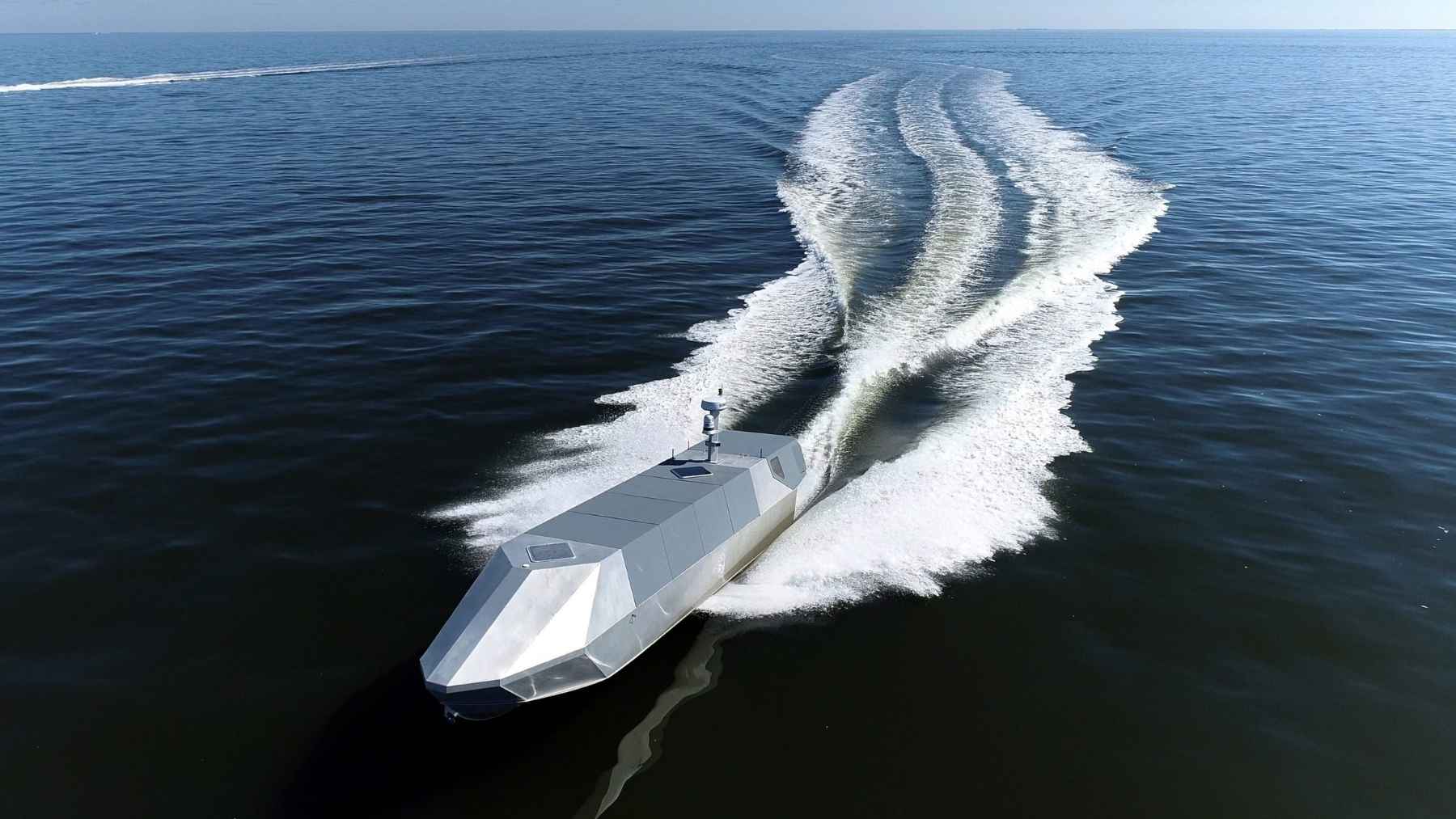
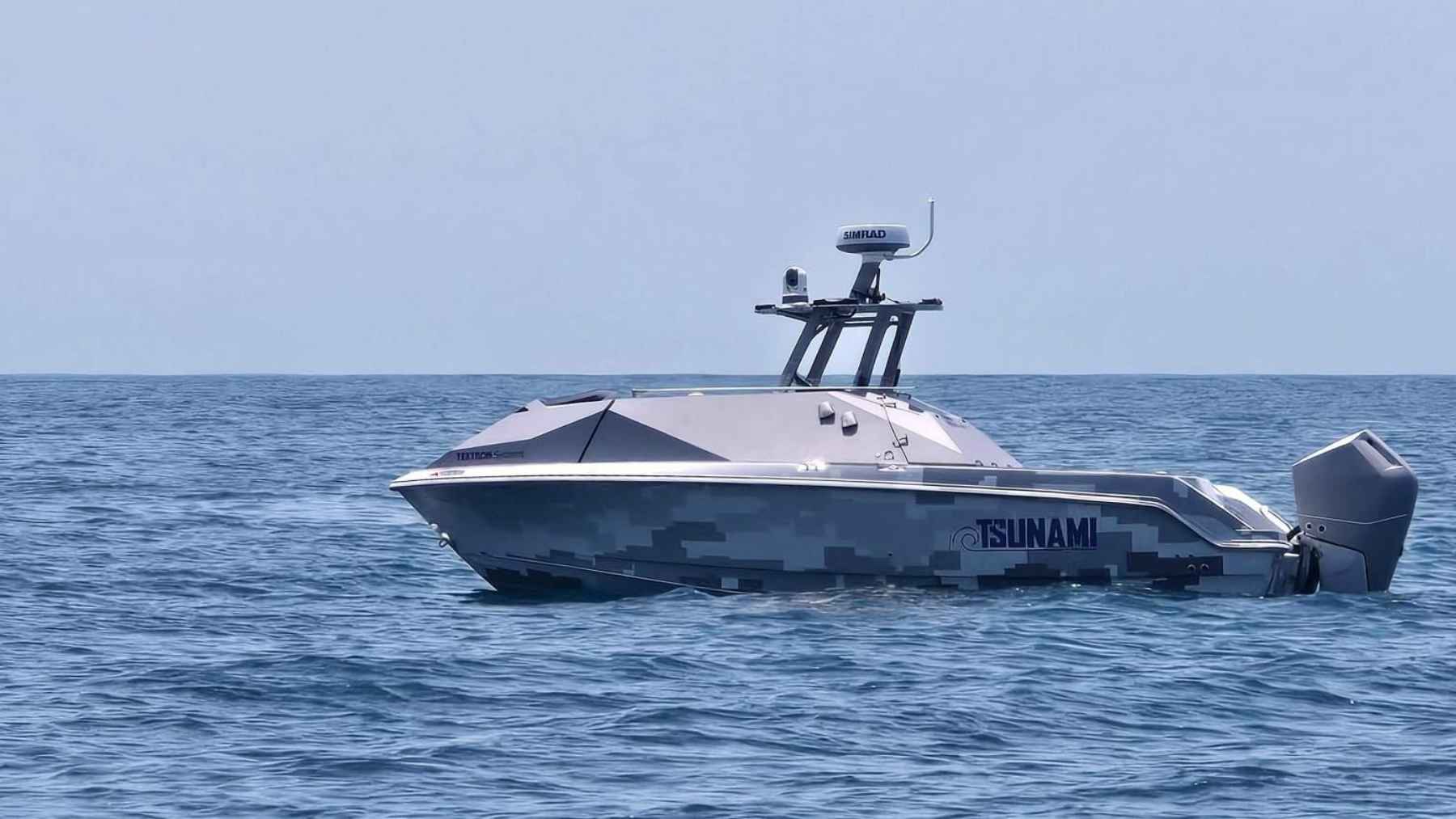
Start with the hull, because the hull is the whole business model. Textron built the Tsunami family with Brunswick Corporation, the company behind Boston Whaler boats and Mercury outboard engines. The platform underneath all the military electronics comes off the same industrial base that cranks out recreational watercraft by the thousands.
That sounds like a compromise. It is actually the point. Textron introduced the family in January 2025 with baseline hulls of 24, 25 and 28 feet, gasoline power for easy logistics, ranges between 600 and more than 1,000 nautical miles, and a Sea State 4 rating. All three baseline variants clear 40 knots, according to trade outlet Baird Maritime, and Textron executives have said the Brunswick relationship gives them access to hulls from 14 feet all the way up to 42.
On top of that hardware sits the autonomy system from Textron’s CUSV, the uncrewed minesweeper that became the Navy’s first small USV program of record. The first 24-foot Tsunami went to the Naval Surface Warfare Center’s Dahlgren Division in May 2025 as a test asset, so the fleet has had over a year of hands-on time with the platform.
The design philosophy is “attritable,” which is Pentagon for cheap enough to lose without anyone writing a strongly worded memo. And Textron’s own product page lists the missions this thing was designed around: offshore counter-narcotics, search-and-rescue and ISR. Keep that first one in mind.
It already pulled the trigger in Key West
The contract came with a live-fire audition built in, and Textron published the results at the end of May. At FLEX, an Aerosonde Mk 4.7, the company’s shipboard VTOL drone, flew off a littoral combat ship carrying a laser designator payload. The Tsunami below carried a precision-guided munition system and took its targeting from the aircraft and other networked sensors.
Together they ran what the industry calls a sensor-to-shooter kill chain. The drone finds and marks the target, and the boat shoots it. Textron says the Tsunami executed surface-to-surface engagements in both single-shot and rapid-fire sequences, with multiple laser designators in play. The Aerosonde family, for reference, has logged more than 700,000 flight hours, so the flying half of this pair is not new to the job.
The weapon side has a name too. The contract announcement specifies the Surface-to-Air Kinetic Engagement system, or STAKE, from Invariant Corporation, an employee-owned contractor out of Huntsville, Alabama. STAKE splits into two modules: a Hunter payload housing the sensors and laser designation gear, and a Killer payload that fires APKWS, the laser-guided 70mm rockets. Invariant demonstrated the system intercepting targets from a moving vessel in 2025, then bolted it onto a Tsunami at Alabama’s Lake Guntersville this February. Its president, Danny Levis, files the whole field under “kinetic maritime autonomy.”
The long-dwell half of the job description leans on battery and solar capability that lets the boat hold station for extended runs without a human topping anything off, per Textron. Loiter cheap, strike fast is the entire pitch.
The day job looks a lot like police work
The Key West demo was not all gunnery. Textron deployed multiple Tsunamis in what it describes as law enforcement and interdiction scenarios, setting up “persistent tripline coverage”: boats parked across a stretch of water, waiting for something to cross. When something did, the group’s job was to detect it, track it and keep custody of it, spreading out to widen the sensing net and ganging up to pursue vessels of interest.
Custody is the operative word in interdiction work. A smuggling run mostly wins by disappearing, and a robot boat that never blinks, never rotates home for dinner, and can call in friends removes the disappearing option. The Tsunami is not arresting anyone; boarding a vessel still takes humans with legal authority. What it takes off those humans’ plate is the long, tedious business of not losing the target.
The boats also demonstrated counter-drone detection during the exercise, because in 2026 even the robots have to watch for other robots.
The Caribbean timing is not subtle
SOUTHCOM’s maritime problem is mostly a seeing problem. Chief of Naval Operations Adm. Daryl Caudle said as much this spring, calling maritime domain awareness the key to the region and drug interdiction its main problem set, while pushing for an enduring naval package there that does not tie up an aircraft carrier.
The Pentagon has also been explicit about which way that package leans. When Defense Secretary Pete Hegseth unveiled Operation Southern Spear in November, the announcement flagged a fleet using robotics and autonomous systems against Latin American drug trafficking. The crewed presence, meanwhile, is thinning out: by late May, USNI News reported the Navy was down to three warships in the region as the Iwo Jima group headed home. One of the three is USS Billings, a littoral combat ship. The Tsunami contract happens to specify flying the Aerosonde off a littoral combat ship. Draw whatever line you like between those two facts, because the Navy has not drawn one publicly.
The Tsunami is also not arriving to an empty field. BlackSea Technologies just rolled out the missile-armed Comet, a 43-foot drone boat built to threaten ships and aircraft, and Leidos pitched its Sea Archer on the same swarm-of-cheap-hulls logic. The Tsunami’s niche is narrower and more police-shaped: not sinking warships, but running down small fast things and, when authorized, putting laser-guided rockets on them.
The Navy is renting, not buying
The contract structure might quietly be the most consequential part. Ryan Schaffernocker, Textron’s senior vice president for air, land and sea systems, said the award sets up both government-owned, contractor-operated and contractor-owned, contractor-operated service models, “allowing for rapid deployment with a lower cost of ownership for the Navy.” Textron field service reps deploy alongside the boats to keep them running.
Translated from procurement, that second model means Textron keeps the boats, Textron’s people maintain them, and the Navy buys the effect: interceptors on the water, by the month. The Defense Innovation Unit, stood up in 2015 precisely to drag commercial technology into the Pentagon faster, tends to fund exactly this kind of try-before-you-commit arrangement.
It also fits the wider pattern of the fleet hiring robot help wherever crews are stretched, right down to the underwater wingmen the Navy wants swimming alongside its SEAL delivery mini-subs. The surface version just comes with rockets.
What happens after the three months is the open question, and the Navy has not answered it. DIU deals buy demonstrations, not fleets, and plenty of promising experiments have died quietly at the transition step. Still, the proposition on the table is a hard one to walk away from: a patrol boat built on recreational hulls, armed like a light helicopter gunship, that works around the clock and bills by the month. For a command whose entire job is watching an enormous stretch of ocean for small fast boats, that is less a gadget than a staffing solution.