
The radiator bolted into the front of your car does one of the least glamorous jobs in the whole machine. Hot fluid runs out, dumps its heat into the passing air, and comes back cooler to go around again, sealed off from everything it touches. A Canadian company called Eavor spent two years burying a version of that same idea about 4.5 kilometers (roughly 2.8 miles) under a town in Bavaria, then ran it backwards, letting hot rock pour heat into the sealed loop instead of a hot engine dumping heat out of one.
In December 2025, the loop started pushing electricity onto the German grid. It was the first time a sealed, closed-loop system of its kind had ever put commercial power on a grid anywhere, and the launch-day coverage treated it like the breakthrough it was.
Half a year later, the version of events coming from Eavor’s own CEO is a lot more honest, and a lot more useful, than the press releases were. The loop works as physics. As a power plant, it is barely running.
The pitch is geothermal without the geology
Conventional geothermal has always been picky about where it lives. You need hot rock, you need that rock to be naturally cracked and permeable, and you need water or steam already moving through it that you can pull up, spin a turbine with, and pump back down. That combination tends to show up in volcanic and tectonically active places, which is why geothermal power has historically meant Iceland, or California, or Kenya’s Rift Valley, and not a lot in between.
Eavor’s pitch throws the geography requirement out. Instead of hunting for a natural underground reservoir, it drills two wells into hot rock, branches a series of horizontal boreholes off the bottom of each, joins them together deep underground, and seals the whole thing into a closed loop. Then it fills that loop with its own working fluid and circulates it, collecting heat through the pipe walls by simple conduction.
No reservoir, no fracking, nothing pumped into the rock and nothing produced out of it. The Geretsried site had actually been drilled before by an earlier project that went looking for hot water and found rock that was, by Eavor’s own account, hot but dry. Useless for old-school geothermal. Close to ideal for a sealed loop that only wants the heat.
There is a genuinely clever trick at the heart of it. Once the fluid in the loop heats up, it starts circulating on its own, hot fluid rising up the outlet well while cooler fluid sinks down the inlet, a thermosiphon that needs no pump to keep going. Eavor used a small pump to get things moving at startup, had the loop self-circulating in under half an hour, and then switched the pump off.
That same itch, clean round-the-clock heat from rock almost anywhere, is what the whole next-generation geothermal field is chasing from different directions. In Utah, Fervo Energy is fracking hot dry rock two miles down and pulling more than 10 megawatts from a single well. An MIT spinout called Quaise is trying to melt straight through granite with a microwave beam. The difference is that Fervo cracks the rock open and runs water through the fractures, while Eavor’s loop never touches the surrounding rock at all. It just collects the heat coming through the wall.
Two vertical wells and a dozen underground loops
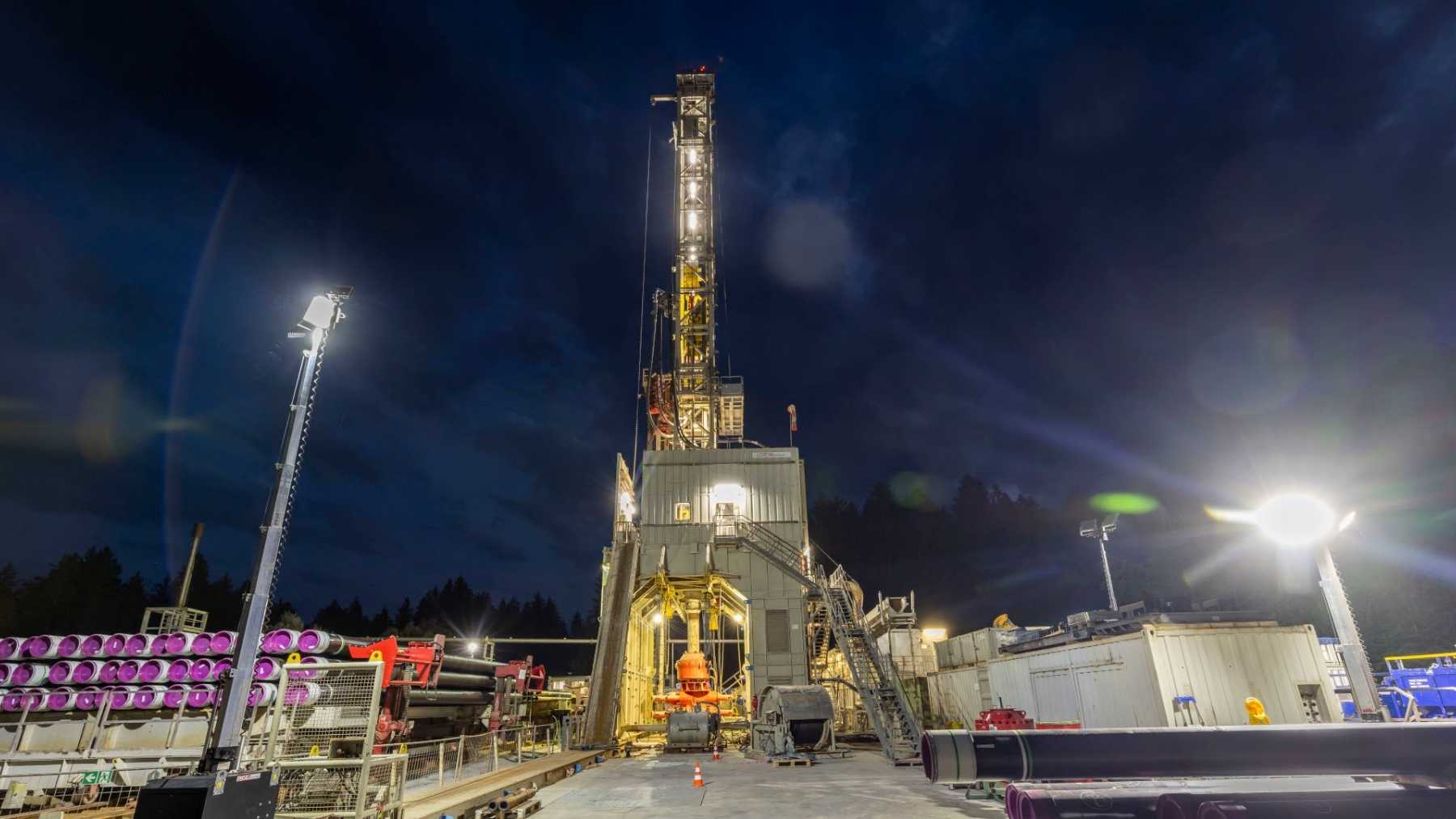
The engineering at Geretsried is real, and so were the headaches. For its first unit, Eavor drilled two vertical wells about 4.5 kilometers down into granite, then steered horizontal boreholes off each one and connected them end to end far underground. Getting two drill bits coming from opposite directions to actually meet that deep is its own problem, solved with an active magnetic ranging tool that homes one bore in on the other. To turn the bare rock walls into a sealed pipe without lining the entire length in steel casing, Eavor used a sealant it calls Rock-Pipe.
The drilling got faster as the crews learned the rock. In a technical white paper, the company reported cutting drilling time per lateral by about half and roughly tripling how long a drill bit lasted before it wore out, partly by adapting insulated drill pipe and oilfield steering tools to survive the heat, according to POWER Magazine.
The flip side showed up at an industry drilling conference, where an engineer from SLB, which partnered on the wells, described the campaign honestly: two rigs that had barely turned in four years, crews that were new to the work, and hard, variable rock that fought the steering tools while drilling mud gummed up the bit. He still called the project “a renaissance moment for us as drillers,” per a recap in Drilling Contractor. Both things were true at once.
The numbers behind the press release are rough
The launch coverage and the reality six months on do not line up. The full Geretsried design called for four of these well pairs, each meant to carry twelve loops, adding up to a plant rated at roughly 8 megawatts of electricity plus 60 to 64 megawatts of heat for the town. What actually exists today is one well pair. And instead of twelve loops, six got drilled.
In a May interview with the subsurface trade outlet GeoExPro, Eavor CEO Mark Fitzgerald filled in the part that had not been public. Of those six completed loops, only three to four are actually moving heat. Two were clogged by rock fragments badly enough that cleaning could not clear them, and a third barely contributes. Current output sits between 0.5 and 1 megawatt, and Fitzgerald confirmed that figure is gross, measured before the plant’s own power draw of around 0.5 megawatt. Which means that most of the time, the plant is not putting anything onto the grid at all.
Against the 8 megawatt design target, that is not a shortfall so much as an order of magnitude. He put the plant’s current efficiency at 2 percent, rising to maybe 14 percent if more loops come online. And the roughly 350 million euro budget is largely spent, with not enough left to finish the other three well pairs.
Eavor is stepping back from its own project
The most telling development is not the underperformance, which is what first-of-a-kind projects do. It is the pivot. Eavor has decided to stop being the operator of Geretsried. The ownership of the project has not formally changed, but the company now needs to find someone else to take over running it and finishing the drilling, and Fitzgerald said it was already in talks with unnamed candidates. The two rigs that drilled the wells are still standing on the site, which is part of why Eavor wants the handoff done quickly.
The company now frames itself as “a technology provider,” the idea being that it licenses the know-how while some other outfit carries the drilling, completion and operating risk. It also cut its headcount from 147 people down to 80 as part of the same shift. Strip away the language and the situation is striking: the company that set out to prove sealed-loop geothermal by building and running the first commercial plant is now looking for someone else to build and run it.
The next bet is deeper, hotter rock
Fitzgerald is not backing off the technology. What he wants to do next is drill deeper than the 4.5 kilometer Geretsried wells to reach hotter rock, and actually complete a full twelve loops per well pair, in what he says are several possible spots around Germany. Hanover, once lined up as the next site, is now uncertain because the local geology is complicated.
Meanwhile, Eavor has been drilling in New Mexico, where POWER reports it put down one of the deepest and hottest multilateral geothermal wells on record, past 5,000 meters into granite hotter than 200 degrees Celsius, mostly to prove its tools can survive down there. That work helped pull in follow-on money from bp and the drilling firm H&P.
His own summary of where things stand is that the concept has been proven and what is left is proving it can make money. The geologist who interviewed him was more cautious, and it is hard to argue with the caution, given a demonstration plant that has not delivered meaningful power and a budget that ran out before the loops were finished.
So is a buried radiator the future of geothermal
None of this means the buried radiator does not work. The fluid circulates on its own, the rock is hot, the loop holds pressure, and every lateral Eavor drilled went faster than the last. What Geretsried has not done yet is the one thing a power plant exists to do, which is reliably make power. A sealed loop pulling heat from dry granite almost anywhere on Earth is a genuinely large idea. At the moment it is a large idea with two clogged loops, a row of idle rigs, and a budget that ran dry before the proof did.
 @mattsmith ROOKIE3 months ago