
There’s a hard limit on how big a crane can get on dry land. Mammoet hit it in 2024 with the SK6000, a ring crane rated to lift 6,000 metric tons, and for now nothing land-based picks up more anywhere on the planet.
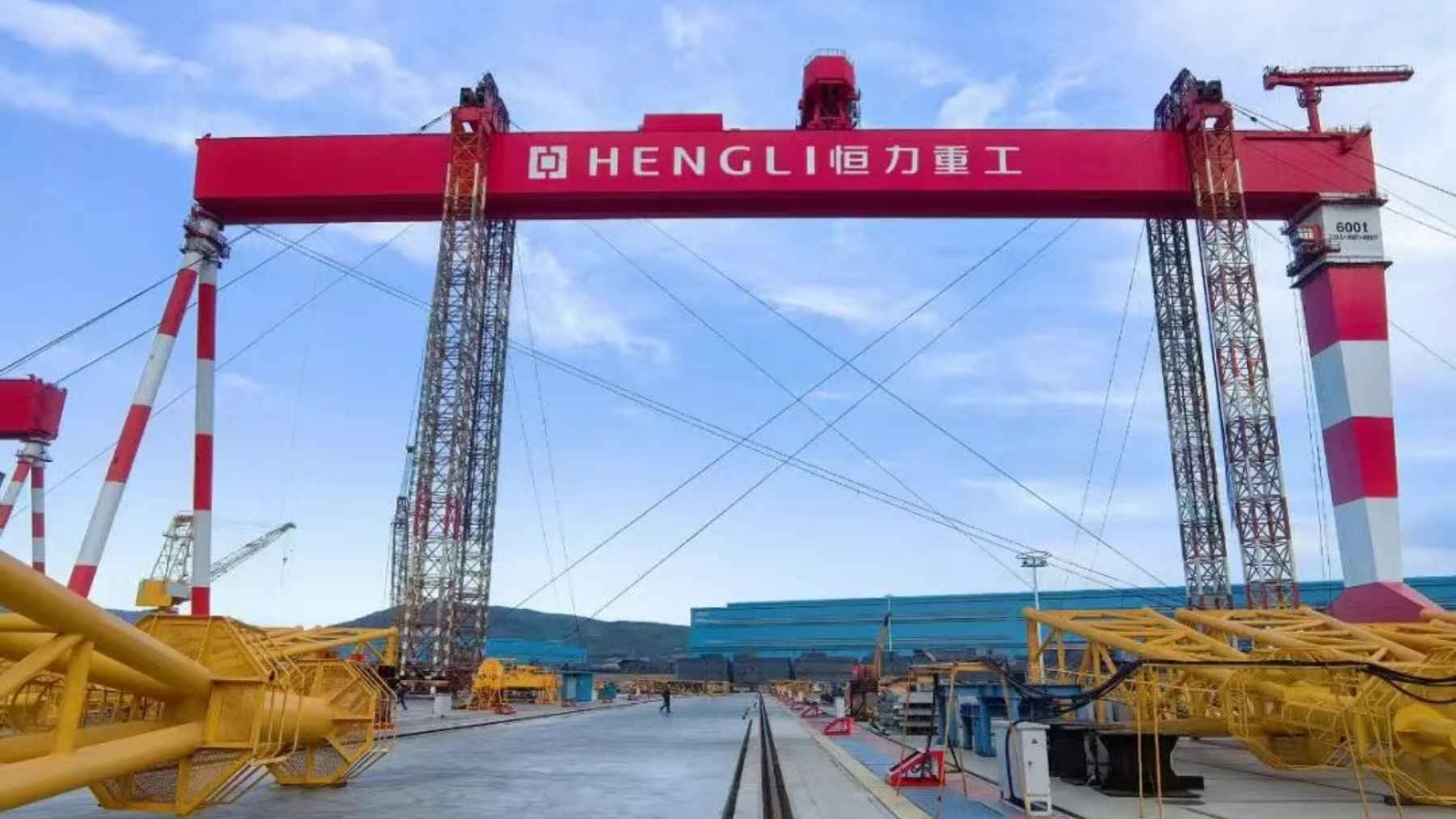
Shipyards ignore that limit. On Changxing Island in Dalian, in China’s northeast, a yard called Hengli Heavy Industry is bolting together three gantry cranes for a single dry dock. Two of them are built to lift more than 10,500 metric tons in one pick, on a span that stretches 256 meters, longer than two and a half football fields laid end to end.
Construction started earlier this year, so none of these cranes has lifted anything yet. But the figures are already rewriting a couple of records, and they say a lot about where the weight of global shipbuilding has shifted.
Three cranes for one dry dock
The maritime outlet Splash247 reported the project in April, with contractor Jiangsu Tianmu Construction Group confirming the numbers. Two of the three cranes are the big ones: a 256-meter span, a single-lift capacity above 10,500 metric tons, and a lifting height of 100 meters. Together the pair weighs 12,700 metric tons. That’s the crane steel alone, before it picks up a thing.
The third crane is the small one, if 8,000 metric tons counts as small. It shares the same 256-meter span, weighs 9,300 metric tons, and lifts 8,000 on its own.
All three will work inside the same dry dock. Hengli says the arrangement lets it assemble ultra-large sections as complete units and lower them into place whole, and that this should cut dry-dock construction time by more than half.
A shipyard builds in blocks, not pieces
For decades, big ships and offshore rigs were put together the slow way: in modules of 1,000 to 2,000 metric tons, hauled into the dock and welded together on site, usually high up where access is bad and everything takes longer.
A crane that can hoist a 10,500-metric-ton block changes the arithmetic. Instead of stitching a hull from small parts, the yard can build enormous sections on the ground, fit out the piping and machinery where workers can actually reach it, then set the whole thing into the dock as one unit. Fewer lifts, less welding at height, less time with the dock occupied.
That’s the logic behind China’s Taisun crane, the 20,000-metric-ton machine at Yantai that pioneered whole-module lifting years ago. It’s also why Britain used one of the largest cranes on land earlier this year to lower a reactor vessel into Hinkley Point C in a single move. Hengli is running the same play at a much bigger span, over a dock long enough to hold several tankers at once.
The record is the span, not the lift
It would be easy to read “10,500 metric tons” and figure these are the strongest cranes ever built. They aren’t, and the record here is more specific than that.
The heaviest-lifting crane is still Taisun, which set a Guinness World Record in 2008 by hoisting a water-ballasted barge weighing 20,133 metric tons, according to Offshore Magazine. A mobile gantry crane called Honghai later went further, to 22,000 metric tons. Both lift far more than Hengli’s new cranes will.
What Hengli’s cranes break is span and self-weight. Taisun spans 120 meters; these reach 256, more than double. At 12,700 metric tons for the pair, they’re the heaviest gantry cranes ever built, per the contractor. A wider span matters more than it sounds, because it lets the crane straddle a longer stretch of dock and set sections down anywhere along it, which is the whole point when the dock is built to hold several ships side by side.
Four years ago, this was a bankrupt yard
The cranes are striking on their own. What’s stranger is how fast the company building them showed up.
The site on Changxing Island used to belong to STX Dalian, a shipyard that went under. Chinese businessman Chen Jianhua bought the bankrupt facilities in mid-2022 and started over as Hengli Heavy Industry. China already dominates the world’s giant machines, from the 5,000-ton boring machine now grinding under the Yangtze to most of the planet’s tunnel borers. Hengli is that same industrial base pointed at ships.
Since 2022 the yard has moved at a pace the industry hasn’t really seen. Hengli booked a new order roughly every three days through all of 2025, and kept it up into 2026. VesselsValue data puts it at 174 orders worth about $16 billion over the past year, which makes it the largest shipyard in China by order volume. Its order book stretches into 2029, with more than 70 ships under construction.
Very large crude carriers are the specialty, at 31% of its bulk orders, and the buyers aren’t only domestic. Hengli has been winning VLCC contracts from European owners, the kind of customers who tend to be fussy about build quality. Earlier this year it became the first shipbuilder ever to launch four 306,000-dwt tankers at the same time, and aerial shots of the yard show what Splash247 called “a forest of gantry cranes on a scale rarely seen anywhere.”
The next record is a dry dock
The cranes aren’t the end of it. In late June, TradeWinds reported, as carried by the American Journal of Transportation, that Hengli is planning what would be the world’s longest dry dock: a 1.2-kilometer trench, 146 meters wide, part of a fresh push of roughly $1 billion aimed at building still more VLCCs. A dock that size could hold four full-length tankers and two half-length ones under construction at once.
That sits on top of a separate 13.5-billion-yuan program, about $1.94 billion, that Hengli says would make its Dalian base the single largest shipbuilding site on Earth. Analysts at SSY expect the yard to hand over at least 160 ships in 2028.
Line it up and the cranes stop looking like a flex and start looking like plumbing. A yard trying to build the most tankers in the world, on the longest dock in the world, needs a way to move the biggest pieces in the world. The 256-meter cranes are how you do that.
None of them has lifted anything yet. When they do, the first thing they pick up will be a slab of ship bigger than most cranes on Earth could touch at all.