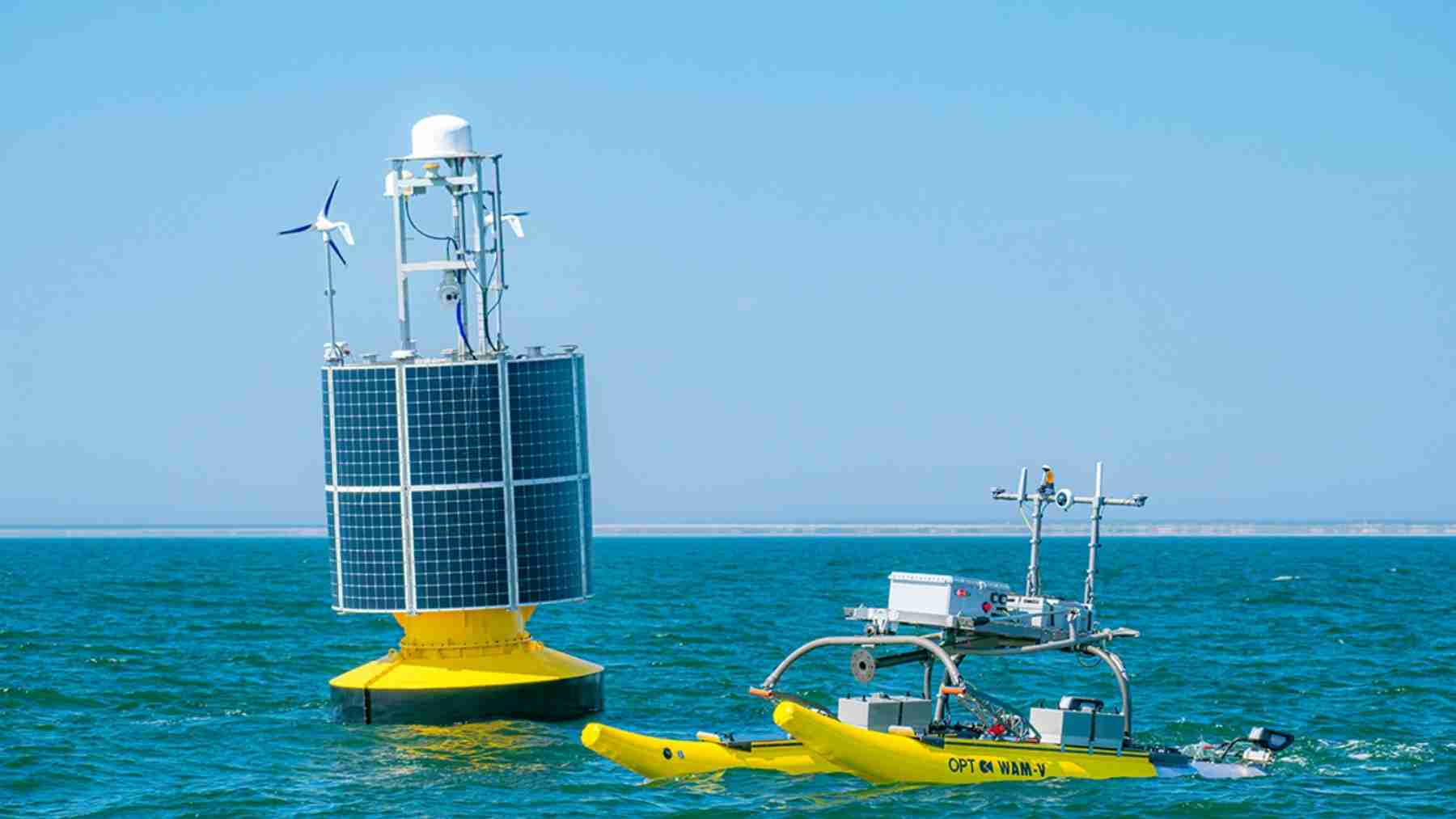

Every uncrewed boat working the ocean has the same unglamorous weakness, and it has nothing to do with the autonomy software everybody likes to talk about. Sooner or later the thing runs out of battery or fuel, and a crewed vessel full of actual humans has to steam out and collect it. That trip costs money, burns diesel, and quietly cancels a good chunk of the reason you bought a robot in the first place.
A company in Monroe Township, New Jersey, says it has now taken the humans out of that trip. Ocean Power Technologies announced on May 7 that its WAM-V maritime drone approached a dock on its own, secured itself, recharged, and went back to work without a person laying a hand on it.
The company frames that as step one toward offshore “charging points” built onto its PowerBuoy platform, the moored buoy it has been selling for years. The eventual pitch is a gas station in open water that pulls its own electricity out of the ocean.
It’s a good idea. It is also, right now, not a thing that exists. And the gap between what OPT demonstrated and what it is selling is where this story actually lives.
The self-docking part is real. The wave-powered pump is not.
Read the May announcement closely and the wording is careful. The drone approached “a dock.” It secured itself, recharged, redeployed. Nowhere does the company say the dock was a PowerBuoy, and nowhere does it say any of this happened in the open ocean.
The buoy tie-in is explicitly future tense. OPT says it is advancing the capability for near-term integration with PowerBuoy, which is corporate for “we have not bolted them together yet.”
There is a paper trail for how long that has taken. In a February 23 operational update filed with the SEC, OPT said the docking and charging program had moved from prototype to full-scale build, and that it had ordered components for system integration and open-water validation. The target it gave then, and repeated in its March quarterly release, is an early-access commercial launch during calendar 2026.
So the sequence runs: prototype, full-scale build, a successful docking demo, open-water validation still to come. That is a normal engineering timeline. It is not the same thing as a robot boat refueling itself in the middle of the Pacific, which is roughly how the story traveled.
Philipp Stratmann, OPT’s president and chief executive officer, put the commercial logic plainly in the May release, describing the goal as “extending time on station while reducing the need for manned support.” Nobody running an uncrewed vessel would argue with him.
The WAM-V exists because somebody kept getting seasick
The drone has one of the better origin stories in marine robotics. WAM-V stands for Wave Adaptive Modular Vessel, and according to Unmanned Systems Technology, the concept grew out of a chronic seasickness problem and a crewed demonstrator called Proteus, unveiled in 2007. OPT bought the company behind it, Marine Advanced Robotics, in November 2021.
The design looks wrong until you understand it. Two inflatable pontoons carry a payload tray on an articulating suspension of springs, shocks and ball joints. The hulls ride the water. The platform on top mostly doesn’t. OPT compares the pontoons to car tires, soaking up high-frequency chop while the suspension dissipates the slower stuff.
They come in three sizes: the WAM-V 8 at roughly 2.5 meters, the 16 at 5 meters, and the 22 at 7 meters. Engine pods hang off hinges at the back so the propellers stay in the water even when the boat is pitching, and a 2:1 length-to-beam ratio lets the 16 spin a full 360 degrees inside its own length.
The detail that matters for a charging story is which of them can plug in at all. Per Unmanned Systems Technology, the 8 and the 16 are fully electric, while the 22, the biggest of the three and the model the company has poured most of its engineering into, is typically fuel-powered, running Honda or Suzuki outboards. A charging buoy does very little for a boat with a gas tank.
Five buoys are in the water, and Anduril holds the contract
The buoy half of the business has moved faster than the charging half. On May 18, OPT said its U.S. PowerBuoy deployments had gone from a single research unit to five running at once: three supporting Department of Homeland Security work, one on Navy research, and one for a U.S. research institution.
Three of those sit off Southern California, streaming data for a Coast Guard maritime domain awareness mission. One of them is moored in water deeper than 1,000 meters. All three feed into Anduril’s Lattice command and control platform.
OPT spelled out the contracting structure itself, so let’s use it. In the March quarterly results, the company said the DHS award is worth approximately $6.5 million and covers four newly built MERROWS-equipped PowerBuoy systems, with Anduril named as the prime contractor on the project. The buoys operate alongside Anduril’s surveillance towers.
That isn’t a knock on OPT. It’s a fair description of where a small buoy company sits inside a defense sensing architecture in 2026. A node, not the network.
In June the customer list widened past defense. OPT deployed a PowerBuoy off New Jersey for Rutgers, replacing an older ocean monitoring system that ran on fixed seabed cables, and booked a WAM-V order from Stevens Institute of Technology. The Rutgers job is the cleanest version of the underlying pitch: a buoy you can pick up and move somewhere else is worth something a cable will never be worth.
Half a megawatt-hour is a rounding error, and that is fine
On June 8, OPT published the first hard number out of the DHS deployment. The MERROWS-equipped PowerBuoy off San Diego has generated close to 0.5 MWh of energy to date, which the company offered as proof of reliable renewable power generation in an active maritime environment.
Half a megawatt-hour is 500 kilowatt-hours. The average American home gets through about 10,500 kWh a year, according to the U.S. Energy Information Administration. The buoy has produced roughly seventeen days of one house.
That number isn’t supposed to be impressive in grid terms, and nobody at OPT is pretending it is. A surveillance buoy has to run radar, cameras and a satellite uplink, not a neighborhood. The entire argument for harvesting power out there is that the alternatives are a diesel generator somebody has to refuel or a cable somebody has to lay across the seabed.
What OPT has not said publicly is which buoy is doing the work. The company sells two designs under the PowerBuoy name. The PB3 converts wave motion through a direct-drive generator, rated at 300 watts continuous and 7.2 kW at peak for about an hour a day, per POWER magazine’s writeup of its commercial launch in 2016. The hybrid PowerBuoy runs primarily on solar, with a small Stirling engine burning propane or biofuel as backup, and makes its electricity independent of wave activity.
The DHS releases say renewable. They do not say wave. For a story about the ocean fueling its own robots, that is not a small distinction, and it is one worth OPT clearing up.
So who actually needs a gas station in the middle of the ocean?
Everyone building persistent robots, and they are all attacking the problem from different directions.
Australia decided its boats should simply never come home. The 40 additional Bluebottle patrol boats Canberra ordered this year harvest sun, wind and wave motion while under way, and one stayed at sea for more than six months without a person touching it. Ocius engineered the energy problem out of the vessel.
DARPA went the other way with Defiant, the 240-ton drone warship that took on fuel at sea from a crewed ship while nobody set foot on it. That works. A crewed ship still had to show up.
China is wiring the seabed instead, building cabled observatories that double as docking and recharging stations so uncrewed submarines can loiter and redeploy without ever surfacing.
OPT’s version splits the difference. Leave the boat cheap and stupid about energy, and put the energy somewhere the boat can go and get it. If that works, the recharging buoy stops being a product and becomes infrastructure, the boring kind that other people’s drones eventually pay to use. Stratmann has described the ambition as letting autonomous systems “power, recharge, and operate indefinitely at sea.”
The catch is that infrastructure takes years, and OPT is burning cash. In the quarter ended January 31, the company booked $513,000 in revenue against a net loss of $11.4 million, holding $7.2 million in cash and equivalents. Backlog hit a record $19.9 million, up 165% year over year, and in June the company priced a $10 million share offering. None of that says the technology doesn’t work. It says the docking system needs to go commercial in 2026 the way OPT promised, because the runway is not long.
The hard robotics is done. The unromantic half is not.
Teaching a boat to find a floating target in a moving ocean, mate with it, take on power and leave again is a difficult problem, and OPT has solved a version of it. What is left is the part nobody puts in a press release: proving it still works when the dock is a buoy bobbing in a three-foot swell instead of a fixed structure, and that the buoy can spare the electrons.
Because that is the thing about a gas station that makes its own gas. On a bad week the ocean goes flat, the sky goes grey, and there are 500 kilowatt-hours in the battery that the radar already has plans for. The drone can dock all it likes.