
Swapping a gasoline car for an EV is the easy part of electrification. The hard part is everything bigger than a car: the semis, the locomotives, and the building-sized machines that dig the raw materials out of the ground in the first place. Mining sits at the far end of that scale, where diesel has always won by default, because for a century nothing else could move that much rock that fast.
So it’s worth a look when the biggest excavator Komatsu has ever built rolls out with the option to plug in.
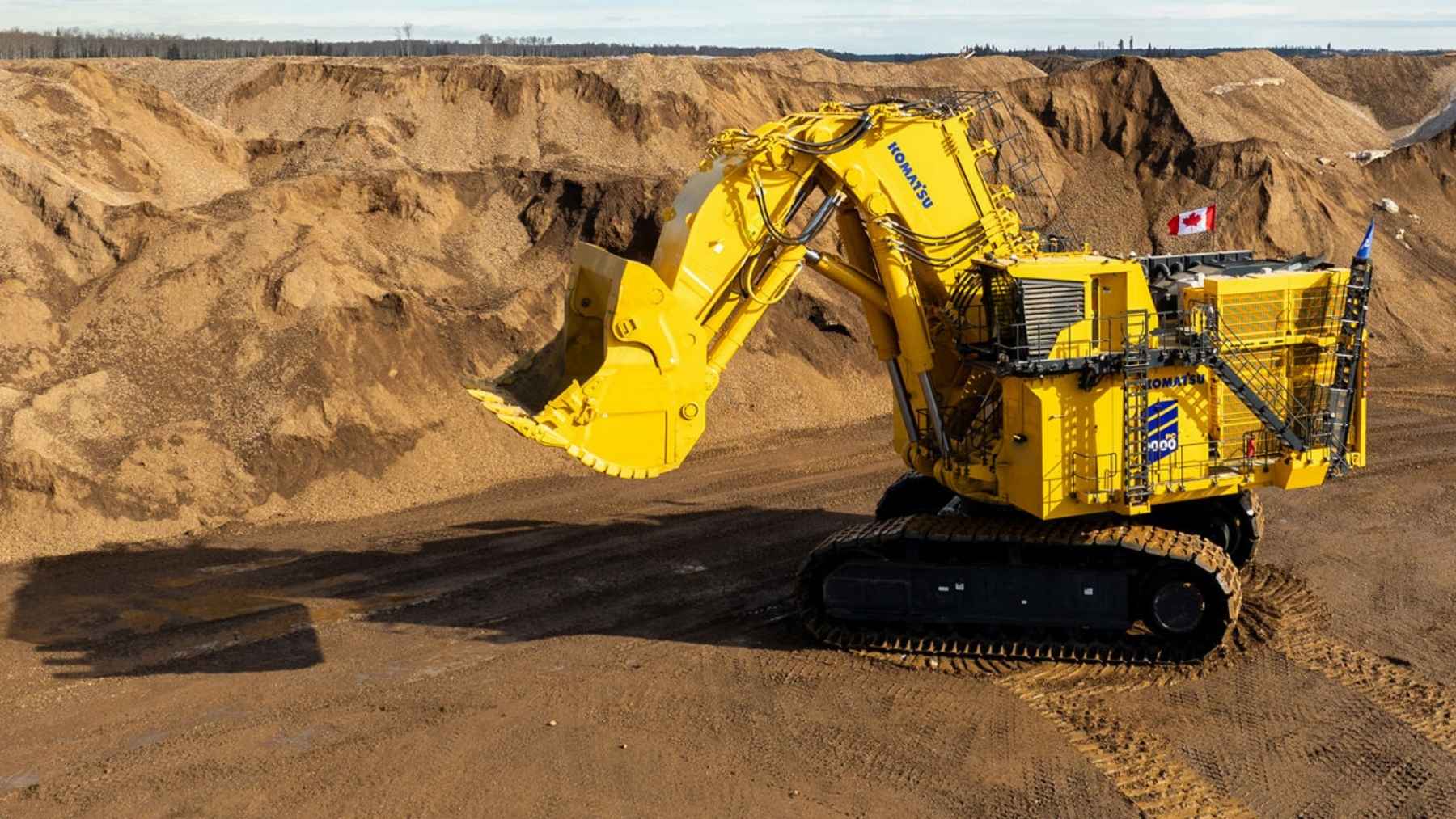
On April 2, Komatsu’s Germany Mining Division put the PC9000-12 on the global market, after the first one spent a year proving itself in a Canadian oil sands mine. It’s a hydraulic mining excavator that weighs up to 896 metric tons (nearly 990 US tons), and it can be ordered with a diesel engine or a fully electric drive. One scoop moves more than 80 tons of material. Under good conditions it shifts around 8,000 tons an hour. And it is, by a comfortable margin, the largest machine of its kind the company has ever put its name on.
The spec sheet reads like a typo
Start with the operating weight. Up to 896 metric tons, depending on how it’s configured, which is about the weight of two of those record-setting power transformers Sweden just shipped to China. Except this one moves under its own power instead of riding a 300-wheel trailer at walking pace.
The bucket is where the number turns silly. In backhoe form it’s 49 cubic meters, about 64 cubic yards, and as a front shovel it’s 46. Either way, one bite grabs more than 80 tons of rock or ore.
Feed that into a truck and the cycle time is the part that actually matters at a mine. Komatsu says the PC9000-12 can load a 980E, a haul truck rated for 400 short tons, in five passes, in under 150 seconds. Do that on repeat and you’re moving somewhere around 8,000 tons an hour.
The machine stands over 33 feet wide and 33 feet tall, which makes it less a vehicle than a piece of relocatable infrastructure. Peter Buhles, Komatsu’s vice president of sales and service, said the PC9000-12 “sets a new benchmark for global surface mining operations,” which is the kind of thing executives say, but the spec sheet mostly backs him up.
It is not the biggest excavator in the world
The headlines tend to skate past one thing. The PC9000-12 is the biggest hydraulic excavator Komatsu has ever built, and that claim holds up. It is not the biggest one in the world.
That title still belongs to the Caterpillar 6090 FS, a roughly 1,000-ton machine with a 52-cubic-meter bucket that traces its design back to the old Bucyrus RH400. By operating weight, per the equipment-spec database LECTURA, the 6090 is the heaviest hydraulic mining excavator ever put to work.
The wrinkle is that Caterpillar has stopped building new 6090s. So while Komatsu’s machine isn’t the biggest ever, it may well be the biggest one you can currently order off a line, which is a narrower, less thrilling claim, and also the accurate one.
And none of these are the biggest digging machines on Earth, for the record. That distinction goes to bucket-wheel excavators like Germany’s Bagger 293, a continuous-mining contraption as long as a couple of football fields laid end to end. Different tool, different job, a whole different kind of ridiculous.
The electric part is a choice, not a default
The “electric” in the headline needs a small asterisk, because the PC9000-12 isn’t electric by default. Komatsu offers it three ways: diesel Tier 4 for regions with strict emissions rules, diesel unregulated for remote sites without the fuel infrastructure, and a full electric drive for operations that want it or are required to run it.
The electric version runs on two motors rated at 1,700 kW each (about 4,560 horsepower combined), fed by a thick high-voltage cable that trails behind the machine and plugs into the mine’s grid. It doesn’t carry a battery. It’s tethered, like the world’s angriest slot car.
The units already digging at Suncor’s Fort Hills mine in Alberta aren’t the reason this counts as an electric story. Those proved the machine works. The electric drive is a box you tick when you order one, and whether it makes sense depends almost entirely on where you’re digging and what your local rules look like.
Electrifying a giant shovel isn’t even new. Caterpillar’s 6090 came in an electric version, and Komatsu’s previous flagship offered one too. What’s actually new here is that the option now comes on the biggest excavator Komatsu makes, and you can order it anywhere in the world.
China just crashed the ultra-class shovel party
While Komatsu was taking its excavator global, China’s XCMG rolled out a different kind of giant. On May 21, at a customer event in Xuzhou, it unveiled the XES55, an ultra-class electric rope shovel with a nominal 55-cubic-meter bucket, as reported by International Mining.
A rope shovel isn’t the same machine as a hydraulic excavator, even though they do a similar job. Instead of hydraulic arms, it uses electric winches and steel cables to swing and crowd the bucket, and it’s permanently plugged into the grid. It can’t roam around a mine the way an excavator can, but it loads the very biggest haul trucks in the fewest passes. XCMG says the XES55 is sized to fill 290 to 360-ton trucks, and pegs it against North American benchmarks like the Komatsu P&H 4100XPC and the Cat 7495.
That last part is the actual story. Ultra-class electric shovels have been a North American specialty for decades, and XCMG rolling out its own, after starting with the smaller XES35 in 2023, is a Chinese OEM planting a flag in a segment it was mostly locked out of. China treats the ability to build machines like this the same way it treats the record boring machines it’s been running under the Yangtze: as a measure of how good its heavy industry really is.
It is not, to be precise, the biggest rope shovel going. Fellow Chinese maker Taiyuan Heavy Industry already builds a 55-cubic-meter shovel that’s been exported to mines in South Africa and Chile, and its 75-cubic-meter WK-75 is the largest rope shovel ever made, though only one exists. The headline isn’t size. It’s who’s suddenly able to build these at all.
What it actually means for the rest of us
None of this makes diesel disappear from a mine tomorrow. A tethered electric shovel only works where there’s grid to tether to, and plenty of the world’s ore sits a long way from a substation. The diesel options exist for a reason.
But the direction is hard to miss. The machines at the very top of the size chart, the ones that dig up the copper and iron and everything else that ends up in batteries, grids, and cars, are the last place you’d expect electrification to show up, and it’s showing up anyway. The biggest electric vehicle anyone has built so far is a battery-powered ferry, not a car, and now the machines that mine the metals are getting the same treatment. Komatsu will sell you its largest excavator with a plug. XCMG will sell you a building-sized electric shovel. Slowly, one enormous machine at a time, the stuff that digs the future is starting to run on it too.