
Finding a submarine is mostly a listening problem. Modern boats run so quietly that the ships, aircraft, and helicopters chasing them spend most of their time with hydrophones in the water, straining to pull one faint propeller turn out of the background noise of the ocean. The catch is that the hunter is usually the loudest thing in the fight, broadcasting its own engines and props straight to the boat it is trying to sneak up on.
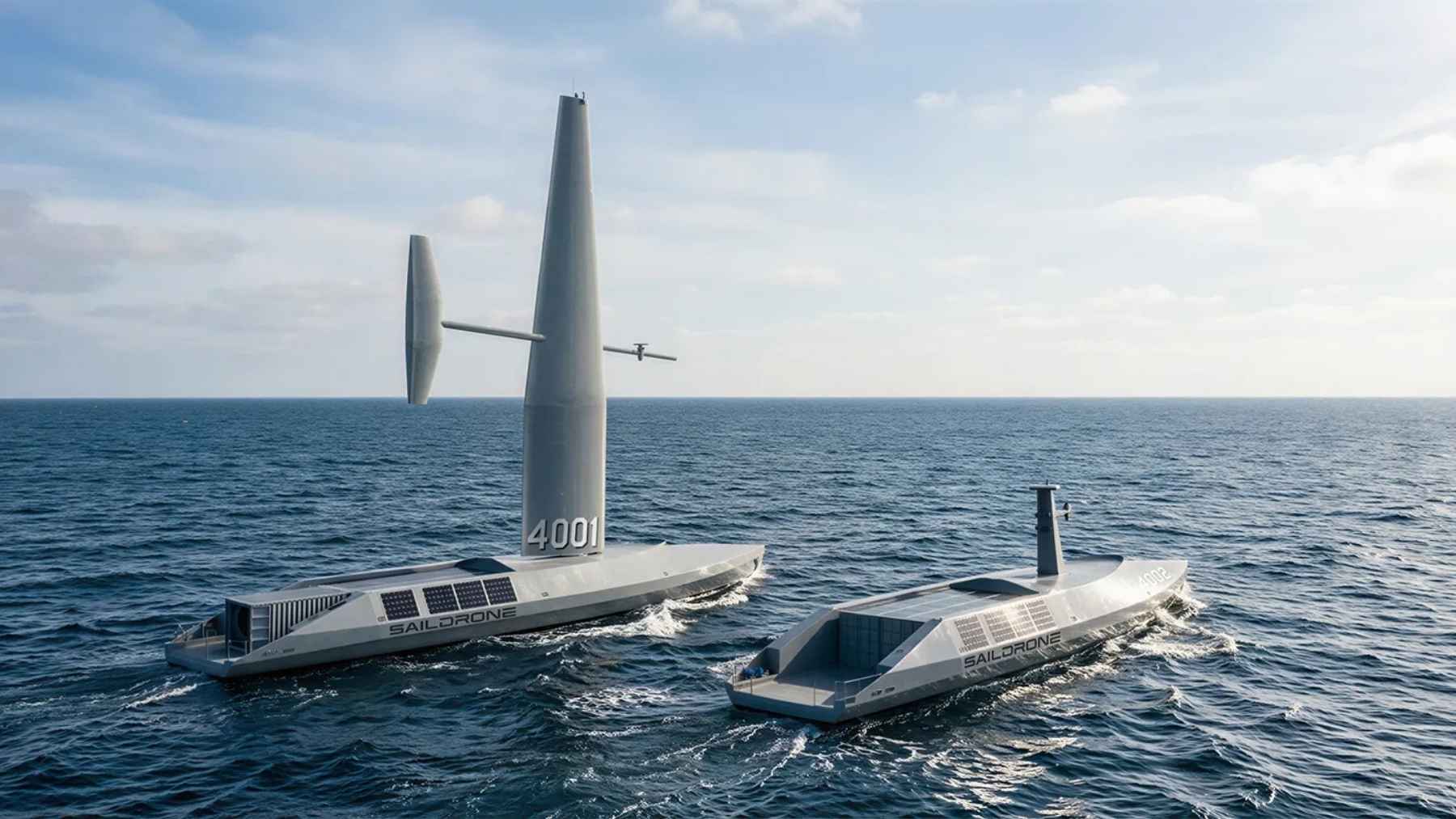
That is the problem a California company thinks it can solve with a 170-foot robot that looks an awful lot like a sailboat. In April, at the Navy League’s Sea-Air-Space exposition in National Harbor, Maryland, Alameda-based Saildrone unveiled Spectre, its largest and most capable unmanned surface vessel to date: 52 meters long, around 250 tonnes, capable of up to 30 knots, and built specifically to hunt submarines. The company says each one will run roughly $40 million. For most of the past decade Saildrone built wind- and solar-powered robots that mapped the seafloor and drove into hurricanes for climate scientists. Spectre takes that same quiet-by-design DNA and points it at one of the hardest jobs in modern warfare.
The whole point is staying quiet
To see why a sailboat-shaped robot makes sense here, it helps to separate the two ways you can find something underwater. Passive sonar is just listening: a hydrophone array picks up the noise a target radiates, the churn of a propeller or the hum of an engine room, and works out where it is coming from. Active sonar is the opposite. It sends out a pulse, the famous ping, and times the echo bouncing back off a hull. Active sonar will catch a quiet target that passive sonar misses, but it also announces exactly where you are to everyone listening, which is why submarine hunting leans on passive listening whenever it can.
A boat under sail barely shows up to that kind of listening. There is no engine roaring, no propeller thrashing, almost nothing for a passive array to grab onto. If you have ever watched a sailboat slip past with nothing but the wind in the rigging, you already know the basic trick, and it is the same reason small yachts can be unnervingly hard to detect from below. Saildrone’s pitch is to turn that silence into a weapon. The wing-assisted version of Spectre can creep along on near-silent electric drive, towing the sort of sensor array that needs quiet water to do its job, and listen for a submarine without the submarine ever hearing it coming.
The quiet cuts both ways, and the second way is the one that actually drives detection range. Self-noise is the enemy of any sonar operator: the more racket your own platform makes, the more it drowns out the faint signal you are trying to hear. Strip that noise out and a towed array or a variable-depth sonar can reach a lot further. Spectre is designed to drop a sensor far out ahead of a carrier group, loiter there for weeks, and watch the water before a single crewed ship arrives. A destroyer can do the same listening. A destroyer is also a very expensive, very loud, very crewed way to do it.
Two boats wearing the same hull
Spectre actually ships in two flavors built on one platform. The first, Spectre Silent Endurance, carries a 43-meter (140-foot) composite wing and is tuned for anti-submarine work and other missions where being heard is the thing you most want to avoid. That wing does double duty: beyond propulsion, it gives the boat a 43-meter height-of-eye for its sensors, essentially a built-in mast for seeing over the horizon. The second variant, Spectre Stealth Strike, drops the wing entirely for a lower profile and more speed, and leans toward strike and electronic-warfare roles.
Under the deck, both run twin shaftlines with a dual electric-and-diesel setup. On battery power the boat slips along at up to 12 knots in near silence; when it needs to move, 5,000 horsepower of Caterpillar diesel pushes it to 27 knots with a full load. A fully loaded Spectre can cover 3,280 nautical miles at a 25-knot cruise, or stretch past 8,000 nautical miles, more than 9,200 miles, if it backs off to that silent 12-knot creep, according to the company’s spec sheet. Maximum payload is over 70 tonnes, carried in containerized modules: anything from two 40-foot containers to five 20-foot ones, deployed out the back through the transom.
That payload bay is where it stops being a research boat. Working with Lockheed Martin, which has been pushing into uncrewed naval concepts of its own like a parasite drone built to ride along with a host warship, Saildrone has set Spectre up to carry thin-line towed arrays like the TB29, the CAPTAS-4 variable-depth sonar from Thales, and up to two Mk70 launchers, the containerized version of the Navy’s vertical launch system that can fire everything from Tomahawk cruise missiles to SM-6 interceptors. A robot sailboat that can quietly find a submarine and then, reconfigured, lob a cruise missile is a fairly large leap from mapping the Gulf of Maine.
Forty million dollars, not a few billion
The number Saildrone keeps pointing at is the price. Founder and CEO Richard Jenkins told reporters at the unveiling that each Spectre runs around $40 million depending on how it is configured and what it carries, and that the company has funded the whole program itself. Lockheed Martin’s Paul Lemmo put the appeal in blunt terms when speaking to Breaking Defense: more shooters on a relatively cheap platform instead of pouring everything into a single multi-billion-dollar destroyer, a lower-cost way to put more players on the field.
“Spectre is the result of 25 years of continually pushing the boundaries,” Jenkins said, framing the design as something evolved through real operations rather than rushed out to chase a particular contract. The hardware backs up at least part of that. The hull is aluminum and will be built in Wisconsin at Fincantieri’s shipyards, which Saildrone says can turn out up to five Spectres a year. The 43-meter wing comes from American Magic Services in Pensacola, Florida, the same composite shop with a pedigree in America’s Cup racing yachts, which is either reassuring or slightly surreal depending on how you feel about racing sailboats going to war.
The design has already been through a tow tank in Copenhagen on a one-seventh-scale model and earned an Approval in Principle from the American Bureau of Shipping, the classification step that says the thing complies with high-speed naval craft standards on paper. Construction of the first hull is meant to start shortly, with sea trials slated for early 2027.
Why the Navy is paying attention
The timing is not an accident. The Navy has spent years trying to figure out what it actually wants from uncrewed surface ships, and it recently swapped an earlier program called MASC for a faster “marketplace” approach that invites companies to pitch mature designs on a short clock. Saildrone submitted Spectre, and Jenkins has said the boat now meets the program’s requirements after sitting awkwardly against the old ones. In late May, the Navy narrowed a field of more than two dozen submissions down to seven designs; Saildrone’s Spectre is among the known contenders, though the service has not formally published the shortlist.
None of this is a contract yet, and the boat has not been in the water. The nearest real test comes this summer, when Saildrone and Lockheed Martin plan a live-fire demonstration during the Navy’s RIMPAC exercise in the Pacific, firing a Mk70 launcher from one of Saildrone’s smaller Surveyor boats to prove the integration works before it ever rides on a Spectre. That demo grew out of a $50 million partnership the two companies signed back in October 2025.
Spectre also lands in a crowded, increasingly global field. Allied navies are chasing the same idea, from Australia’s Ghost Shark uncrewed submarine to the Navy’s own long-running Sea Hunter, the medium drone ship that finally left experimental status this year. The wider push is real money. Navy officials have talked about wanting roughly a dozen operational medium uncrewed vessels within a year or so, and projected that half the surface fleet could be uncrewed by 2045. The service has been flying Saildrone’s smaller boats on real missions since 2021, from surveillance work in the Middle East to counter-drug patrols in the Caribbean, so the company is not exactly a stranger to the fleet. Spectre is just a much bigger, much more heavily armed bet on the same idea.
The clever part of Spectre is also the gamble. A wing that lets a 250-tonne robot sit and listen in near silence is a genuinely smart answer to a hard problem, but a slick scale model in a Danish tow tank and a render at a trade-show booth are a long way from a working submarine hunter. The autonomy has to hold up at extended range, the sonar has to actually hear what the company says it will, and a Navy that has burned through a decade of uncrewed-ship false starts has to keep writing checks. The first honest answer to whether the quiet pays off arrives when that first aluminum hull slides into the water in 2027, with the RIMPAC missile shot this summer as the warm-up act.