
Tearing a building down is usually the cheap part of a construction job. You hire a contractor, a machine shows up, and inside of a week a small lab is a pile of rubble and a few dumpsters. That isn’t how it goes when the building made radioactive material for a living.
At Oak Ridge National Laboratory in Tennessee, ten of those buildings sit in a tight cluster in the middle of the working campus. Crews needed six years of preparation before heavy equipment was allowed near the first one. That one’s now down, and the other nine are supposed to be gone before New Year’s.
The cluster is called Isotope Row. Workers put the ten facilities up between the late 1940s and the early 1960s, and for decades the people inside were making and studying isotopes for medicine, industry, science and the defense program. Production stopped in the early 1990s. The buildings stayed exactly where they were while the rest of the lab grew around them.
The first one to come down was the Isotope Area Storage and Service Building, known on site as Building 3036.
The timing’s a little muddled, so here’s what I can pin down. UCOR, the cleanup contractor, said in a note to its own workforce on August 3 that “we began demolishing the first of ten” that Monday. August 3 was itself a Monday, so I can’t tell you whether the first teardown happened that day or the Monday a week earlier.
The Energy Department didn’t publish its own announcement and photo until September 1. A month of lag between a contractor’s note and a federal write-up is pretty standard for this kind of work, but it does mean the picture going around this month shows something that happened in the summer.
So what takes six years?
It’s what the crews had waiting for them inside. The buildings were left standing with their ventilation systems contaminated, their hot cells still in place, process gear inside and what DOE files under legacy radioactive materials. A hot cell is a concrete room with walls thick enough to stop whatever sits inside from irradiating the person outside, and you’re doing the work through shielded windows with mechanical arms instead of your hands.
So why not flatten the whole row and deal with the contamination afterward?
Because a machine chewing through contaminated ductwork doesn’t make rubble, it makes dust, and dust goes wherever the wind takes it. The contaminated pieces come out first, slowly, and the empty shell gets knocked over at the end. It’s the same logic that had a French crew send a robot in to cut up a reactor plug from the hot end before anyone finished the job by hand.
That part’s mostly done now. According to the Oak Ridge Office of Environmental Management, crews pulled four 2,000-pound krypton tanks out of Building 3093 in 2024, a storage building that had supported thermal diffusion work. Earlier this year they took out process off-gas and central ventilation lines loaded with transuranic isotopes, which are the man-made elements heavier than uranium on the periodic table. If you’ve heard of any of them, you’ve heard of plutonium.
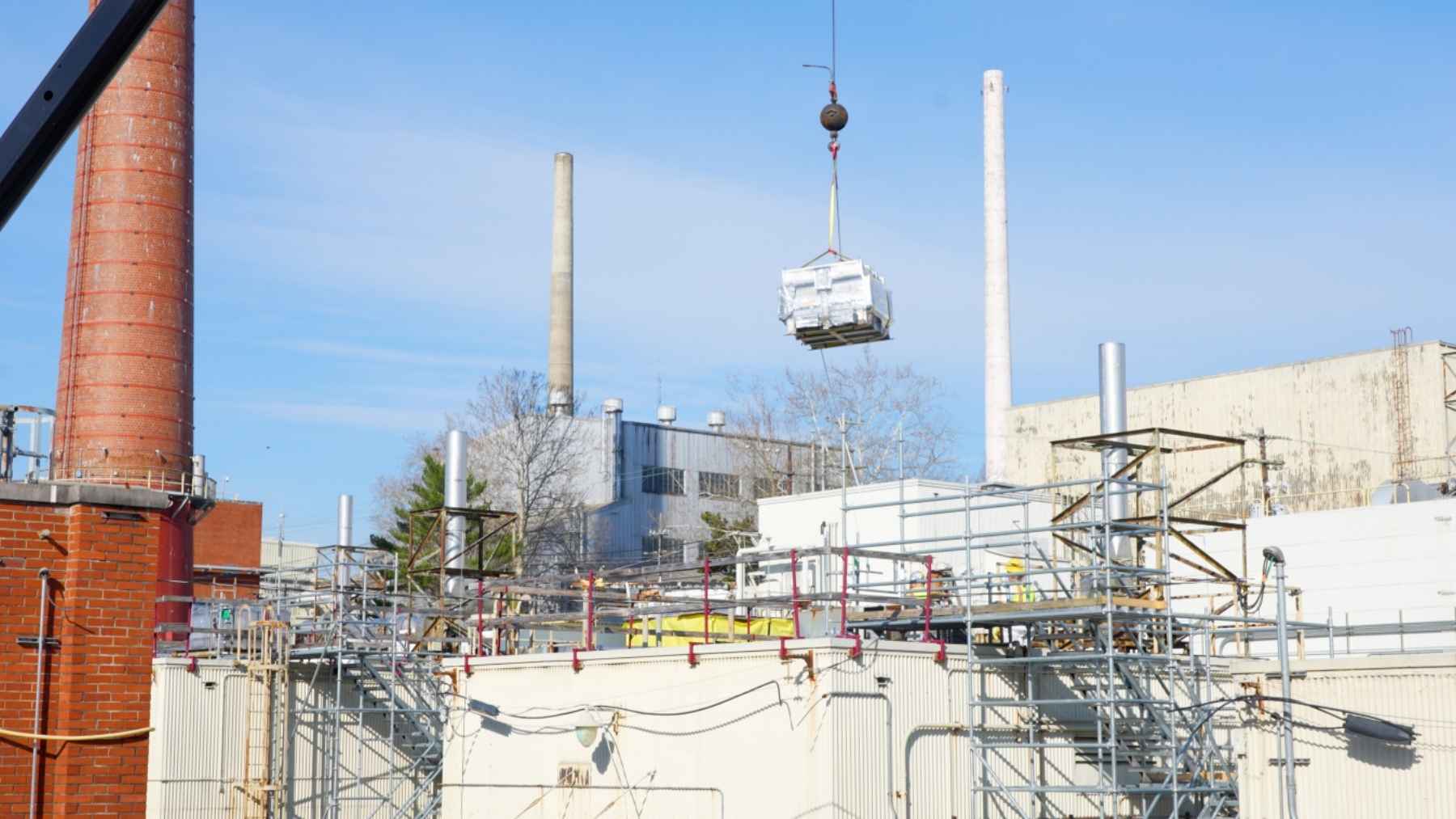
They also brought in a 110-ton crane to lift radiological filter houses and pipe bridges off the rooftops, cut the leftover hot cells down to size, packaged them and ran contamination surveys across the footprint.
The teardowns happen after everyone else goes home
Isotope Row sits in ORNL’s central campus, which means you’ve got people running experiments in the buildings around it. So the teardowns are scheduled for the late afternoon, outside the lab’s normal operating hours. That’s why the DOE photo of Building 3036 coming apart looks like it was shot at quitting time. It was.
The buildings are also coming down one at a time in a set order. UCOR president Jim Blankenhorn told staff the sequencing exists because the footprint is so tight, and crews want no cross contamination between one building and the next. They’re packed in close enough that a mess made at one lands on its neighbor.
If you’ve ever watched a building come down, you’ve seen the crew work behind a fence with a clear drop zone. This crew has working labs on either side and a deadline at the end of the year.
Building 3029 stopped the job for a while
There’s a story attached to the biggest building on the row. In 2020, while UCOR was preparing the buildings for demolition, workers found a highly radioactive source inside the hot cells of Building 3029. “Once this unexpected level of radiation was discovered, work was immediately paused,” UCOR project manager Zachary Dew said in the cleanup office’s write-up.
Getting past it took years. Crews used radiation-resistant cameras to locate the source, tracked it to 18 high-dose legacy items and then worked them out one at a time with remote-controlled equipment and long-handled tools.
Each item goes through a small transfer window into a neighboring hot cell, into a heavily shielded drum, and then into a secure shipping container outside. On July 7 the office said 10 of the 18 were out.
Here’s where the numbers stop lining up, and I’d rather say so than paper over it. That same July write-up describes the row as eight radioisotope production labs and three storage buildings, which comes to eleven, while every demolition announcement says ten facilities. Building 3029 was still being emptied in July, so my guess is that it isn’t part of this year’s ten. No one’s spelled that out, so treat it as a guess.
The payoff is smaller than you’d think
So what does the lab get for six years of this? About 12,000 square feet, according to UCOR. That’s roughly a quarter of an acre spread across ten building footprints, or one decent suburban lot.
For the effort involved that’s pretty thin, and I don’t think the square footage is really the point. The ground sits in the middle of the central campus, where the lab wants new research facilities and has nowhere else to put them.
The buildings were also the hazard themselves, standing among offices and labs where people work every day, which is arguably the better argument for spending six years on them. Crews in Italy are handling the same problem by cutting a reactor apart under ten feet of water.
The September 1 announcement says crews expect all ten to be down by the end of the year. If that holds, a row of labs that stopped making anything in the early 1990s is gone in about five months, after six years of getting it ready.