
Boil a pot of water in Denver and it never reaches 212 degrees. It quits at about 202, because there is a mile less air pressing down on the pot, which is why boxes of pasta bother to print high-altitude instructions. Pressure decides when water boils. Take enough pressure away and water will boil at a temperature your home water heater hits on a normal Tuesday.
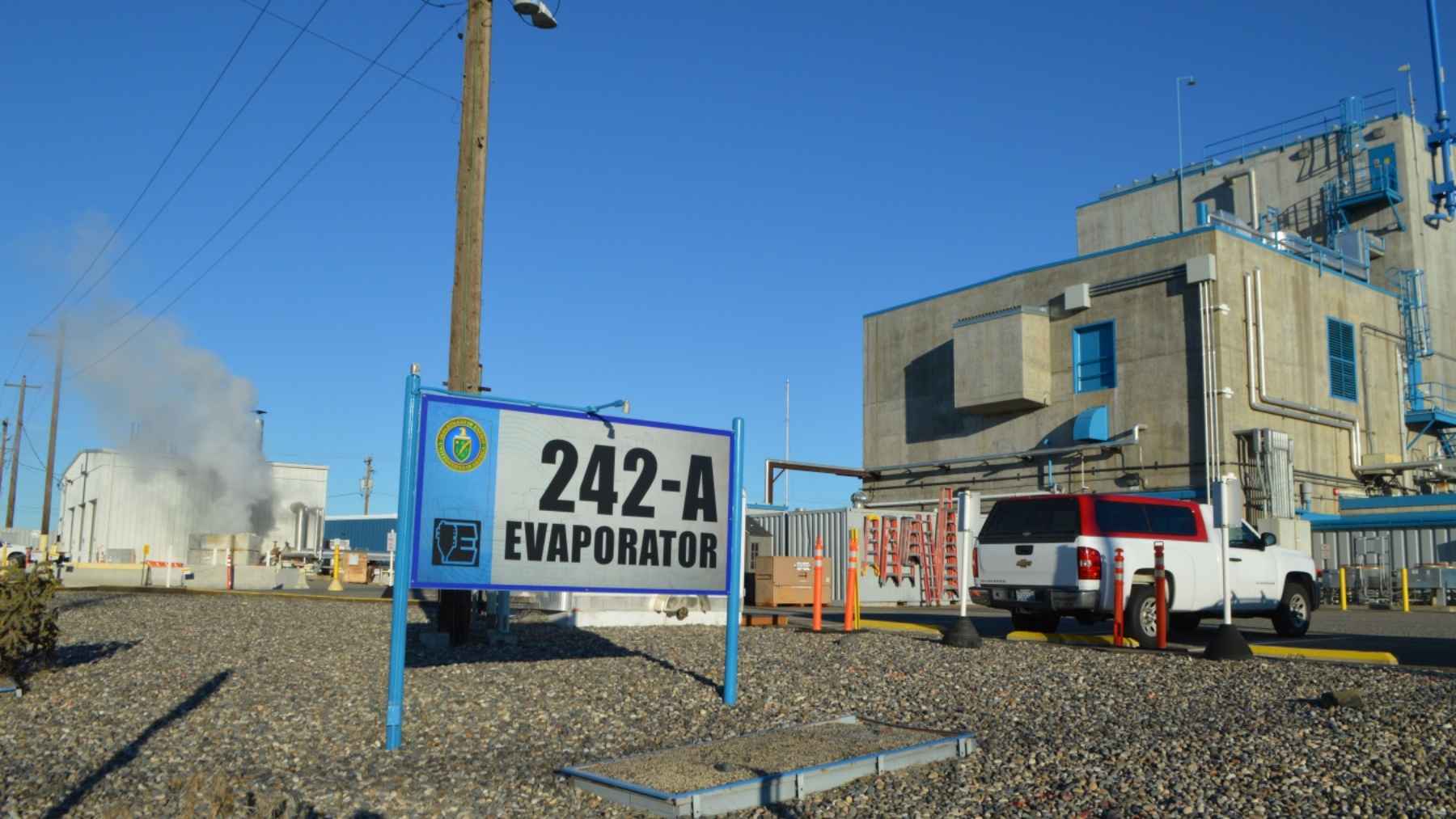
That principle is doing serious work on one of the most contaminated sites in the country. In the middle of the Hanford Site in eastern Washington, a plain concrete building called the 242-A Evaporator seals radioactive tank waste inside a vessel, pulls the pressure down and boils the waste at 125 degrees Fahrenheit (52 Celsius). The Department of Energy announced on August 18 that the latest run had opened up another 353,000 gallons of room inside Hanford’s underground tanks.
Hanford calls each run a campaign. This one behaved like the last several did, which is the boring outcome and also the one the site needed.
So how do you boil something at 125 degrees?
You cheat on the pressure. Liquid waste gets pumped over from a nearby double-shell tank into a sealed vessel, steam heat goes in, and a vacuum system drops the pressure inside the vessel until the waste boils at 125 degrees instead of 212, according to Hanford’s own fact sheet on the facility. Food plants use essentially the same trick to concentrate milk and fruit juice without cooking them to death. The goal here is duller and worth a lot more. Water leaves, everything else stays, and the volume in the tank goes down.
Two things come out the other end. The thick concentrated slurry goes back into a double-shell tank to wait for treatment. The water that boils off is captured, filtered and handed to Hanford’s Effluent Treatment Facility, which processes it for disposal.
You do not get less radioactivity out of any of this, and nobody at Hanford pretends otherwise. You get the same radioactivity in less liquid, sitting in a tank farm that suddenly has room in it again.
So what does that room actually buy?
Hanford is running out of double-shell tank space
Some background helps here. Hanford made most of the plutonium for the American arsenal starting in World War II, and it left about 56 million gallons of radioactive and chemical waste in 177 underground tanks. Of those, 149 are single-shell tanks with one steel wall, and 28 are newer double-shell tanks with a second wall wrapped around the first. The entire cleanup depends on pumping waste out of the old tanks and into the newer ones.
Which only works while the newer ones have space left. In an August 10 release, DOE said the double-shell tanks are nearly at capacity, and that the site’s only tank-side treatment system has sat idle since March 10, waiting on the vitrification plant to work up to speed.
The agency put a number on that pause. It counted 400,000 gallons of waste that could have been treated during the stoppage and were not, and it warned that further delay could stop crews from pumping out single-shell tank A-103. Against that, one evaporator campaign just handed back 353,000 gallons of room.
The machine is 49 years old and still the workhorse
Construction on the 242-A finished in 1977, and over 82 million gallons of liquid have come out of the tanks through it since. It also sat shut down for six years while crews repaired and upgraded it, then went back into service in 2025, so the campaigns it has run since the restart are the first real proof the overhaul took.
I cannot find published start and finish dates for this particular campaign anywhere in DOE’s material, or a figure for how many days it ran, which is a slightly strange thing to leave out of an announcement about a campaign. What the agency did publish is the ceiling on the whole approach, and it came from the man who runs the place.
Evaporator campaigns are “effective to a point and can only remove so much water,” said Will Ruane, the 242-A program manager at DOE’s Hanford Field Office, in the August 18 release. Boiling buys room. It does not treat anything.
So why not run the evaporator harder and skip the rest of the argument? Because the water is the easy part. The salts, sludge and radionuclides left in the tank still have to be turned into something that can be buried, and that is the fight Washington State is having right now.
Washington State has been asked to allow more grout
Waste that goes into glass at the vitrification plant is dealt with permanently. That plant passed 100,000 gallons of tank waste turned to glass this spring, which is real and also slow, and the plant is still working up to full speed.
On August 10, DOE’s Hanford Field Office asked the Washington State Department of Ecology to modify two of its cleanup permits. The change would let tank-side treated waste out of double-shell tank AP-106 go into grout, a cement-like solid, and travel to a commercial site out of state, rather than wait for a slot in the glass line.
Hanford Field Office Manager Ray Geimer said the vitrification plant will be fed first, and that as much as a million more gallons could leave the state in grout by the end of next year. Ecology has not approved either request. Both go through public comment and agency review first, and DOE scheduled a public meeting on the proposals for August 26 at the Richland Public Library.
Watchdog and environmental groups in the state oppose wider use of grout, on the argument that cement does not hold waste as securely as glass does. That fight will run for months. The evaporator meanwhile keeps doing the one job nobody objects to, because pulling water out of a tank upsets absolutely nobody.
Eastern Washington is where American nuclear projects go to become somebody’s long-term problem, from the tank farms to the 1,020-ton reactor buried in a pit near Richland. A 49-year-old building boiling sludge at water-heater temperature is arguably the least dramatic machine out there, and this year it is carrying a lot of the load.
Contractor Hanford Tank Waste Operations & Closure runs the facility for DOE, and the next campaign at the 242-A Evaporator is scheduled for the first quarter of 2027.