
Keeping an eye on an oil pipeline or a fiber-optic cable at the bottom of the ocean has always meant sending a ship out to do it. A crew sails to the spot, lowers a remotely operated vehicle down on a long cable, and then burns fuel sitting on station while the robot does the actual poking around.
It works. It’s also a little backwards, because the expensive part is the boat, not the robot. Argeo, the Norwegian survey outfit that became this machine’s first paying customer, reckons roughly 90 percent of the cost of this kind of inspection is tied up in the vessel.
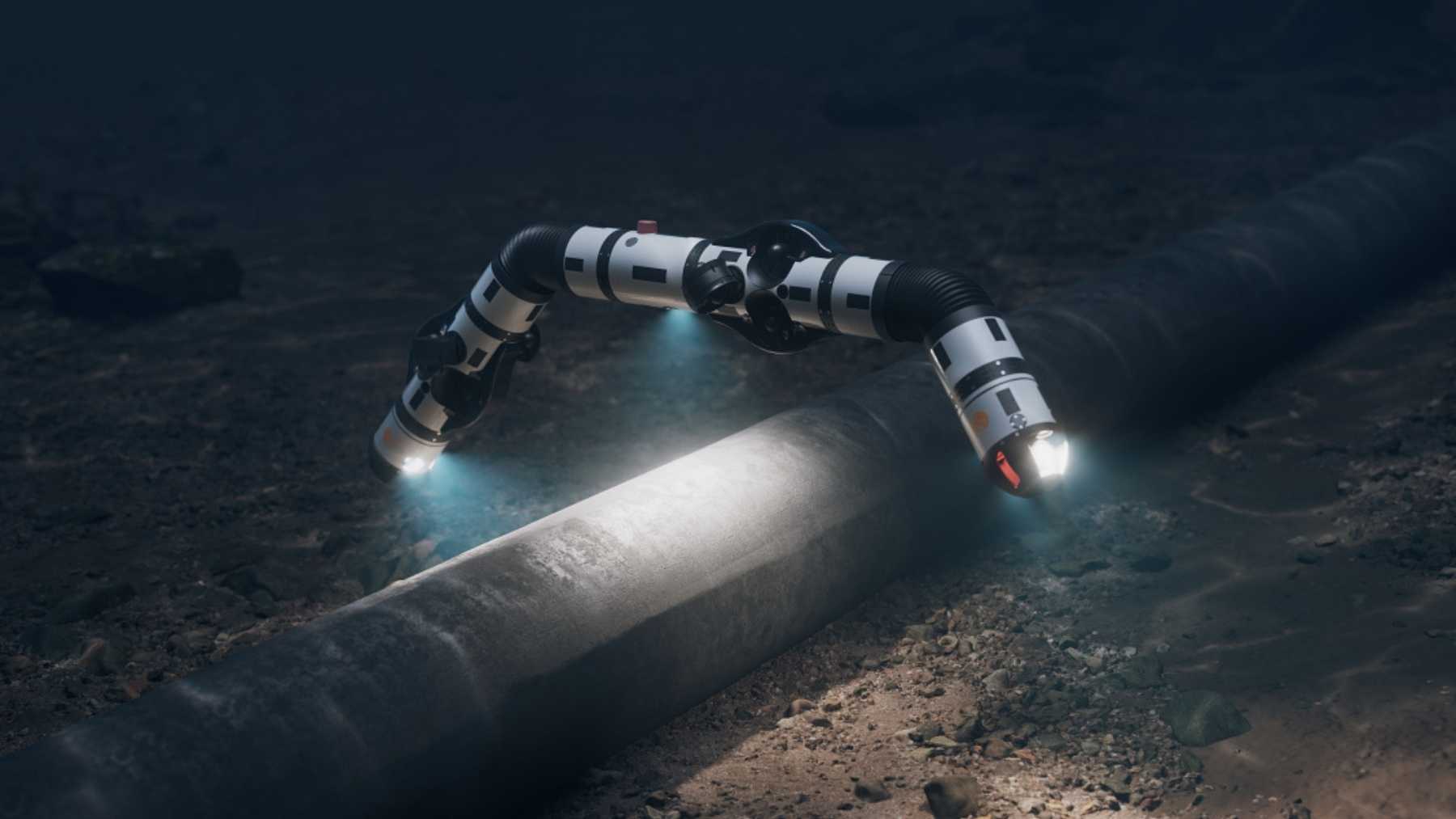
A small Norwegian company spent the last decade building the way around that. The machine is called Eelume, it’s shaped like a snake, and instead of riding down from a boat every time there’s a job, it lives on the seabed full time. It parks in a docking station, charges itself, and swims out when there’s something to look at.
The idea has been kicking around since 2015. What changed this spring is who signed up for it. In April 2026 the Norwegian Ministry of Defence handed Eelume a three-year research contract to teach the snake to work alongside the country’s warships.
How you end up with a robot shaped like a snake
Eelume started as a spin-off from the Norwegian University of Science and Technology and the research group SINTEF back in 2015, founded by robotics researchers Kristin Ytterstad Pettersen and Pål Liljebäck. The lab had spent years on snake robots. Someone decided the shape was wasted on land and pointed it at the ocean instead.
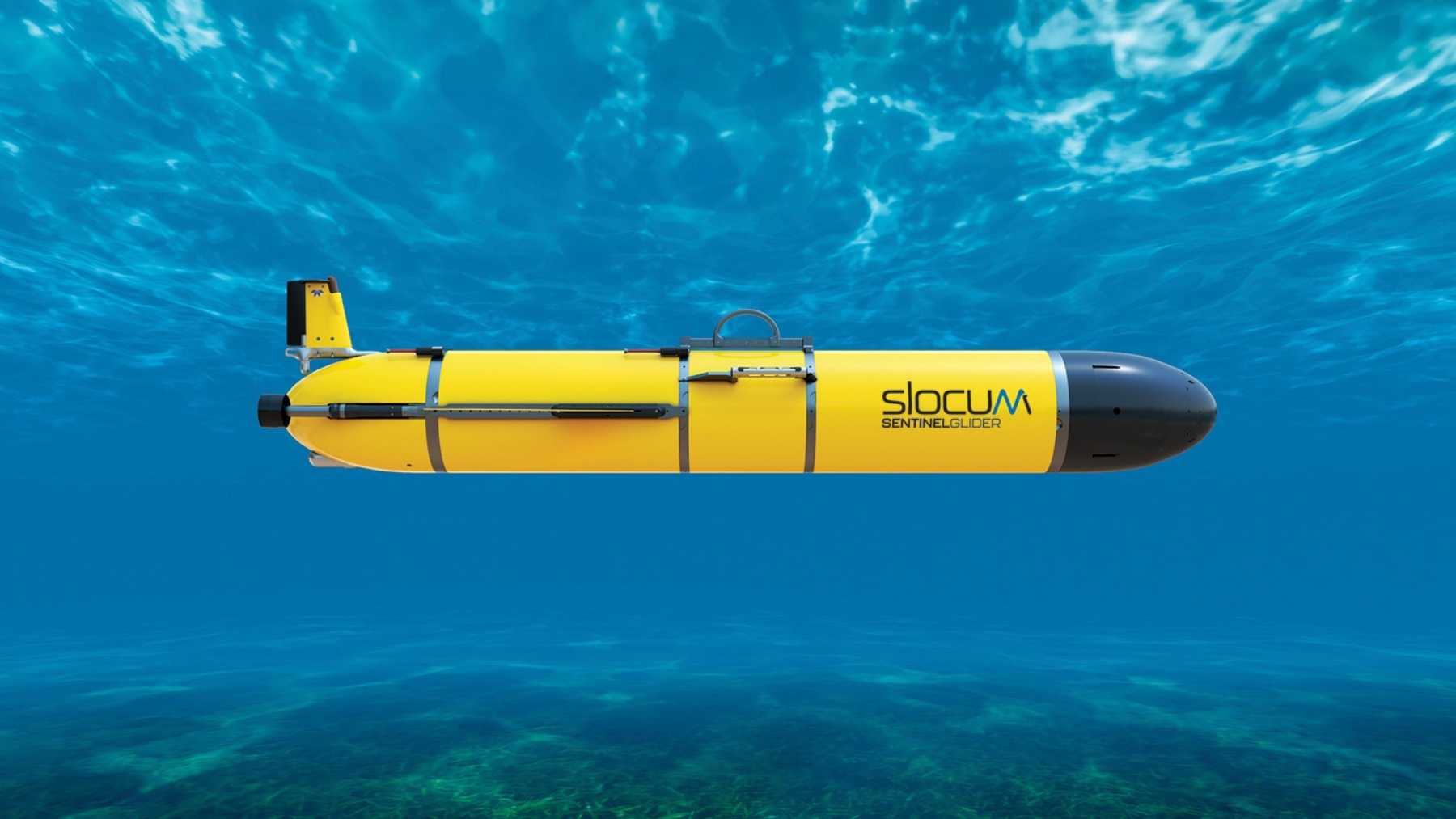
The result is about six meters long, modular, with a camera and sensors at each end. It moves two ways. It can undulate side to side like an actual sea snake for slow, precise work, or it can straighten out into a stiff torpedo and run on thrusters when it needs to cover distance.
That flexibility is the whole point. A rigid inspection vehicle bumps up against anything tight or awkward. A snake can thread into confined spaces around a wellhead or a subsea structure that a conventional ROV has to work around from a polite distance.
Kongsberg Maritime backed the project early and became its majority owner, bringing close to 30 years of experience from its HUGIN survey drones. So while the company is tiny, the engineering behind it is not some garage experiment.
It lives down there so a ship doesn’t have to
The trick that makes Eelume different is that it doesn’t come home at the end of the day. It sits in a docking station on the seabed, at depths down to 500 meters, in a low-power hibernating mode until it’s needed. The station is also where it recharges, which solves the one problem every underwater robot eventually runs into: you can’t exactly plug a 500-meter power strip into the surface.
Built that way, one of these is designed to stay down for up to six months without a surface vessel babysitting it. On a single charge it can range about 20 kilometers out and back, and a single docking station covers a service area of roughly 20 square nautical miles, per Maritime Executive’s writeup when it entered service.
It also changes its own tools. Between jobs it can swap in gear to turn a subsea valve, or a cleaning brush to scrub marine growth and sediment off whatever it’s inspecting. Picture swapping the bit on a drill, except the drill is a six-meter robot working half a kilometer underwater with nobody in the loop.
That resident model puts Eelume at one end of a market that’s suddenly crowded. At the other end are cheaper, tethered inspection drones that still hang off a surface node, like the seabed drone a Kiwi-British startup recently put in the water to guard cables. Eelume’s pitch is the opposite bet: nothing on the surface at all, for months at a time.
From a science project to something Equinor actually bought
For a long time Eelume was a very impressive demonstration and not much of a business. That’s the hard part for any of these ocean-tech outfits. Building a robot that works in a test tank is one thing. Getting a customer to run their real infrastructure on it is another.
The first commercial deal came in 2021, when the survey company Argeo agreed to put one to work. The bigger vote of confidence landed last autumn. In September 2025, Equinor moved from testing the robot to buying it, procuring the current-generation Eelume S for subsea inspection work.
Equinor is a major oil and gas operator, not a startup looking for a science project, and it had helped develop the thing in the first place. “Moving from demonstration to adoption shows that our vision has become reality,” said Eelume CEO Thomas Nygaard when the deal was announced. When your development partner starts writing purchase orders, the technology has graduated.
Around the same time, in October 2025, Eelume teamed up with fellow Norwegian firm Maritime Robotics. The plan there is to pair the snake with an uncrewed surface boat that acts as a floating relay, handling communication and control while the AUV does the work below. It keeps humans off the water entirely and, Eelume says, can cut operating costs dramatically against sending out a crewed ship.
None of this comes from a giant company. Eelume runs out of Trondheim with a headcount you could fit around a couple of dinner tables, with Nygaard as CEO and co-founder Pål Liljebäck as CTO. It’s a small outfit that happens to make a robot bigger navies want.
The seabed turned into a problem worth watching
Here’s the part that turned a niche inspection tool into something a defense ministry cares about. Over the past few years, the floor of the Baltic and the North Sea has become the site of a slow, deniable campaign against the cables and pipelines lying on it.
Gas lines have been torn open, power interconnectors have gone dark, and internet cables have snapped, often near ships whose anchors happened to be dragging at the time. Investigations tend to end without anyone being convicted, partly because proving intent on the ocean floor is genuinely hard. No party has been found responsible in court for much of it.
The stakes are not abstract. Submarine cables carry something like 99 percent of the world’s intercontinental data. The power and gas that keep northern Europe running cross that same shallow, contested seabed. Once you’ve watched enough of it get cut, a robot that lives on the bottom and notices when something changes stops looking like a luxury.
That’s exactly why Western navies have been buying subsea drones by the armful, including the US Navy vehicles that spent BALTOPS 2026 patrolling the Baltic floor where the cables keep going down. Norway, sitting on a coastline threaded with oil, gas and cable infrastructure, has been rearming hard, and in December 2025 it signed a wide-ranging undersea-security pact with the UK aimed squarely at this threat.
The military just signed up
Which brings it back to that April 2026 contract. The Norwegian Ministry of Defence gave Eelume a three-year research and development deal, run with the Norwegian Defence Research Establishment, to develop the Eelume S alongside the armed forces and demonstrate that it can operate from a range of military platforms.
This wasn’t a cold call. Eelume has already worked with units of the Norwegian Armed Forces on the jobs navies least want to send people to do: mine countermeasures, intelligence and surveillance, and clearing unexploded ordnance, from the Arctic down to southern Norway.
The clearest sign of where this is going showed up in January 2026, when Eelume and Maritime Robotics unveiled a mine-hunting system called the WP960. It’s an optionally-crewed surface vessel built to carry a swarm of Eelume S snakes plus inspection drones, with an AI layer from a company called Biodrone that flags likely mines in the sensor data so a human operator isn’t staring at sonar all day.
Nygaard described the ambition as giving operators “control over every square centimeter and threat in any fjord.” It’s the same job as another wave of seabed machines now going into the water, like the American drone that crawls across the seabed on tank tracks to hunt mines, just approached from Norway’s snake-shaped angle.
The dual-use logic underneath all of it is simple. The exact machine that inspects a pipeline for corrosion is the machine that can check whether someone has been messing with a cable. Sensors don’t care whether the threat is rust or sabotage.
Whether a snake beats a submarine
Eelume isn’t the biggest or the flashiest thing on the seabed these days. There are hydrogen-powered drones staying under for months and submarine-sized machines built to hunt other submarines. Next to those, a six-meter articulated snake looks almost modest.
But modest is sort of the pitch. It’s small enough to run out of a van, cheap enough for a company of eleven people to build, and it never has to be launched, because it’s already down there. For an operator watching a pipeline or a navy watching a fjord, a robot that’s waiting on station beats a better one you still have to sail out and drop over the side. The snake’s advantage was never that it’s the strongest machine in the water. It’s that it doesn’t leave.