
Car companies are strangely proud of how they destroy things. Every automaker on the planet runs a proving ground where doors get slammed half a million times, engines hold redline for days, and finished cars get shaken on hydraulic rigs until years of abuse fit inside a few weeks.
It’s the only honest way to find out what breaks before a paying customer does. And the nuclear industry has the exact same problem, with higher stakes and far fewer places to solve it.
You can’t hand an experimental fuel rod to a working power plant and ask them to run it for six years just to see what happens. So America built a machine for that instead. It sits in the sagebrush desert of eastern Idaho, it has been running since 1967, and its one job is making nuclear materials grow old before their time.
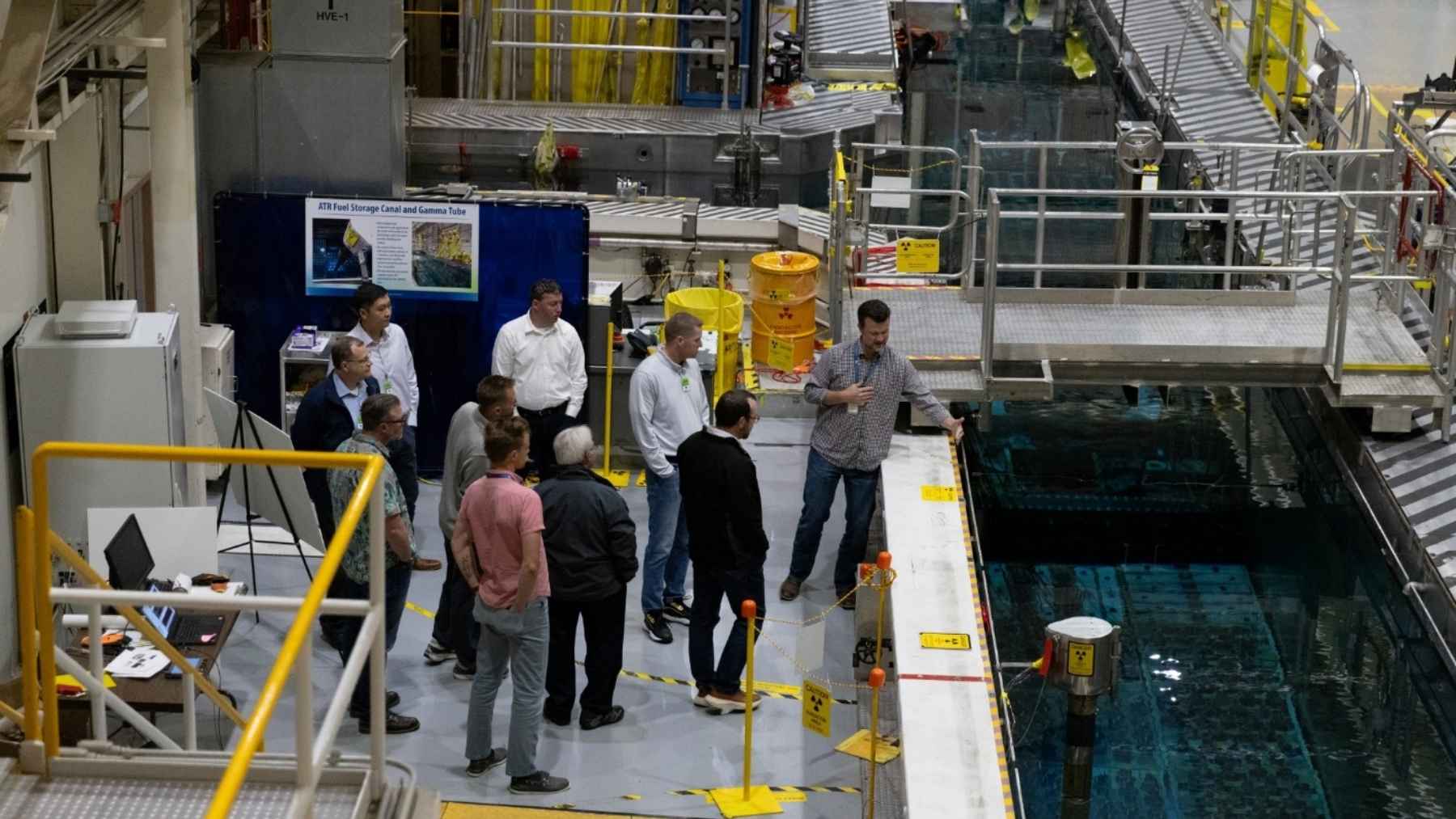
It’s called the Advanced Test Reactor, and it’s back in the news. On June 25, Lightbridge Corporation announced that the first samples of its uranium-zirconium fuel had survived the treatment, pulled from the core on May 6 after months of accelerated punishment. To understand why the company flew 24 people to Idaho just to watch a capsule come out of the water, you need to understand the machine itself. There is nothing else like it in the country.
The only reactor in America with nothing to sell
The Advanced Test Reactor, or ATR, lives at Idaho National Laboratory, the Department of Energy’s lead nuclear research site. On paper it’s a pressurized water reactor rated at 250 megawatts thermal, which sounds like a small power plant. It isn’t one.
Not a single watt reaches a grid. As World Nuclear News puts it, the ATR’s main output is neutrons rather than heat. INL describes it as the only research reactor in the United States that can soak large test volumes in high-flux thermal neutron radiation inside a prototypic environment. Lab director John Wagner goes further and calls it “the world’s most powerful test reactor.”
The core is the famous part. Forty curved fuel elements snake around each other in a serpentine loop that, seen from above, draws a four-leaf clover. Each leaf can run at its own power level, so the ATR can hit different experiments with completely different conditions at the same time, in the same core.
Woven between those lobes sit nine high-intensity flux traps, plus 68 more test positions, each up to 48 inches long. At full power, the thermal neutron flux peaks around one quadrillion neutrons crossing every square centimeter, every second.
And the detail that surprises everyone: the thing runs cool. Per the DOE’s own fact sheet, the ATR operates at about 360 psi and around 180 degrees Fahrenheit, roughly the temperature of a fresh cup of coffee. A commercial power reactor runs at 2,000 to 3,000 psi and about 600 degrees.
Low temperature, low pressure, absurd neutron output. It’s a machine tuned for exactly one product, and it has cornered the market.
How do you cram a decade of wear into months?
Radiation damage is the tax every reactor pays. Inside an operating core, neutrons slam into the crystal structure of fuel and cladding and knock atoms out of place, over and over, trillions of times. Fuel swells. Metals go brittle. Nothing gets out clean.
For a new fuel design, proving it can take that abuse is the whole game, and it has traditionally been brutally slow. Commercial fuel spends years inside a reactor, so a realistic endurance test used to mean loading samples and then waiting most of a decade before anyone could measure anything useful.
That’s the bottleneck the ATR attacks. INL says the reactor supports endurance tests that “mimic the wear and tear incurred over a decade of service” in a commercial plant, compressed into a fraction of the time.
The Lightbridge campaign used the most aggressive version of that trick, a method called FAST, short for Fission Accelerated Steady-state Testing. Developed at INL, it loads small samples with highly enriched uranium so fission piles up burnup far faster than conventional testing allows. Same damage, compressed calendar.
The goal is fuel with the mileage of years inside a power plant and the calendar age of a lease return. Then researchers tear it apart and see how the material actually held up.
The fuel that just took the beating
The timeline runs like this. Lightbridge’s samples, coupons of enriched uranium-zirconium alloy manufactured at INL’s Materials and Fuels Complex, went into the ATR on November 19, 2025. They came out on May 6, 2026.
The company had 24 people on site for the occasion, its full-time fuel engineering team plus senior management, and the day after, they sat down with Wagner and INL associate lab director Jess Gehin to plan the next phase. When your entire product depends on one capsule surviving one reactor, that’s the kind of day you fly everyone in for.
The samples now cool for several months. Post-irradiation examination, the forensic teardown where researchers measure exactly what the neutrons did to the alloy’s microstructure, thermal conductivity and swelling behavior, is expected to begin later this year.
The fuel itself is a genuine departure. Nearly every commercial reactor on Earth burns ceramic uranium-oxide pellets stacked inside sealed metal tubes, a basic recipe that hasn’t changed in half a century. Lightbridge’s design is solid metal, a uranium-zirconium alloy extruded into rods with multiple lobes and a helical twist, like a piece of licorice with a security clearance.
The company says the geometry gives each rod far more surface area than a cylinder, so heat escapes faster and the fuel runs cooler, and the underlying chemistry has decades of service history in the reactors of nuclear-powered icebreakers. The commercial version is designed around HALEU, uranium enriched to just under 20 percent, aimed at existing plants and small modular reactors.
One honest note. Lightbridge trades on the Nasdaq, and everything about better safety margins and better economics is, at this stage, the company’s own pitch. What May 6 established is narrower and physical: the material went through an accelerated high-burnup campaign in the most powerful test reactor in the country and came out ready for examination. Seth Grae, Lightbridge’s president and CEO, framed the data gathered so far as validation of the engineering behind the fuel. The teardown that starts later this year is where that claim gets tested, and NRC licensing sits well beyond that.
Cancer beams, Mars rovers, and the US Navy
Fuel torture is the headline job, but the clover moonlights. The ATR was built for the Navy’s nuclear propulsion program, and per the DOE, the Navy remains a prime user nearly six decades later, with a fleet safety record the agency calls “unmatched by any fleet in the world.” A lot of that fuel did its suffering in Idaho first.
The reactor is also the only US source of medical-grade, high-specific-activity cobalt-60, the isotope behind gamma knife radiation therapy for brain tumors. Pellets of ordinary cobalt-59 go into the flux, cobalt-60 comes out, and hospitals get their beam source.
And if you’ve enjoyed a single photo from NASA’s Perseverance rover, the clover had a hand in it. The ATR is one of the two reactors the DOE uses, alongside Oak Ridge’s High Flux Isotope Reactor, to irradiate the targets that become plutonium-238, the heat source powering deep-space missions. In February the department completed a major plutonium-238 shipment for NASA, with the Dragonfly mission to Saturn’s moon Titan next in line.
The American Nuclear Society declared the complex a historic landmark in 2016, and the DOE’s own fact sheet points out the reactor came online the same year as the Big Mac. That’s the kind of joke an agency makes when its flagship machine is pushing 60 and still fully booked.
Every new reactor in America needs this machine first
Which is why the ATR matters more right now than it has in decades. American nuclear is in the middle of a genuine construction rush. TerraPower is building its sodium-cooled Natrium plant in Wyoming, Oklo’s compact fast reactor is going up on the same Idaho site that hosts the ATR, and a federal crash program spent the spring racing brand-new reactors toward criticality by the Fourth of July.
Every one of those designs runs on fuels and materials that need irradiation data before regulators will sign anything, and much of that data has exactly one address. New cladding alloys, new metallic fuels, higher burnups for the existing fleet: the road runs through Idaho, through a machine that predates the Moon landing.
So the Lightbridge coupons will sit in the cooling water a while longer, then get sliced, scanned and measured until the alloy gives up every secret of what the clover did to it. If the numbers hold, the company has its case to bring to regulators. If they don’t, better to learn it now, in coupon samples, than years later in somebody’s power plant.
Either way, the reactor has already moved on. There is always another experiment waiting for a slot, another material somebody needs aged in a hurry. The ATR has been doing the same ugly, indispensable job since 1967: breaking things carefully, so the rest of American nuclear doesn’t have to find out the hard way.