
The US Army wants to fix its Pacific cargo problem with drone boats, and it wants a lot of them. In a roundtable with reporters this week, the general in charge of sustainment in the region said the goal is a fleet of 30 to 100 uncrewed vessels moving supplies between allied ports with nobody aboard.
Here’s the part that matters, and the part most headlines skip. These are not the little drone boats the Army already plays with. Maj. Gen. Gavin Gardner told reporters he wants heavy-duty hulls, each big enough to carry eight to 10 standard 20-foot shipping containers. That’s a cargo ship that happens to have no crew.
And it doesn’t quite exist yet. Gardner named zero companies, said the defense industry is still building this class of boat, and put the first test hull in the water no sooner than next summer. So the honest answer to “what boat is this” is: the Army has described it, the market is racing to build it, and nobody has won anything.
This is not the little drone boat you’re picturing
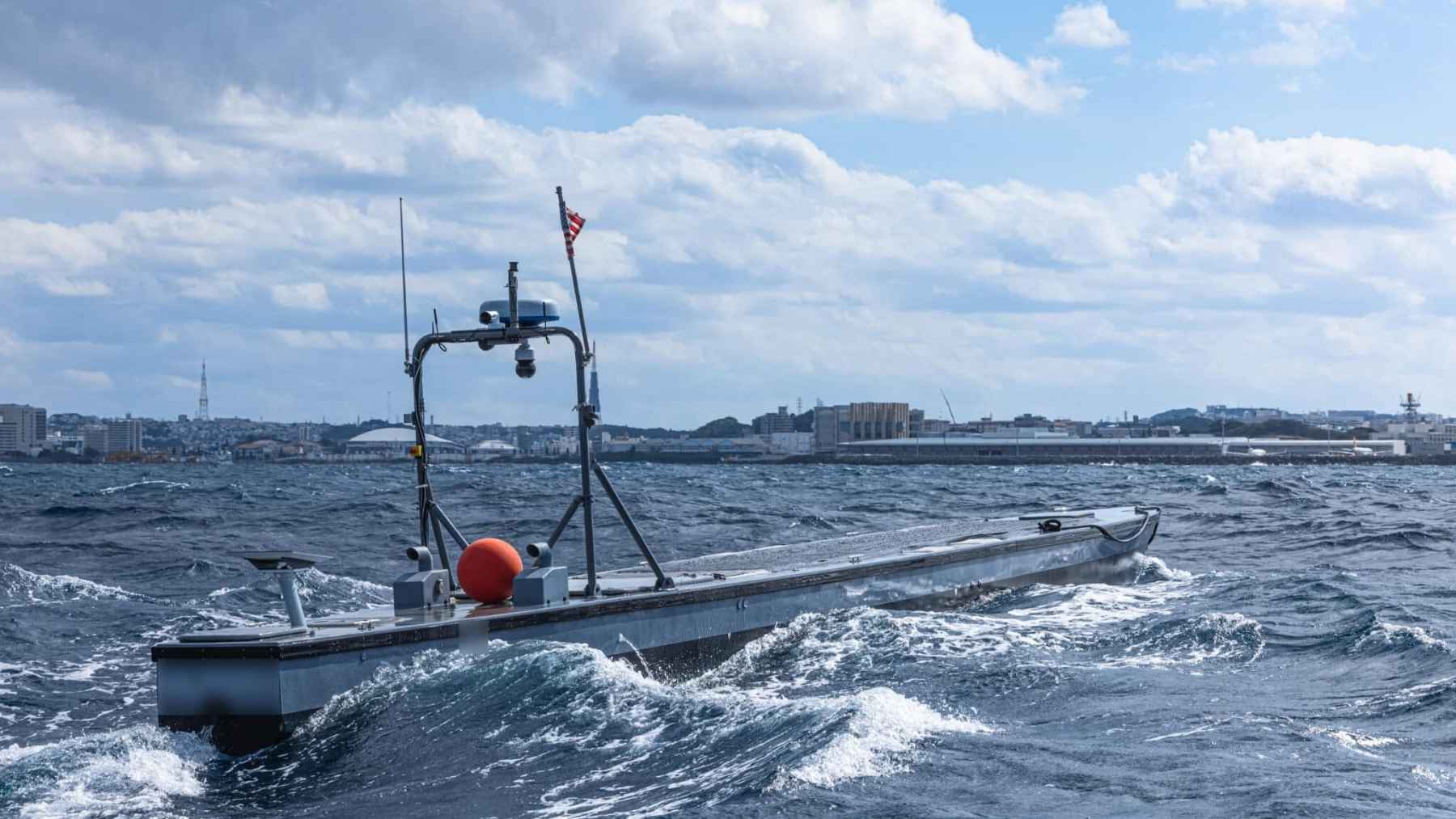
The Army already runs small autonomous boats, and they’re cheap. Earlier this month it sent a swarm of roughly $100,000 solar-powered drones to screen a crewed cargo ship 260 miles up the Philippine coast. Those things fit in the back of a truck.
What Gardner described is a different animal entirely. Eight to 10 containers is real tonnage, the kind of load that needs a proper hull, not a 14-foot sled. He wants them berthed forward in partner nations from South Korea to Thailand and run remotely from his Hawaii headquarters, keeping supplies constantly in motion across the theater.
So when you read “drone boat,” picture something closer to a small uncrewed freighter than a robot jet ski. That distinction is the whole story, because boats that size, fully autonomous, crossing open ocean with containers on deck, are exactly the thing the industry has not delivered at scale yet.
The boat already out there looks like a smuggler’s
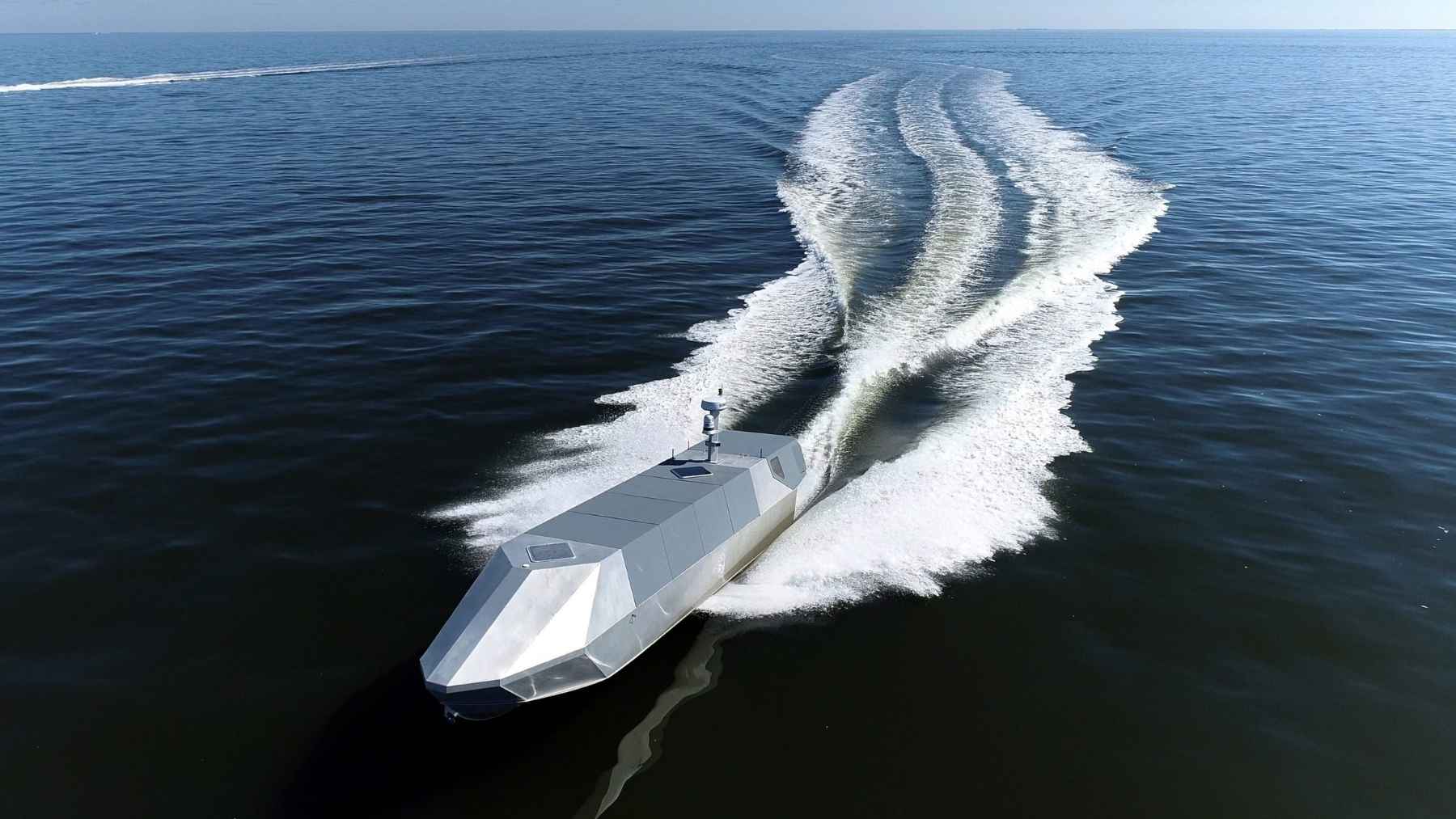
If you want a real vessel to picture, the closest one already swimming in the Pacific is the autonomous low-profile vessel the Marine Corps has been testing, and it looks the part. It runs about 55 feet, carries roughly five tons of cargo, and can cover 2,000 nautical miles on its own.
Officials are blunt about where the design came from. “Truth be told, this is just a narco boat,” Brig. Gen. Simon Doran said of it, explaining the low, hard-to-spot hull was lifted straight from drug smugglers. The Marines have run it off Okinawa and Camp Pendleton and are training their own people to operate and maintain it.
It’s a great illustration of the breed, with one honest caveat: it’s a Marine Corps program, and at five tons it’s smaller than the eight-to-10-container monster Gardner is talking about. Think of it as the little cousin that already works, while the Army waits on the bigger version.
The Pentagon also asked for a mini version
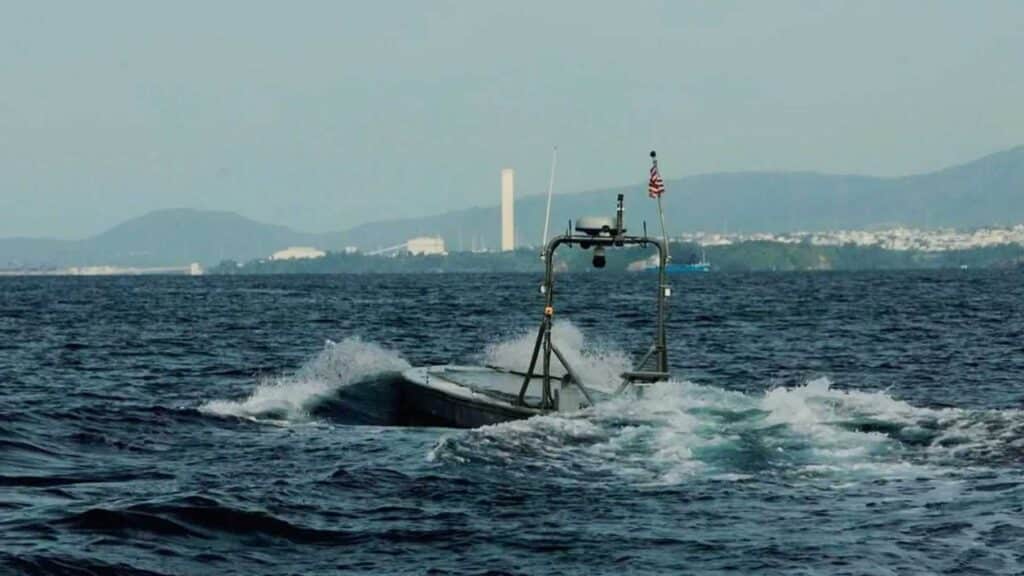
Here’s where it gets messy, in a way that tells you the requirement isn’t settled. While Gardner talks up big heavy-duty hulls, the Pentagon’s Defense Innovation Unit spent the spring shopping for the opposite.
That program is literally named ARV-S, the S for small. It asks for an uncrewed boat that carries at least two containers, sits low enough in the water to reach shallow, austere beaches, and can make a 1,600-nautical-mile round trip through rough seas. Submissions closed June 12, and the Pentagon said it may need dozens of them, either purpose-built or converted from crewed boats.
So the Army’s own paperwork points two directions at once: a commander dreaming of 10-container freighters, and a formal solicitation for shallow-draft two-container beachers. Both are real, and that gap is a decent sign nobody has locked in what the winning boat actually is.
The Army has already run the play once
The concept itself isn’t theoretical. Back in April 2025, off Ford Island in Pearl Harbor, the Army pulled off an autonomous ship-to-shore resupply demonstration during Project Convergence Capstone 5.
An uncrewed vessel carried supplies in and then offloaded a cargo-laden unmanned ground vehicle onto the shore by itself, run by soldiers from the same 8th Theater Sustainment Command now pushing this fleet. The longer-term vision pairs aerial drones with the boats, shuttling containers off without a person in the loop. The boats are getting wet now, even if the final hardware isn’t picked.
Why the Army is this motivated
The pressure behind all of this is a crewed fleet in bad shape. A Government Accountability Office report found the Army’s Pacific-based watercraft fell from about 134 vessels in 2018 to roughly 70 in 2024, while the share that’s actually mission-capable dropped from more than 70% in 2020 to under 40% by 2024, against a 90% goal.
That’s a thin, tired fleet trying to cover enormous distances. Crewed Army boats simply can’t keep pallets moving on demand between Korea, Japan, the Philippines, Australia, Singapore and Thailand, which is the hole a few dozen autonomous hulls are meant to fill.
Drones do the milk runs, crews keep the beaches
Gardner was firm on one point: the drones supplement the crewed fleet, they don’t replace it. He sees autonomous boats handling “routine delivery,” while manned Army watercraft keep the harder job of putting cargo on a contested beach where the situation changes by the minute.
That’s the realistic read, because the autonomy is the hard part. America’s broader uncrewed-boat push has had a rough stretch, and the Army has watched where the Navy’s program stumbled with collisions and a paused contract. For the dangerous work, the Army still leans on hardware like its lone Maneuver Support Vessel (Light), which landed a HIMARS launcher on an austere beach in Hawaii this spring. One boat doing that is not a fleet, which is the entire reason this drone math is being run.
If Gardner’s timeline holds, a contracted drone boat shows up in Hawaii around this time next year to haul cargo between Oahu and the Big Island as a live audition, with a fleet of 30 to 100 riding on whether it works.
The machine doesn’t have a name or a maker yet. What’s clear is the shape of it: not the toy drone you were picturing, but a crewless cargo ship, and the Army wants a hundred of them.