
Hungary has run on the same four reactors since the 1980s. The Paks plant sits on the Danube about 100 kilometers (60 miles) south of Budapest, and the four Soviet-designed units inside it all switched on between 1982 and 1987.
Between them, those four reactors quietly make roughly half the electricity the country produces. That’s a lot of weight resting on machinery that’s now older than most of the people running it.
So Hungary is building two more reactors right next door. And the single most important part of each one isn’t being cast in concrete on-site. It’s being forged out of steel in Russia.
The part is the reactor pressure vessel: one thick steel can that holds the nuclear fuel, the coolant, and the reaction itself. For the new Paks units, the finished vessel weighs close to 330 metric tons and has to do its job without cracking for at least six decades. It’s the heart of the machine, in the most literal way, and there’s a hole being dug in Hungary right now to make room for it.
Hungary Is Digging a Hole You Could Lose a Building In
The newer of the two reactors, unit 6, doesn’t have a foundation yet. It has a pit.
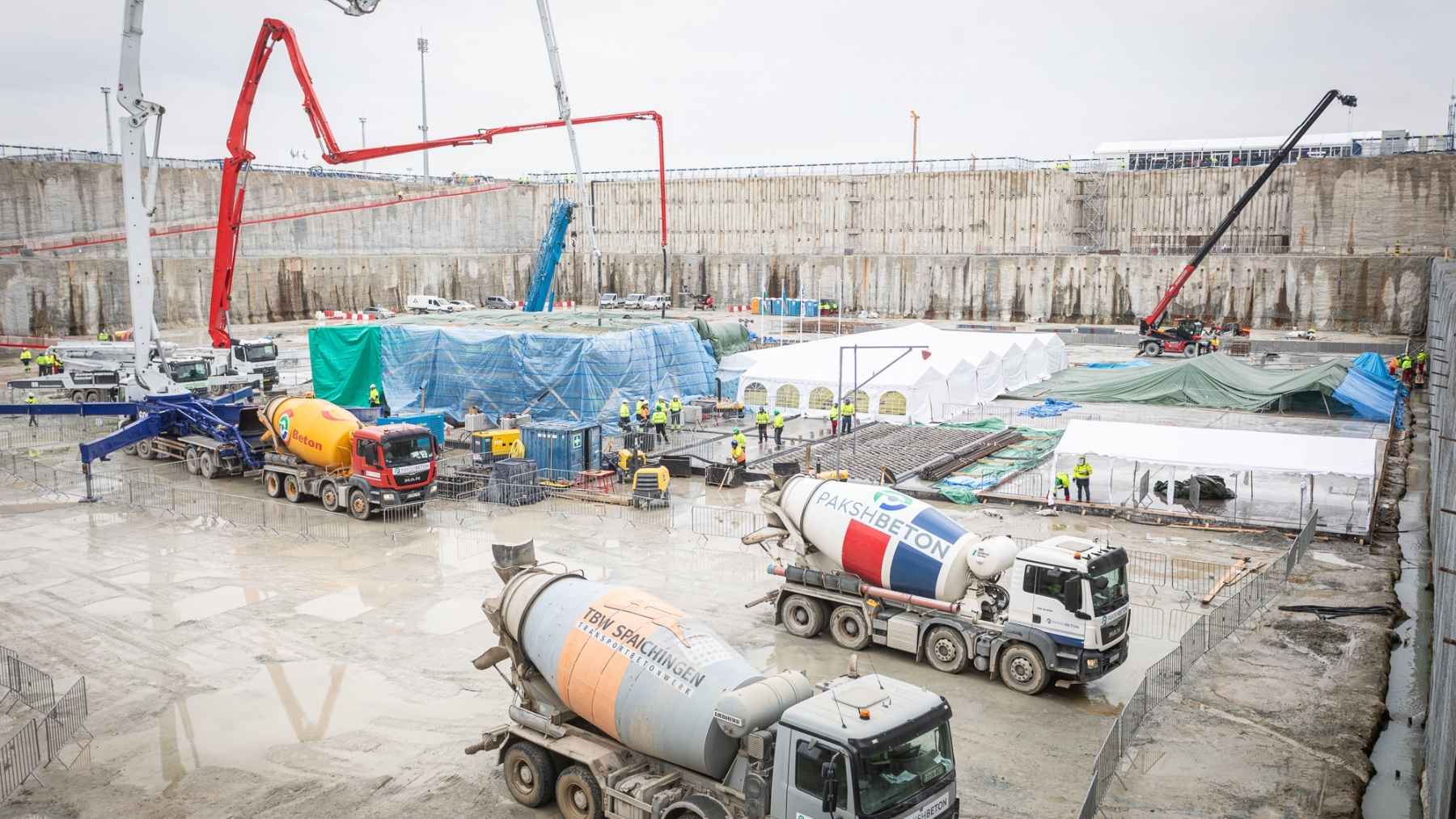
Crews are carving it out of the ground next to the existing plant, and the dimensions are hard to picture. The excavation runs 150 meters wide and 190 meters long (roughly 490 by 620 feet), and it goes down 23 meters, about 75 feet, deep enough to bury a building seven stories tall.
Getting there means moving around 500,000 cubic meters of soil. Per the project company’s latest update, reported by World Nuclear News, more than half of that dirt is already gone.
Soil-milling machines, crawler excavators, bulldozers and trucks have been grinding away at the site, with the walls held back by anchored concrete piles as the hole deepens. Hungary’s nuclear regulator checks the work on-site, and the company says the dig is on schedule.
Next door, unit 5 is further along. Its first concrete was poured in February, the moment the whole project officially counted as a nuclear plant under construction.
The Most Important Part Is a Single Piece of Steel
A reactor is mostly plumbing wrapped around one irreplaceable object. Take away the turbines, the cooling towers and the control room, and you’re left with the pressure vessel, the steel container the entire reactor is built around.
For the Paks units, it starts as a batch of steel blanks weighing about 600 metric tons. Those go into a forging press at one of Europe’s largest automated forging plants, in St. Petersburg.
There, the rings that form the body of the vessel and its rounded bottom get squeezed into shape under roughly 12,000 metric tons of force. Once the rough shapes come out, they’re machined down and assembled at a separate plant.
What’s left at the end weighs nearly 330 tons on its own. The walls run up to 285 millimeters thick, about 11 inches, roughly the long edge of a sheet of printer paper rendered in solid steel, because they have to hold pressure and shrug off years of radiation without ever failing.
According to Paks II, the Hungarian company managing the build, each vessel passes around 700 separate quality checks before it’s accepted. The material and manufacturing are rated to last up to 100 years, which is the kind of figure you only attach to something nobody ever plans to replace.
Only a Handful of Forges on Earth Can Make One
Almost nowhere on the planet can actually build one of these.
A full-size reactor vessel forged in one piece, with no weld seams to fail, needs a press most countries simply don’t own. The long-standing bottleneck is a single Japanese plant in the port town of Muroran, which forges a big share of the world’s reactor vessels and can only finish a few a year. We dug into how one Japanese forging line became a chokepoint for the entire global nuclear build-out.
Russia is one of the few other places with its own heavy forging line for this kind of work, which is the whole reason the Paks vessels get made on schedule. The plant doing it belongs to Rosatom, the Russian state nuclear company that’s also the main contractor building the reactors.
That setup is exactly what makes Paks II unusual. It’s a Russian-built nuclear project rising inside the European Union, the first Russian nuclear construction ever started in an EU member state, and it has kept moving despite the sanctions aimed at Russia since 2022.
What the Steel Has to Hold
So what actually goes inside the 330-ton can?
The Paks units are VVER-1200 reactors, a Russian pressurized-water design and the latest generation Rosatom builds. Each core is made up of 163 fuel assemblies, and the vessel exists to hold that core and the superheated, pressurized water flowing around it.
This is proven, conventional technology, a water-cooled reactor of a type that’s run for decades, not one of the experimental designs chasing headlines. Italy is testing a full-size reactor cooled by molten lead, with electric heaters faking the uranium. Paks is the opposite bet: take a design that already works and scale it up.
It’s the same model Rosatom just finished installing across the border in Turkey. There, the most powerful crawler crane on the planet lowered a 350-ton VVER-1200 vessel through an open hole in the roof before the dome went on, which is more or less what’s coming for Paks once the pit is finished and the foundation poured.
Each finished unit is rated at 1,200 megawatts. That’s more than double what the old VVER-440s next door put out, even after years of upgrades pushed them to around 500 megawatts apiece.
Hungary’s foreign minister has said the expansion would let the country cover around 70 percent of its electricity use with nuclear power. That’s a target for the 2030s, though. Today, the existing plant still does the heavy lifting: the World Nuclear Association credits Paks with generating about half of Hungary’s electricity, even if imports mean it covers closer to a third of what the country actually uses.
A New Government Wants to Recheck the Price
There’s one more thing happening above ground, and it has nothing to do with steel.
Hungary elected a new government this spring. Prime Minister Peter Magyar, sworn in in May, had called the price agreed for the new reactors too high during his campaign. Last month his government announced a review of the Paks II contracts and the entire investment.
Rosatom has said it’s ready to answer any questions about the project and its costs. The digging, the forging and the concrete haven’t paused while that gets sorted out.
That’s the odd thing about a build on this scale. A 330-ton vessel takes years to forge and machine. A 23-meter pit takes most of a year to dig. The reactor underneath won’t feed the grid until the early 2030s.
The decisions that kicked all this off were made more than a decade ago, and the steel is already being shaped in St. Petersburg. Whatever the new government decides, it’s deciding it around machinery that is already very, very real.