
Building a boat hull has worked the same way for about sixty years. You cut a mold, lay composite into it by hand, let it cure, then sand the result until it looks like a boat.
The mold is the expensive part. It is also the part that punishes you for changing your mind, because a two-inch change to the bow means starting the tooling over.
That trade works when you are turning out identical fishing skiffs on a five-year cycle. It works badly when the Pentagon wants small, cheap, throwaway robot boats and wants the geometry revised every few weeks based on whatever happened in the Black Sea last month.
A company in St. Petersburg, Florida, thinks the answer is to skip the mold entirely.
What Haddy announced, and what it left out
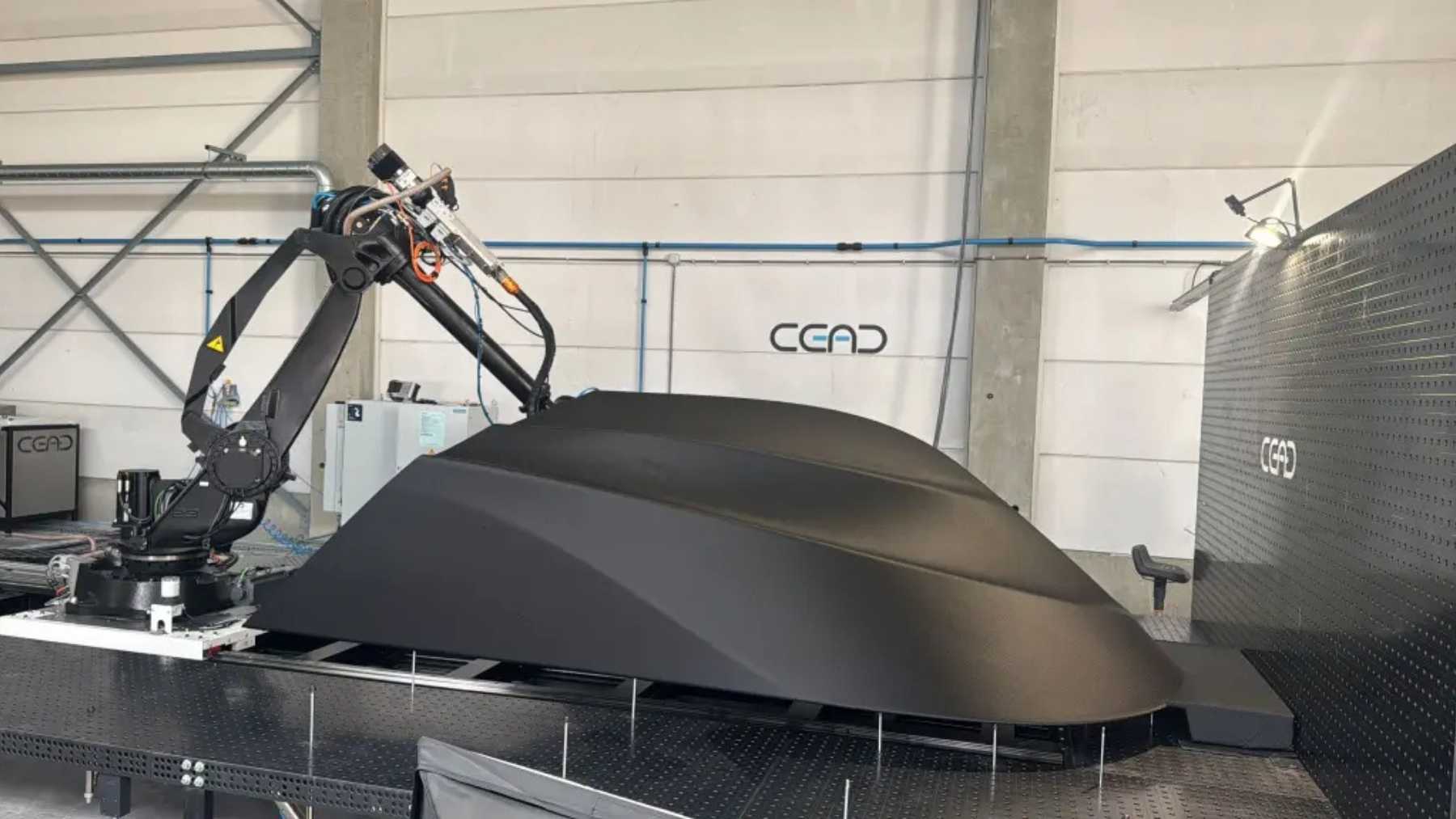
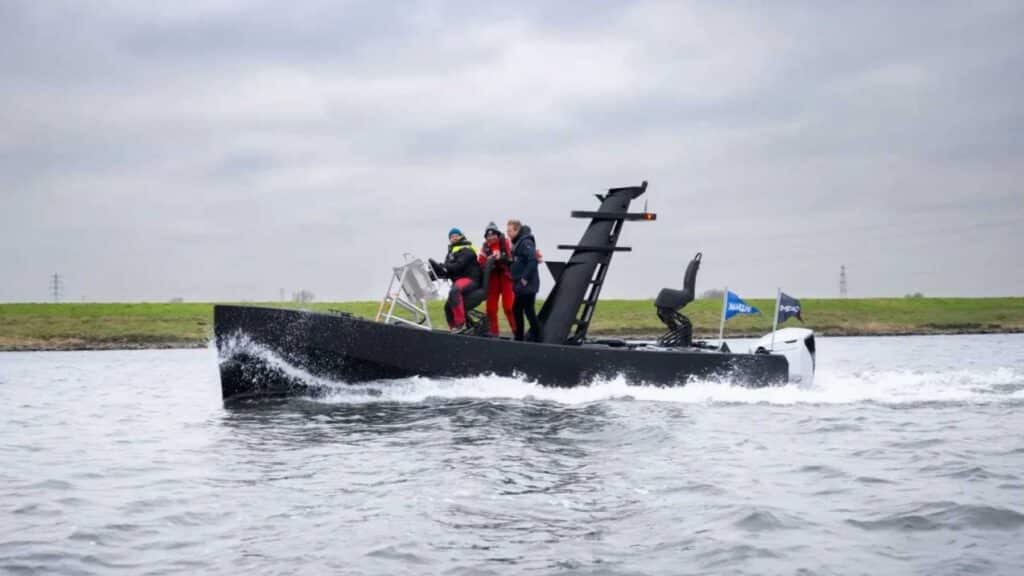
On Saturday, August 8, Haddy said it had produced an uncrewed vessel called the TF-179 Drone Boat, printed by industrial robot arms laying down composite one bead at a time. Defence Blog covered the announcement.
Then the details stop. No customer name. No mission. No length, no displacement, no propulsion, no material data.
3D Printing Industry put it bluntly: that omission leaves the boat itself impossible to evaluate on its own terms. Haddy released photographs and a statement about how vessels get built. It released nothing about this vessel.
Which is either normal operational security for a defense customer, or a sign the TF-179 is a demonstrator wearing a program designation. Both readings fit the available evidence.
What can be checked is the factory. Haddy has been showing that off in public for a year, and the machinery is the more interesting story anyway.
The rail is the whole trick
The plant occupies about 30,000 square feet of downtown St. Petersburg, though some accounts put it nearer 32,000. Inside are eight Flexbot systems from CEAD, a Dutch robotics firm, installed with Siemens.
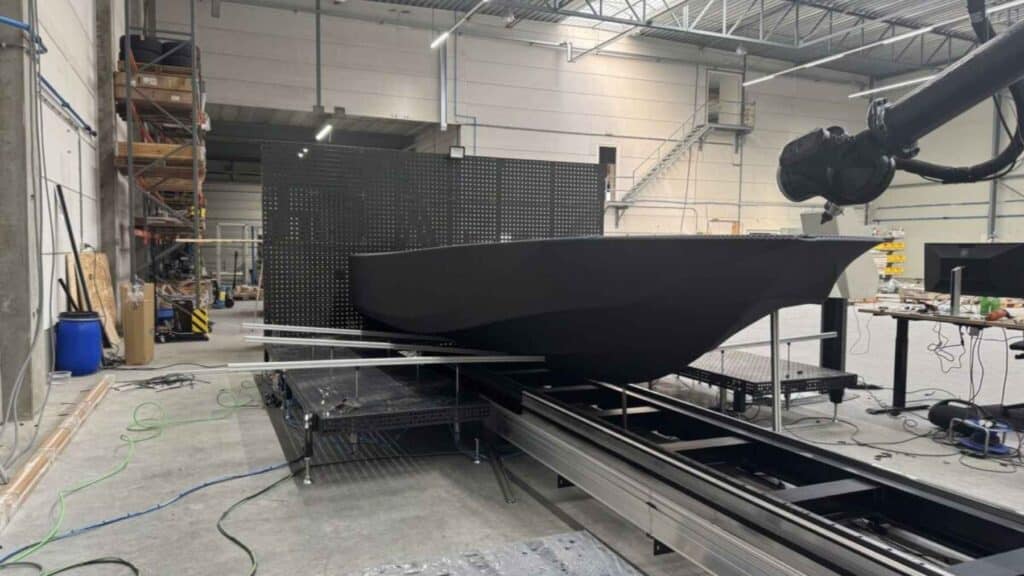
These are not printers with a milling robot standing next to them. Each Flexbot is a hybrid cell that does additive and subtractive work inside one envelope, with CNC finishing folded into the same job file and Siemens Sinumerik control running underneath.
Seven of the eight ride on rails, and that detail is the one that matters. CEAD prints sideways against a vertical bed while the arm travels its track, so part length is limited by how long you make the rail rather than by the size of the machine.
CEAD co-founder Maarten Logtenberg told 3D Printing Industry that the approach puts printed boats of up to 40 meters within reach. That is 130 feet, which is patrol craft territory, not skiff territory.
Haddy opened the plant in April 2025 and bills it as “the world’s largest 3D printing facility,” measured by total throughput and number of machines. That is a company claim rather than an audited one, but nobody has stepped up to dispute it either.
Harbinger is the boat with actual numbers
The TF-179 has no published specifications, but Haddy’s previous maritime job does, and it is the better example.
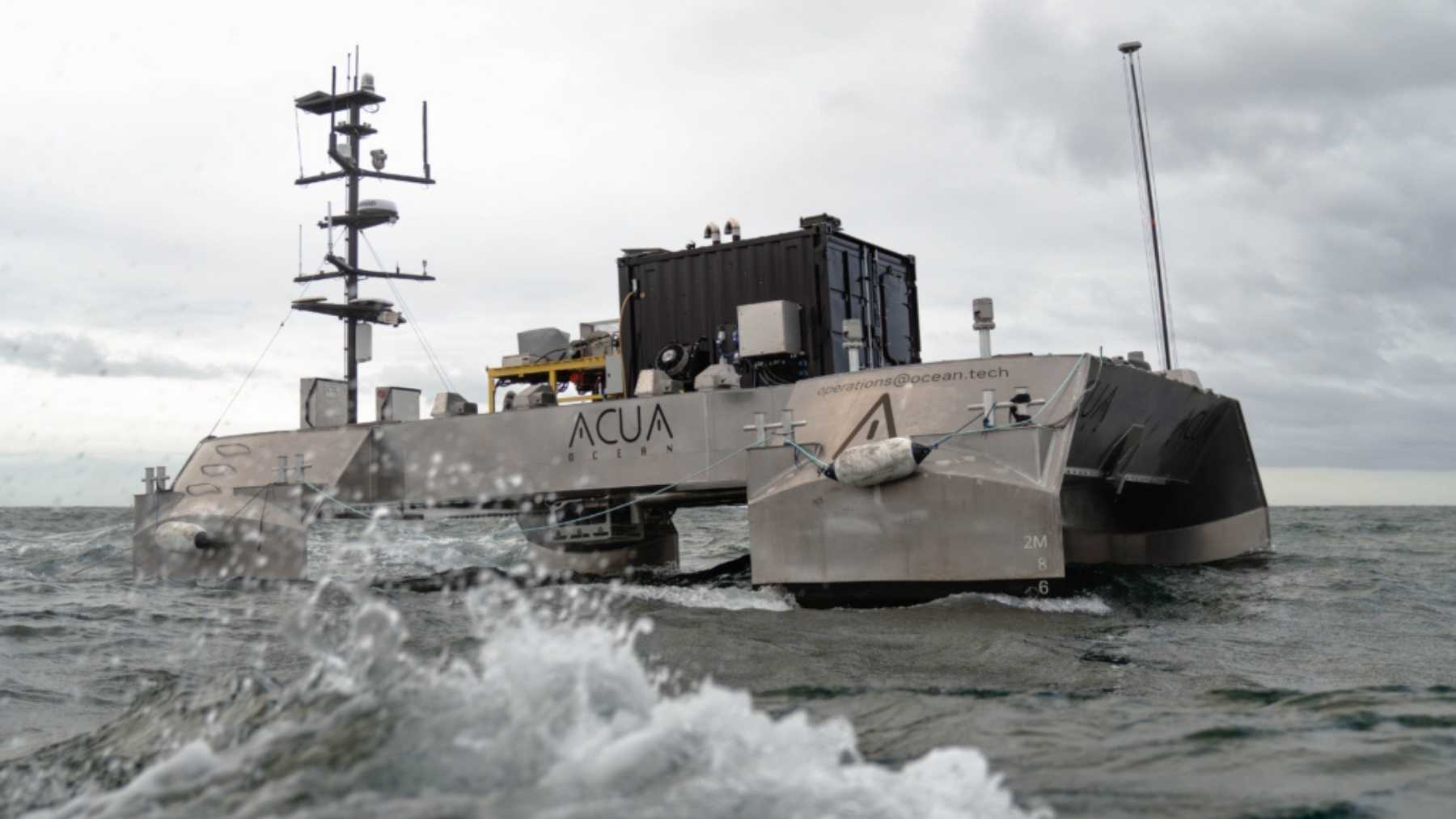
HavocAI, out of Providence, Rhode Island, builds a vessel called Harbinger. It is a 40-foot semi-submersible autonomous low-profile vessel designed for contested logistics and resupply, meaning it rides low enough in the water to be difficult to see or paint with radar.
Haddy printed the hull in carbon fiber-reinforced polymer. HavocAI announced the maiden full-power voyage in March and said the hull arrived nine days after the print started, integration took under a week, and the whole boat was on the water inside 30 days.
The numbers vary a little depending on who is telling it. CompositesWorld frames the same job as design to sea trial in nine days. Haddy has separately claimed a 12-meter low-profile hull went from design to shipment in ten days, up to nine times faster than conventional production.
Here is the qualifier nobody repeats. By HavocAI’s own account the boat is a stand-in, built at somewhere between half and two-thirds of the size the finished design calls for, and meant to exercise autonomous behavior rather than deploy anywhere. Printing a shrunken demonstrator in nine days is impressive. It is not the same as printing the real thing.
Ukraine wrote the business case
None of this money would exist without the Black Sea. Cheap Ukrainian drone boats have repeatedly damaged or destroyed Russian warships worth orders of magnitude more, and that lopsided exchange rate rearranged how American planners think about hulls.
Speed and volume beat sophistication when the boat is meant to be spent. A design revision that would require retooling a physical production line can instead be edited in CAD and printed the same week.
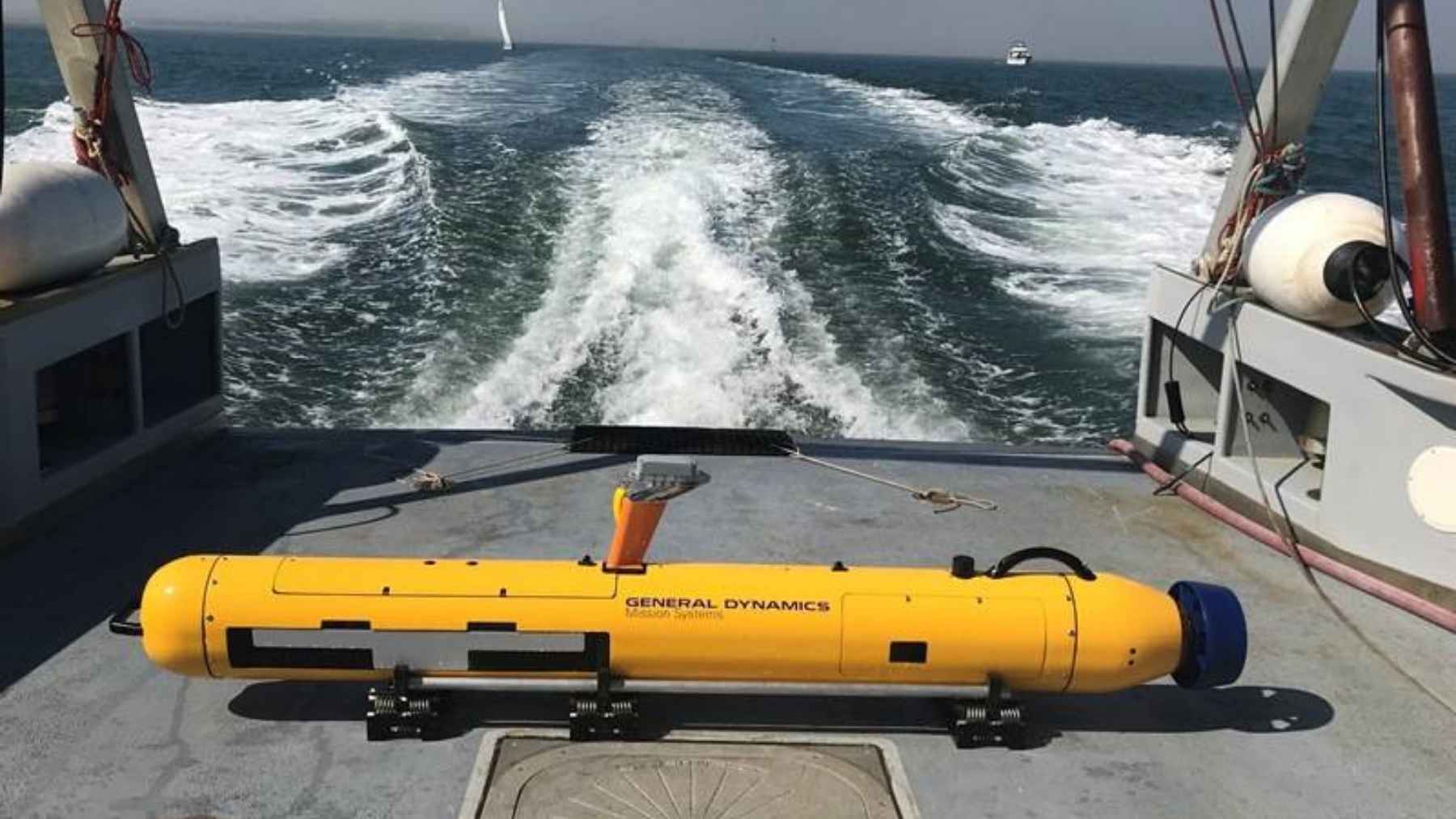
The rest of the uncrewed fleet is moving the same direction. Anduril is printing underwater drone hulls in Rhode Island at rates measured in hundreds per year, and a 20-person Australian shop has already delivered a container-shipped robot submarine to the US Navy.
Valdosta, Georgia is where this gets real
In April, Red Cat Holdings signed Haddy to expand its maritime division, Blue Ops. The framing matters here, because it is not a print-for-hire deal.
Per the announcement, Haddy is installing robotic production systems inside Blue Ops’ own plant in Valdosta, Georgia, roughly doubling output. Blue Ops can also order additional hulls from Haddy’s shops when it needs surge capacity.
The product lines are five-meter and seven-meter uncrewed surface vessels derived from Ukrainian designs, offered in several configurations for combat and surveillance work. Red Cat separately signed a partnership with Ukraine’s Spetstechnoexport in March.
Barry Hinckley, who runs Blue Ops, said the arrangement lets the company iterate at the speed of modern conflict. He also cited data and intellectual property protection as a reason for choosing Haddy, which is the quiet part of digital manufacturing: the geometry of your attack boat is a file, and files walk.
Georgia’s governor announced in April that the Valdosta operation would add hundreds of jobs in Lowndes County. The state put its economic development office on the project.
The part that should stay skeptical
Both companies lean on the phrase “Agentic AI-powered robotic production systems,” which is doing a great deal of work for a term nobody has defined in this context.
The cost figures are Haddy’s own. So is the throughput ranking. So is most of the speed data, sourced back to the company rather than to a customer’s acceptance testing.
And the TF-179 remains a boat with a name, a photograph, and nothing else. No buyer, no mission, no sea trial results, no indication whether it is one hull or the first of a run.
What is solid is the manufacturing. A rail-mounted hybrid cell that prints laterally and mills in the same pass is real hardware doing real work, and CEAD’s machines are producing hulls that other companies have put in the water.
Four years ago this shop was making furniture. If the Navy validates what Haddy says these robots can do, the slow part of building an uncrewed fleet stops being the boats and starts being everything bolted to them.