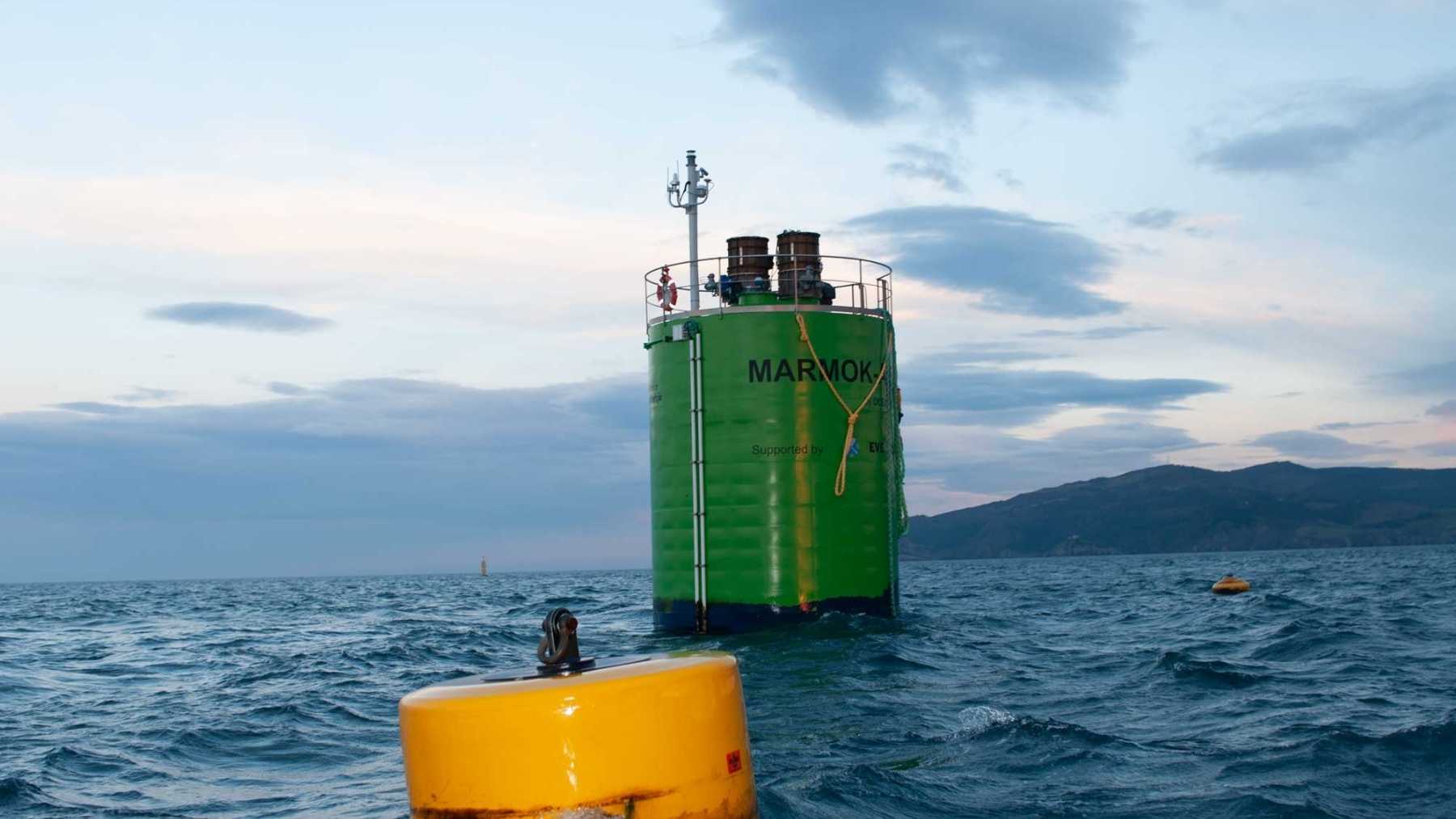

Wave energy has a reputation problem. For decades it’s been the renewable that’s always five years away, the one that turns up as gorgeous concept art and confident press releases and then quietly vanishes before anything actually gets wet. So it’s worth paying attention when a real machine, not a render, is bobbing in the Bay of Biscay and feeding electricity into the Spanish grid. It’s called the MARMOK-A-5, it stands 140 feet (42 m) tall, and Bilbao-based engineering firm IDOM towed an upgraded version out to a test site off the Basque coast in mid-May. It doesn’t make much power. The whole thing tops out around 30 kilowatts, which is closer to a handful of houses than a power station. But the wattage was never the point.
What’s actually bobbing off Bilbao
The MARMOK-A-5 is a spar buoy, which is engineer-speak for a tall, skinny cylinder that floats upright like a fishing bobber the size of an apartment building. Of its 42 meters, about 36 sit underwater and roughly 6 stick up above the surface. It’s 5 meters (16 ft) across, displaces around 160 metric tons of water, and is moored to a seabed about 90 meters (300 ft) down in open water off the port of Armintza.
The clever part is what happens inside. The buoy is built around a hollow column of seawater and works on a principle called an oscillating water column. As waves roll past, the water inside that column rises and falls relative to the buoy, acting like a giant piston. The moving water shoves air back and forth through a chamber at the top, and the rushing air spins a turbine that drives a generator. The electricity then runs to shore along a subsea cable. No combustion, no fuel, and crucially, no spinning blades sitting out in the waves getting battered, just a column of water breathing in and out. That last detail is a big reason the design has held up where flashier concepts have been ripped apart.
It’s the same broad class of problem as other ocean-energy experiments, like the osmotic power plant Japan switched on to pull energy from the boundary where freshwater meets the sea. The ocean is loaded with energy. Getting it out cheaply and reliably, year after year, without the salt water destroying your hardware, is the genuinely hard part.
The buoy has been here before
This isn’t the MARMOK-A-5’s first swim. An earlier version of the device was installed at the same BiMEP site back in 2016, originally developed by the Basque firm Oceantec, whose wave-energy work is now run by IDOM. At the time it became the first floating wave-energy device wired into Spain’s national grid, and one of the first anywhere in the world. The first kilowatt flowed into the grid in December 2016.
It then did something most prototypes never manage: it survived. Across deployments running to 2019, the buoy weathered three Bay of Biscay winters, rode out waves reported up to 12 meters high, and steadily improved its availability as part of a European research effort called OPERA. Proving a machine can sit in the North Atlantic for years without coming apart is, frankly, half the battle in marine energy. The seabed off Europe is littered with promising designs that never made it through their first bad storm.
So what’s in the water now is best understood as the same proven hull on its second life, fitted with a brand-new power take-off system, the bit that converts wave motion into electricity. IDOM rebuilt that machinery from the ground up using everything the earlier campaigns taught them, which is why this counts as a fresh deployment rather than just plugging the old buoy back in.
The whole upgrade rides on the turbine
The headline change is the turbine. IDOM reworked its Wells turbine, the air-driven type at the heart of the system, and added variable-pitch blades that adjust their angle on the fly. The reason matters more than it sounds. A fixed turbine is tuned for one kind of sea, and the real ocean stubbornly refuses to behave like one kind of sea. Blades that change their pitch let the buoy stay efficient across gentle swells and rough chop alike, instead of only performing on the days the spreadsheet liked.
The upgraded unit also carries onboard batteries and smarter control systems, and IDOM redid the mooring layout and the umbilical cable routing while it was at it. The company says this installation went substantially faster than before, which is exactly the kind of unglamorous progress that actually decides whether a technology can ever pencil out. According to EuropeWave, the program funding the work, this is also the first wave-energy converter to connect electrically to the grid through the HarshLab buoy stationed at the Biscay Marine Energy Platform. Borja de Miguel, project manager at IDOM, called the deployment “a pivotal milestone for IDOM and the EuropeWave program.”
Thirty kilowatts isn’t the story
Here’s where you have to be straight about the numbers. Around 30 kilowatts at peak is enough to keep the lights on in maybe fifteen to twenty homes on a good day, and that’s the ceiling, not the average. Nobody is retiring a gas plant on the strength of this. If you came looking for a wave-powered city, this isn’t it, and to IDOM’s credit, the company has never pretended otherwise.
What it is instead is a full-scale machine doing the real thing in real water, which is a far rarer commodity in this field than it ought to be. Wave energy is drowning in concepts and pretty pilot renderings. The number of devices actually exporting electrons to a grid you could point to on a map is small. A 160-ton buoy that survives Biscay winters and reliably feeds power into the system is worth more as a stream of real-world data than a hundred slideshows. It’s the same logic behind ambitious in-water builds like Germany’s hydropower turbines on the Rhine: a machine that runs beats a machine that’s merely promised.
The MARMOK-A-5 is one of three projects in the final phase of EuropeWave, an EU-backed effort that has put roughly €20 million (US$23 million) into pushing wave power toward commercial viability through a competitive procurement model. The buoy is now entering a commissioning phase, where IDOM will gradually ramp it up and gather performance data in genuine sea conditions. That data is the actual deliverable here, the evidence the whole sector needs before anyone risks building something large.
The gap between a single buoy off Bilbao and a wave farm that meaningfully powers a coastline is still enormous, and anyone telling you otherwise is selling something. But that gap closes one boring, verifiable step at a time: a turbine that copes with bad weather, an install that goes quicker, a grid connection that holds. A 140-foot cylinder quietly breathing electricity into the Spanish grid won’t grab attention the way a glowing render of an offshore array does. It just has the distinct advantage of being real.
 @francisconoguei ROOKIE3 months ago