
The standard knock on a solar farm is that it’s a dead zone. You take a field, bolt glass and steel over the top of it, and whatever used to live there gets evicted so the panels can drink up the sun. It’s the line you hear at just about every rural planning meeting in Britain, usually wedged somewhere between “what about food security” and “think of the view.”
A study out of the East Anglian Fens points at something that argument never accounted for: manage the ground under those panels the right way, and a solar farm can end up holding nearly three times as many birds as the cropland sitting right next to it.
The research came from the RSPB and the University of Cambridge, ran across six working solar farms, and was published in the journal Bird Study. It’s worth pulling apart now, because Britain is about to build a great many more of these things, and the gap between a solar farm that helps wildlife and one that genuinely is a dead zone comes down to a couple of management choices that cost almost nothing.
The difference came down to hedgerows and sheep
The team, led by RSPB conservation scientist Dr Joshua Copping, didn’t just count birds on a few solar farms and declare victory. They ran an adapted version of the national Breeding Bird Survey, walking 23.2 kilometers of transects and logging every bird seen or heard within 100 meters of the line. Then they split the sites into two camps based on how the land was run.
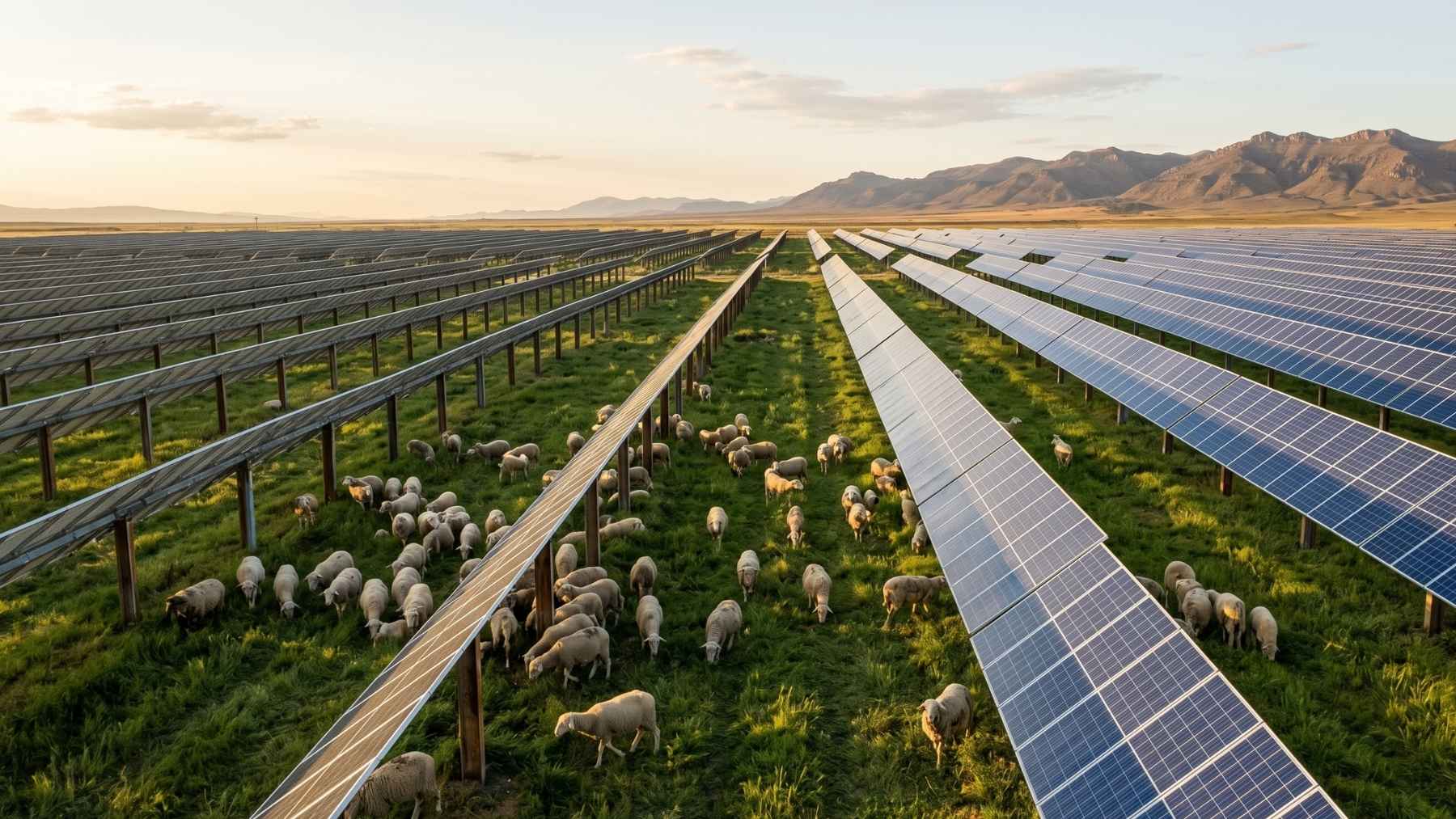
The “simple habitat” farms were the intensively managed kind: no hedgerows along the boundaries, the grass kept short by sheep grazing more or less constantly. The “mixed habitat” farms were the opposite. Hedgerows around the edges, no grazing, no grass cutting, which let a much wider spread of flowering plants take hold between the rows of panels. Same technology making the same electricity. Completely different ground underneath.
The bird counts tracked that split almost exactly. Summed across every species and modeled out to a standard patch of land, the mixed-habitat solar farms came back with about 35.1 birds per four hectares. The simple-habitat sites managed 17. The surrounding arable farmland, the stuff the panels supposedly displaced, sat at 11.9. That’s where the “nearly three times” figure comes from, and it held up statistically: of the 44 species recorded, 34 were most abundant on the mixed-habitat sites.
Model-fitted bird abundance, summed across all species. Source: Copping et al., Bird Study (2025), RSPB and University of Cambridge.
The birds that turned up were the ones in trouble
Sheer numbers are one thing. What gives this result teeth is which birds were doing the showing up. Across every count, roughly a quarter of the individual birds (24.5 percent) were on the Red list of the UK’s Birds of Conservation Concern, the tier reserved for species in the steepest decline. Another 38.6 percent were Amber-listed. These aren’t statistically padded counts of wood pigeons, although the wood pigeon was in fact the single most common bird recorded, 152 of them, about 18 percent of everything counted.
The threatened species clustered hardest on the mixed-habitat farms: corn bunting, yellowhammer, linnet, greenfinch. If you don’t follow British farmland birds, the short version is that these have been quietly falling off a cliff for decades as hedgerows came out and fields got bigger and cleaner.
Dr Copping, who led the study, said solar farms managed well for nature “could make an important contribution” to turning those declines around. A handful of species, including collared doves, grey heron, willow warbler and the dunnock, turned up only on the mixed-habitat sites and nowhere else in the survey.
It lands as Britain prepares to pave in panels
The timing is what makes a 2025 bird study worth your attention in 2026. The UK government’s Solar Roadmap, published last year, set a target of 45 to 47 gigawatts of solar by 2030, up from somewhere around 18, and the document is blunt that hitting it would take only about 0.4 percent of the country’s land for ground-mounted panels.
Then in March 2026 the government released its long-delayed Land Use Framework for England, which tries to referee how a crowded island splits its acres between food, housing, nature and clean energy, and pencils renewables in at roughly 1 percent of England’s land by 2050.
Every one of those acres is going to get fought over, and “solar farms kill the countryside” is one of the louder arguments in that fight. The Fens study doesn’t settle it, but it reframes the question from whether you build to how you build. Dr Catherine Waite of Cambridge, a co-author, has made the same point: run the panels the right way and you’re not choosing between clean power and wildlife, you get both. It’s the same biodiversity-under-panels puzzle that German researchers ran into on rewetted peatland, and a world away from the California tower plant that cooks birds in mid-air.
Most British solar farms already have the part that matters
There’s an encouraging wrinkle, though. If hedgerows are the lever, a lot of British solar farms are already pulling it, whether by design or by accident. A separate mapping study published in early 2026 in Ecological Solutions and Evidence digitized 1,300 solar farms across the UK, the most complete picture anyone has built, and found that more than 70 percent of the sites in England, Wales and Scotland already had hedgerows within five meters of the panels, with a median hedge length of 118 meters.
That doesn’t mean 70 percent of British solar farms are bird havens. A hedge on the boundary is only half the recipe; the Fens work suggests the other half is laying off the intensive grazing and the grass cutting so the ground between the rows can actually grow something. But it does mean the gap between an average solar farm and a genuinely good one is smaller than the dead-zone crowd assumes.
The expensive part, the land and the hedges, is frequently already there. What’s missing is often just a mowing schedule and a decision to leave the sheep at home.
One region, six farms, one breeding season
None of this is a license to bulldoze a meadow. Six solar farms in one corner of England, surveyed across a single breeding season, is a starting point, not a national verdict, and the authors are careful about that. The comparison also flatters solar a little, because the Fens are some of the most intensively farmed land in the country, so beating the surrounding arable on bird numbers is a lower bar than it sounds. A nature-run solar farm isn’t outperforming a wildflower meadow. It’s outperforming a barley field that had most of its wildlife squeezed out years ago.
The grazing result is the part worth chewing on, if only because it cuts against the cheerful “graze sheep under the panels” pitch you hear from developers and saw play out on China’s largest solar farm in the Tibetan desert. Sheep can be fine.
Sheep grazing the grass to a buzz cut all year is what dragged the simple-habitat sites down toward bare arable. So the next time someone calls a solar farm an ecological dead zone, the honest answer is that it depends entirely on what the operator does with the grass and the edges. Get that wrong and the critics have a point. Get it right and the panels end up doing a second job nobody put in the brochure.