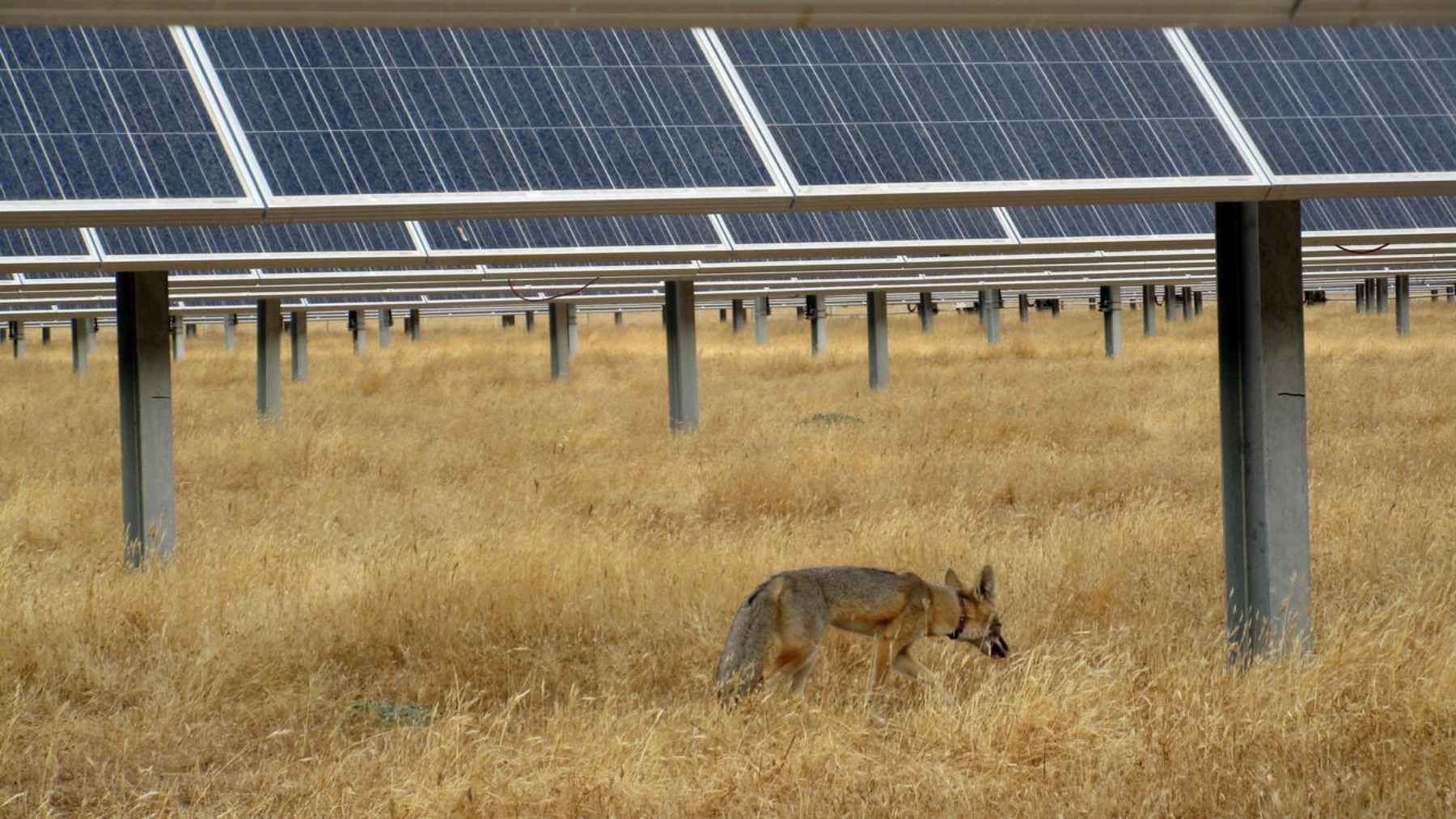

Build a solar farm big enough and somebody will accuse you of paving paradise. It is one of the more durable knocks on utility-scale solar: thousands of acres of panels go up, the scrubland underneath gets fenced off, and whatever used to live there has to find somewhere else to be. Out on California’s Carrizo Plain, an endangered fox the size of a house cat ran straight at that argument and did the opposite. It moved in, raised pups, and ended up at least as safe as the foxes living outside the fence.
The animal is the San Joaquin kit fox, and it is not doing well as a species. The conservation group Defenders of Wildlife puts the wild population at fewer than 3,000 and figures the fox now holds onto less than 10% of the range it once covered across central California. So when researchers collared dozens of them at two big solar plants built directly on top of their habitat, and the foxes inside posted survival numbers as good as the ones in open country, that was not the result anyone fenced the place expecting. The catch, which we will get to, is that none of it happened by accident.
The fox that lost almost everything
The San Joaquin kit fox is the smallest fox in North America, about five pounds of mostly ears and tail, and it lives nowhere else on Earth but California. It is built for dry country, dens underground to beat the heat, and can go its whole life without drinking freshwater, pulling what it needs straight from the food it catches. For a long stretch of the 20th century, that food and that country were spread all across the San Joaquin Valley.
Then the valley got farmed, paved, drilled, and built on. By 1979, federal biologists reckoned only about 6.7% of the valley floor south of Stanislaus County was still untilled and undeveloped. The fox got squeezed into a handful of fragments, and today its strongholds come down to three core areas, the largest of which is the Carrizo Plain in San Luis Obispo County. The U.S. Fish and Wildlife Service listed the fox as federally endangered back in 1967, and California calls it threatened.
Habitat is only half the problem. Out in the open, the kit fox sits near the bottom of the food chain. Coyotes kill them, bobcats kill them, and golden eagles pick them off from above. Coyotes are the single biggest source of death for the species, and with no wolves left in California to keep coyote numbers in check, that pressure has only grown.
Add a sarcoptic mange outbreak chewing through the urban foxes around Bakersfield and a run of brutal droughts, and the math on this animal is grim. The bar for good news about the kit fox is low, which is part of what makes the solar story land.
Why a solar fence turned into a fox door
The whole thing turns on the fence. A standard utility-scale solar farm is wrapped in security fencing that runs right to the ground, and to a kit fox that fence is a wall. It locks the animal out of the habitat underneath, or worse, locks a few inside with no way to reach mates, prey, or an escape route. Build enough of them across a valley and you have not just removed habitat, you have chopped what is left into pieces foxes cannot cross.
The two plants on the Carrizo Plain were built differently on purpose. Both Topaz Solar Farms (around 3,500 acres) and the neighboring California Valley Solar Ranch (about 1,780 acres) went up on land the Fish and Wildlife Service classifies as core kit fox habitat, which meant the projects came loaded with conditions.
The fences were given a gap of roughly 12 to 15 centimeters along the bottom, wide enough for a five-pound fox to scoot under and far too tight for a coyote or a bobcat to follow. At Topaz, crews added a rail across that gap so larger predators could not dig their way under it either.
The panels did something the designers may not have fully planned for: they became a roof. A kit fox out in open grassland has nowhere to hide when a golden eagle is overhead, but a fox under a solar array has acres of overhead cover.
On top of that, the arrays at Topaz were broken into smaller blocks with open corridors running between them instead of one giant unbroken slab, so foxes could move through the site, and the operators dropped in artificial escape dens, reinforced pipe burrows the animals could duck into. Sheep graze the rows down between the panels, which keeps the grass low the way foxes like it and cuts the fire risk at the same time. None of that is standard. All of it was designed in.
What the collared foxes actually showed
Good intentions are not data, so two research teams from the Endangered Species Recovery Program at California State University, Stanislaus, went out and counted. Led by biologist Brian Cypher, they ran separate three-year studies from 2014 to 2017, one at Topaz and one at California Valley Solar Ranch, collaring and tracking foxes inside the fences against foxes at nearby reference sites in open country. The work was presented at UC Santa Barbara’s Bren School and laid out in a 2019 report.
At Topaz, the team collared 52 foxes. Inside the fence, a fox had roughly a 65% chance of surviving the year (a 0.65 survival probability in the study’s terms), against 49% at the reference site off the farm. The researchers are careful to say that difference was not statistically significant, so this is not proof the panels made foxes immortal.
But it is the opposite of the decline you would expect if a solar farm were quietly killing them. The foxes inside were doing at least as well as the ones outside, and the open-country number was running lower, not higher. Home ranges inside the fence were actually larger, 9.4 square kilometers against 5.1, and the foxes used more dens, 11.2 on average versus 8.4. Their body weights matched. The California Valley Solar Ranch study, 50 more collared foxes, told the same story, with survival on the solar site at 0.76.
A second, separate study backs it up. Between 2019 and 2022, the same group tracked kit foxes at the Panoche Valley Solar Farm in San Benito County, a different plant in a different county. Survival on the solar site held steady across those three years while it slid at the reference site outside. Two plants, two counties, two windows of time, and the same pattern: behind the fox-friendly fence, the animals were not just surviving, they were holding their ground while their neighbors lost it.
The catch nobody should skip
This is where the honesty matters, because it would be easy to twist this into “solar farms are good for wildlife,” and that is not what happened. The same agency paperwork that praises the Carrizo Plain plants also shows regulators warning, before construction, that Topaz’s fencing could block kit foxes and pronghorn from moving north across the landscape.
The default version of this story is a barrier. The good version exists only because someone was forced to engineer the gaps, the rail, the corridors, and the dens, and because the sites happen to sit in a place with the right soil and prey to begin with.
Solar still hurts wildlife in plenty of places. Defenders of Wildlife lists utility-scale solar right alongside agriculture and roads as a driver of the habitat loss pushing the kit fox toward extinction, and argues local governments should be setting aside far more protected land to offset these projects.
It gets worse for animals that cannot read a fence. Birds routinely mistake the dark, glassy sheen of a solar field for open water and try to land on it, which is its own slow disaster for migration. And the harshest version of solar versus wildlife is not even about panels: California’s $2.2 billion Ivanpah plant runs mirrors that concentrate sunlight hot enough to scorch birds in mid-air. The Carrizo Plain foxes are what good design looks like. They are not proof that solar and wildlife automatically get along.
A door, or a wall
That is the real lesson sitting out on the Carrizo Plain, and it has nothing to do with whether solar is good or bad. A fence with a four-inch gap along the bottom is a door. The exact same fence poured to the ground is a wall. The endangered fox does not care about your clean-energy targets or your environmental impact statement. It cares whether it can get under the fence, hide from the eagle, and find a den on the other side.
China ran into its own version of this when its largest solar farm grew so much grass that operators had to bring in 20,000 sheep to keep the panels clear, and the same idea is showing up along the country’s 250-mile “solar great wall” in the Kubuqi Desert, where the land underneath is being nursed back instead of buried. Build the thing carelessly and you get a graveyard. Build it like somebody was paying attention, and a five-pound fox might just outlive the ones living free.